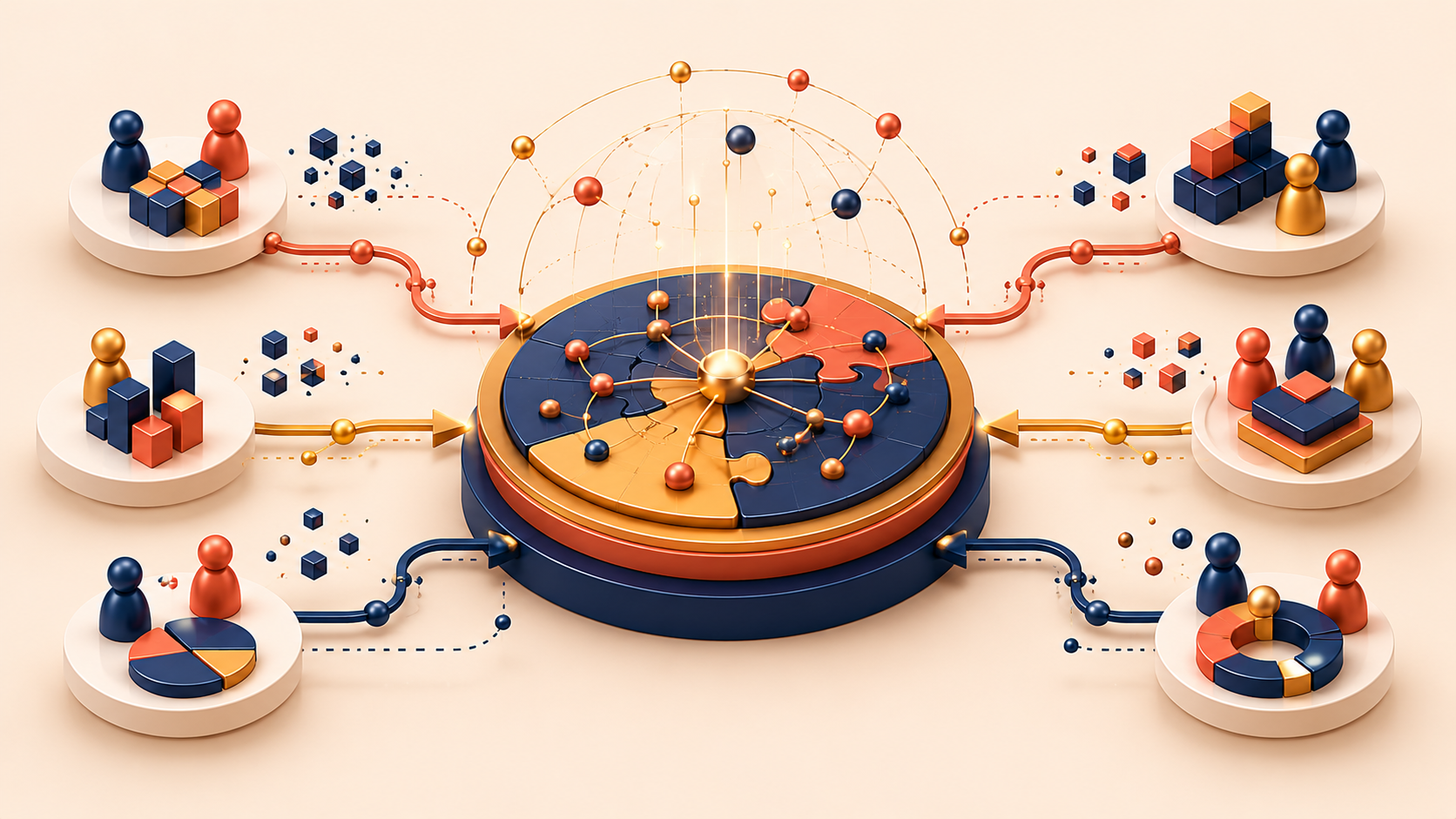
You shipped a product. It works. Something still feels off. That uneasy feeling is often the first signal of software complexity — not the satisfying kind that comes from solving a hard algorithm, but the painful kind that quietly grows under the surface of a product.
A few signs that this kind of complexity has taken hold:
- Every new feature creates unexpected side effects
- Teams argue more about what a word means than about how to solve a problem
- A simple change requires weeks of coordination
- Requirements look clear in the document but turn ambiguous in implementation
This series treats Domain-Driven Design (DDD) not as an engineering practice, but as a decision-making and collaboration framework that reduces ambiguity in product thinking. The first post defines what Domain-Driven Design looks like from a product manager’s seat and covers three places it does the most work: shared language, business rules, and conceptual scalability.
Why Software Complexity Often Comes from Domain Ambiguity
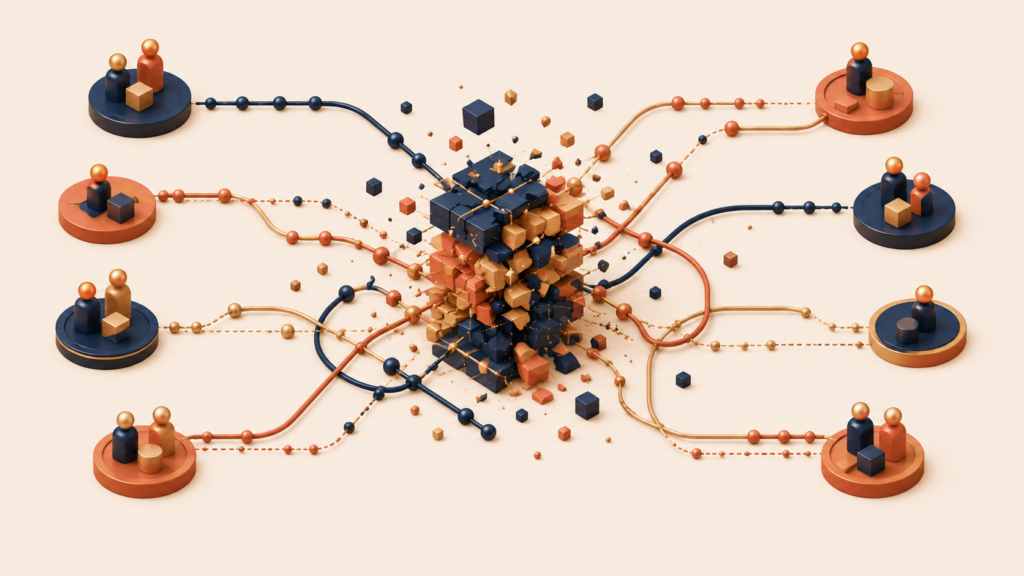
Most teams assume complexity is a technical problem. It usually is not.
- Microservices vs. monolith is an architecture choice, but it often exposes unclear domain boundaries rather than solving them
- Which database to use is an optimization decision, but no database choice will rescue a weak domain model
- Which framework to adopt can accelerate development speed, but a framework cannot define what your users actually do
- How to set up cloud infrastructure is a scaling question, and clear domain understanding has to come first
These debates are surface symptoms of one underlying problem: the team does not share a solid understanding of the domain.
By domain, we mean something specific:
The real-world activities, constraints, and mental models that sit behind your product.
In other words, what users are actually trying to do, and what rules exist in the environment where they do it. When the domain is poorly understood, the same pattern keeps repeating:
- PMs and stakeholders describe needs in business language
- Engineers translate that business language into technical language without fully understanding it
- The resulting technical design becomes hard to reverse later
- The product begins to accumulate workarounds
- Complexity keeps rising even though the feature set has not grown much
A product can have very few features and still reach a point where adding the next one feels impossible. That is what domain ambiguity does over time.
Think of domain ambiguity like an international meeting without translators. Each delegate speaks their own language and assumes the others “probably got the gist.” The meeting minutes look like a consensus, but each side actually agreed to something different. In software, when PMs, designers, and engineers use the same word with different meanings, the code still “works” — but the product that ships is not the one anyone intended.
The Hidden Cost of Sequential Handoffs
Sequential workflows — business analysis, then documentation, then implementation — create a predictable gap between “analysis” and “design.”
- During analysis, conversations rely on domain-specific terms that engineers do not always grasp
- During design, engineers fill in the blanks with assumptions
- Once deployed, code built on those assumptions becomes difficult to undo
Domain-Driven Design keeps domain understanding and software design connected at every step. It aligns “what we mean” with “what we build.”
When every new feature costs disproportionately more time, money, and headcount, the bottleneck is rarely raw development speed. It is the accumulated weight of domain ambiguity that has been carried forward, handoff by handoff.
DDD as a Product Management Framework: Three Core Applications
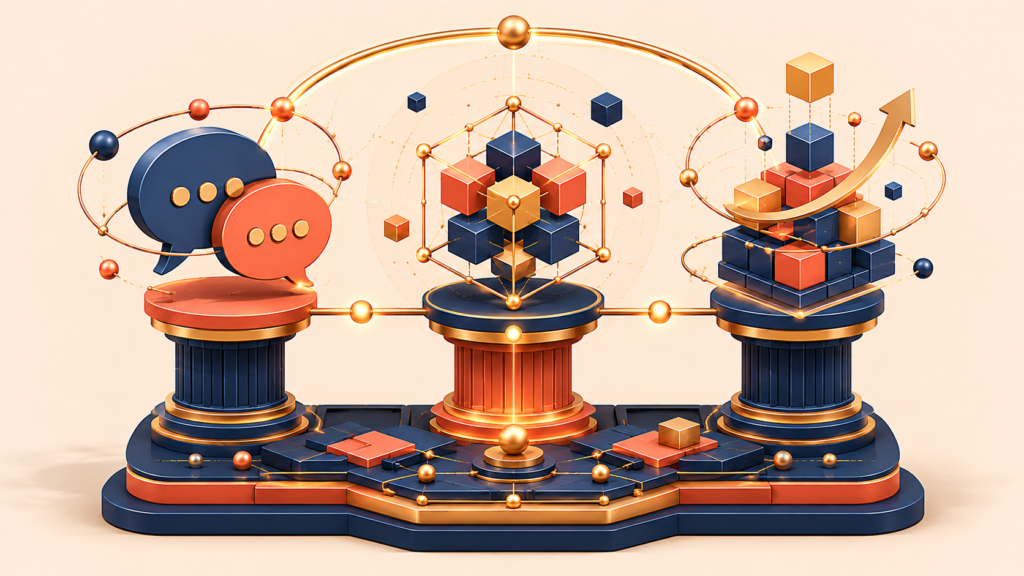
From a product lens, Domain-Driven Design is about building a shared map of the reality your product is trying to address. Three applications do most of the work for product teams.
Ubiquitous Language: How to Avoid Terminology Debt
Many product conflicts trace back to the same source: terminology.
Imagine you are building a subscription-based corporate learning platform. In a single meeting, people might use any of these words:
- “Seat”
- “License”
- “Member”
- “User”
- “Learner”
- “Account”
When these terms blur together, quiet confusion grows:
- Is a “seat” a paid entitlement, an invited person, or an active learner?
- Can one user hold multiple seats across multiple departments?
- When someone is deactivated, does access disappear immediately or at the end of the billing cycle?
Domain-Driven Design encourages teams to define a ubiquitous language — a consistent vocabulary that the product team uses across PRDs, design files, code, and meetings. The goal is simple: lower the cost of coordination and shorten the time it takes for teammates to understand each other.
Writing Requirements as Business Rules, Not Implementation Details
Planning usually pulls teams into one of two failure modes.
- Requirements written too vaguely, which leads to rework
- Requirements written too specifically, which accidentally dictates implementation
Domain-Driven Design offers a third option: write requirements as domain actions and business rules, not as UI details or database structures.
Instead of writing this:
- “Add a toggle to disable seat sharing”
Write something like this:
- “A license can belong to only one member at a time”
- “A member can belong to multiple workspaces, but billing is per workspace”
This gives engineers a stable foundation while leaving room for the right implementation.
The shift is similar to how a homeowner talks to an architect. “Please install a three-meter sliding glass door in the living room” is an implementation instruction. “I want the living room to feel open to the garden, with plenty of natural light” expresses intent. The second framing produces better results because it leaves the architect free to choose the best solution.
Conceptual Scalability: What Grows When a Product Grows
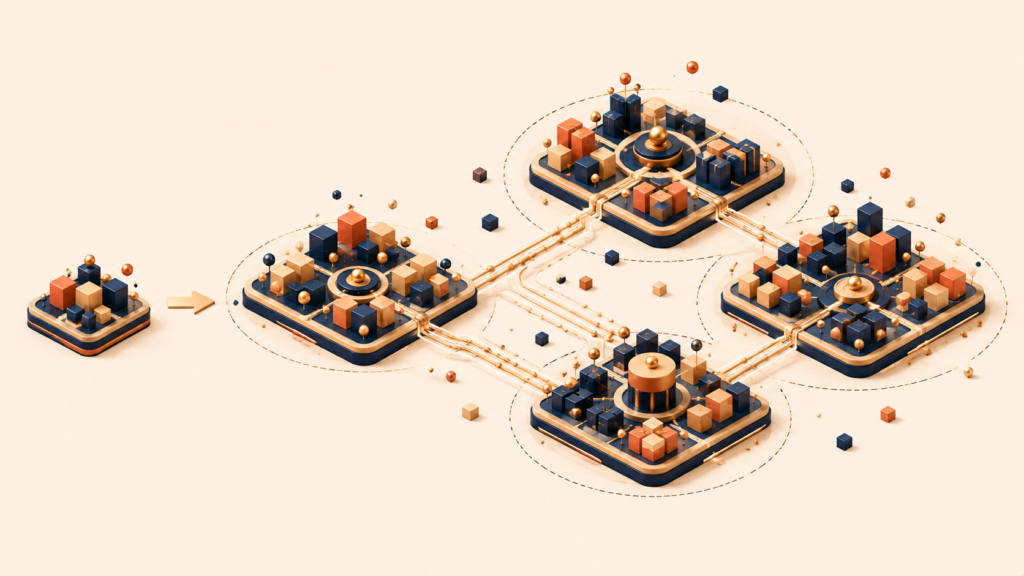
When products grow, the hardest scaling problems are rarely about performance or infrastructure. The conceptual problems grow too.
- The same word starts to mean different things on different teams
- One part of the product evolves faster and breaks assumptions elsewhere
- A new customer segment introduces rules that conflict with existing ones
A strong domain model helps a team make decisions about:
- What should change together
- What should stay separated
- Where complexity is allowed to live
Conceptual scaling works like city planning. In a small town, shops, homes, and small factories can coexist on the same block. As the city grows, zones for residential, commercial, and industrial use need to be separated. Otherwise, factory noise ruins the residential area, and shops in the industrial zone never find customers. Products work the same way. As they grow, boundaries between areas have to be made explicit so each part can evolve independently.
Conclusion
From a product perspective, Domain-Driven Design is less about modeling notation and more about building a shared map of reality. A ubiquitous language lowers coordination cost. Business-rule-shaped requirements give engineers a stable foundation without dictating how to build. A conceptual view of scalability tells the team where boundaries belong before complexity hardens around the wrong lines.
The next post in this series defines what a domain model actually is — and what separates a useful one from a decorative one.
Domain-Driven Design Series
(1) Domain-Driven Design as a Product Management Framework
(2) What is a Domain Model? Definition, Quality Criteria, and Examples
(3) DDD Layered Architecture: The Role of Each Layer in Domain-Driven Design
(4) Object in DDD: Building Blocks of the Domain Model
(5) Service in DDD: When Business Logic Doesn’t Belong to a Single Entity
(6) Modules and Bounded Contexts in DDD: Structuring Domains for Scale
(7) Aggregate Root Pattern in DDD: Consistency Boundaries Explained
(8)Factory Pattern in DDD: Controlling How Aggregates Come Into Existence
(9) Repository in DDD: Pattern, Principles, and the Domain Model Checklist