
When teams stay silent in meetings, leaders often read it as low motivation or weak ownership. Most of the time, it is neither. People stay silent because speaking up feels risky, pointless, or not worth the effort.
In practice, this shows up as long pauses, surface-level agreement, and conversations that circle without landing. The instinct is to push for more participation. The deeper issue is usually the questions being asked. How questions are shaped and delivered decides what people are willing to think, share, and push back on.
The assertive inquiry technique offers a way out — an approach that turns team silence into meaningful conversation by replacing defensive questioning with structured curiosity. The sections below cover the three steps, concrete assertive inquiry examples, and how to reframe aggressive questions in your next decision-making discussion.
Why Questions Matter More Than Ever in the AI Era
“Garbage in, garbage out.”
The phrase has become unavoidable in the AI era. Most generative AI products run on conversational interfaces, so the ability to describe context, intent, and constraints through questions has turned into a core skill. But the more useful question is whether this ability actually became important because of AI.
It did not. Humans are wired to respond to questions. When a sentence ends with a question mark, the mind reaches to fill the gap. Questions have always shaped the direction, depth, and continuity of conversation — long before chat interfaces existed.
In organizations, a question is not just a conversational tool. It is a decision-making tool, and that is why it deserves care. From customer discovery to strategic debate, how a question is framed decides whether the conversation becomes collaborative or defensive. In that sense, assertive inquiry is less a communication trick and more a form of decision-making discipline.
What is Assertive Inquiry?
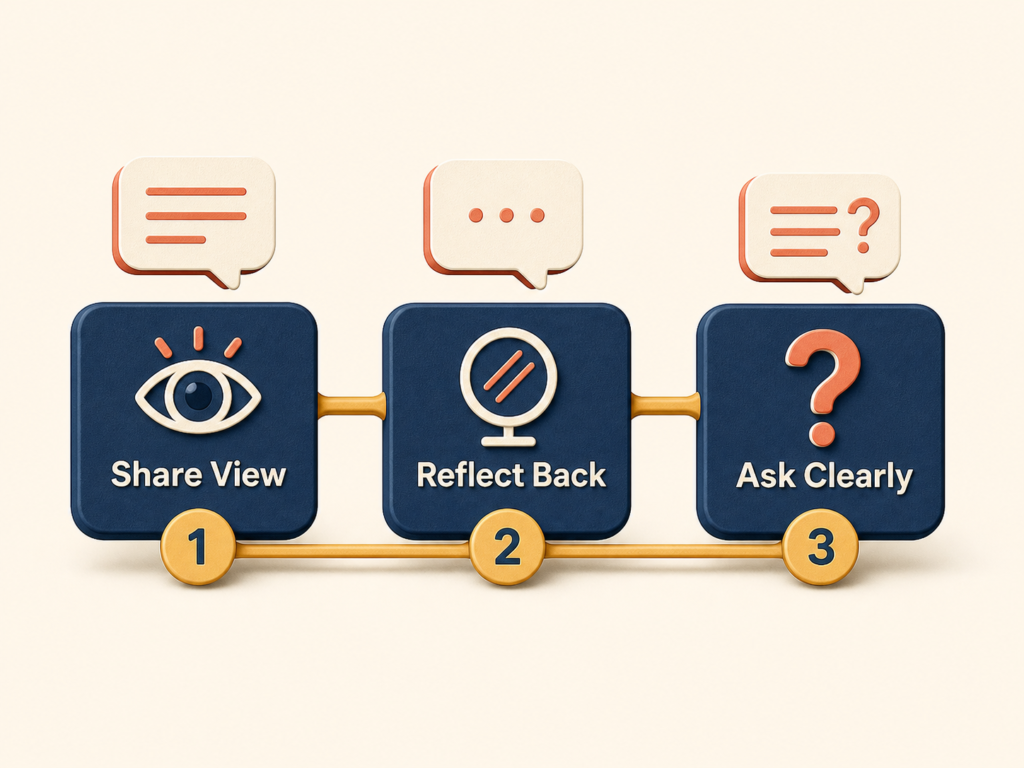
Assertive inquiry is a structured way of advancing your view while genuinely inviting challenge to it. It is not about speaking loudly, and it is not about backing down. It is doing two things at once:
- Explaining your thinking, assumptions, and reasoning clearly
- Sincerely asking others to challenge, extend, and refine that thinking
The concept is rooted in Harvard Business School professor Chris Argyris’s work on “advocacy and inquiry” and double-loop learning. P&G is the most commonly cited example of a company that applied these principles to leadership and decision-making during a major strategic transformation.
In practice, assertive inquiry runs through three steps.
Start by explaining how you see the situation and why. Then make space for a different reading.
“Here is how I am seeing this, mainly because of X. But I might be missing something. Do you see it differently?”
This framing signals openness. It presents your idea not as the correct answer, but as a working hypothesis that can be refined.
2) Reflect Back to Confirm Understanding
Next, restate the other person’s view in your own words to check that you have it right.
“If I am understanding you correctly, you are saying X because of Y. Is that right?”
This step does two things at once. It prevents misunderstanding, and it shows respect for the other person’s reasoning rather than skipping past it.
3) Ask Clearly About What You Do Not Yet Understand
If something is still unclear, name it and ask for more.
“That helps. The part I am still not following is X. Could you walk me through how you got there?”
This keeps the conversation as a place for learning rather than a place to win. The simple sentence “I might be missing something” has a surprising effect. It quietly says, my view is not complete, and yours matters. That alone lowers the defensive instinct most people bring into debate and creates the conditions for a more productive conversation.
How Assertive Inquiry Improves Team Decision-Making
In organizations, a “good decision” is not the one that sounds most logical in the room. A good decision is one that defines the real problem accurately, solves that problem effectively, and produces a meaningful outcome or opportunity for the organization.
Put differently, a decision proves its value when it leads to measurable impact. That is why problem definition matters so much.
1) Problem Definition Is Not Just Observation
You cannot define a problem well by observing its surface symptoms. Real problem definition requires understanding the background that led to the problem, the context in which it appeared, and the different ways people interpret it.
That calls for two distinct modes of thinking:
- Divergence: expand the range of information and perspectives
- Convergence: synthesize that information into a clear, shared problem statement
The quality of the decision depends heavily on the quality of the information collected during divergence.
2) Where Good Questions Become Essential
The most valuable information in the divergence stage comes from understanding each stakeholder’s context in depth. That level of understanding only happens through good questions.
Assertive inquiry helps a team surface:
- Hidden assumptions
- Unspoken constraints
- Different mental models
Questions driven by defensive or aggressive instincts block this entirely. When people forget how limited their own information is, confirmation bias takes over. The problem definition becomes narrow, personal, and subjective. What should have been “our problem” turns into “my opinion.” At that point, the organization is no longer solving a shared problem — it is amplifying individual perspectives.
Defensive Thinking: Why Teams Stop Asking Real Questions
In many organizations, people slip into self-protective postures during debate without noticing. They dress up arguments with polished language, data points, and rhetorical moves — but the purpose is defense, not learning.
When this pattern repeats, predictable things happen:
- People listen less and focus on each other less
- The goal shifts from understanding to persuasion
- The conversation drifts away from the actual organizational goal
A discussion that started as “what is the right outcome” quietly turns into a personal contest over who said the smarter thing.
1) When “Asking Questions” Goes Wrong
Confusing assertive inquiry with simply putting a question mark at the end of a sentence makes things worse. Consider these:
- “Why do you think that?”
- “Isn’t it obvious we should do X?”
- “What have you actually been doing all this time?”
On the surface, they look like questions. In practice, they are judgments dressed up as curiosity. They do not invite exploration. They demand justification. And the moment someone feels they have to justify themselves, they go on defense almost instantly.
Assertive Inquiry vs. Aggressive Questioning
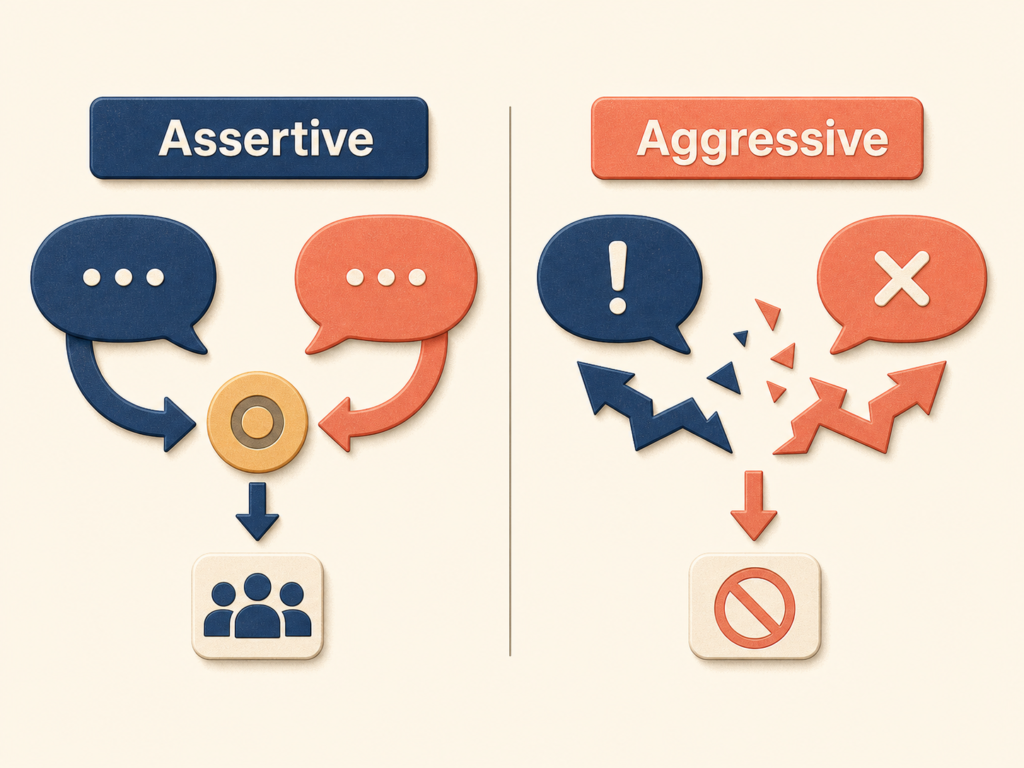
| Dimension | Assertive Inquiry | Aggressive Questioning |
|---|---|---|
| Center of the conversation | We | I |
| Direction | Future-oriented | Past-oriented |
| Primary intent | Work together toward a shared goal | Defend a personal view |
| Underlying message | “To reach a shared goal, I want us to think together, challenge assumptions, and broaden our understanding” | “I disagree. Convince me” |
| Psychological effect | Builds psychological safety and openness | Triggers defensiveness |
| Effect on debate | Encourages learning and constructive discussion | Turns debate into justification and conflict |
| Effect on the team | Better problem definition and decision quality | Fragmented alignment and stalled progress |
Assertive inquiry creates psychological safety while still allowing rigorous debate. Aggressive questioning, when it comes from judgment rather than curiosity, carries a quiet dismissal or pressure with it.
For example, “Why do you think that?” often really means “That doesn’t make sense — explain yourself.” The assumption that the other person is wrong is already built into the question. The conversation flips from collaboration to defense, and learning stops.
What Teams Should Aim For in Productive Discussions
1) The Ripple Effect of Aggressive Questioning
Aggressive questioning does more than make people shrink. It turns the discussion into a contest. The damage shows up at every level:
- Individuals reinforce a narrower view
- Teams lose alignment
- The organization drifts from its goal
Organizations exist to produce shared outcomes. People bring different backgrounds, experiences, and value systems into that work, so the real task is not to erase those differences. It is to use them productively.
2) What Makes a Question Good
A good question tends to share three traits:
- It is specific
- It expands thinking
- It connects to action
If, after a conversation, you walk away thinking so what?, what am I supposed to do with this?, or why did they even say that?, something went wrong. But pointing that out with another aggressive question — “Why are you saying it that way?” — only deepens the confusion.
3) A Better Alternative: Framing With “We” and “Future”
If you genuinely care about both your own growth and the success of the organization, start by reframing the problem around “we” and “future.”
Instead of asking:
“Why are you saying it that way?”
Try:
“I’m worried that discussing it this way might make it harder for us to move forward. What kind of conversation would help our team navigate the future more effectively?”
This small shift changes everything. It moves the conversation from past behavior (which invites defense) to future action (which invites collaboration). It moves the subject from “you” to “us.”
Conclusion
Assertive inquiry is not about softening your voice or avoiding conflict. It is a structured way of asking better questions, improving team communication, and reaching higher-quality decisions. The value becomes most visible in complex, cross-functional environments where multiple disciplines have to agree on what the problem even is.
Teams do not stop talking because they lack ideas. They stop talking because the questions in the room have stopped feeling safe to answer honestly. Changing the questions changes everything that follows.