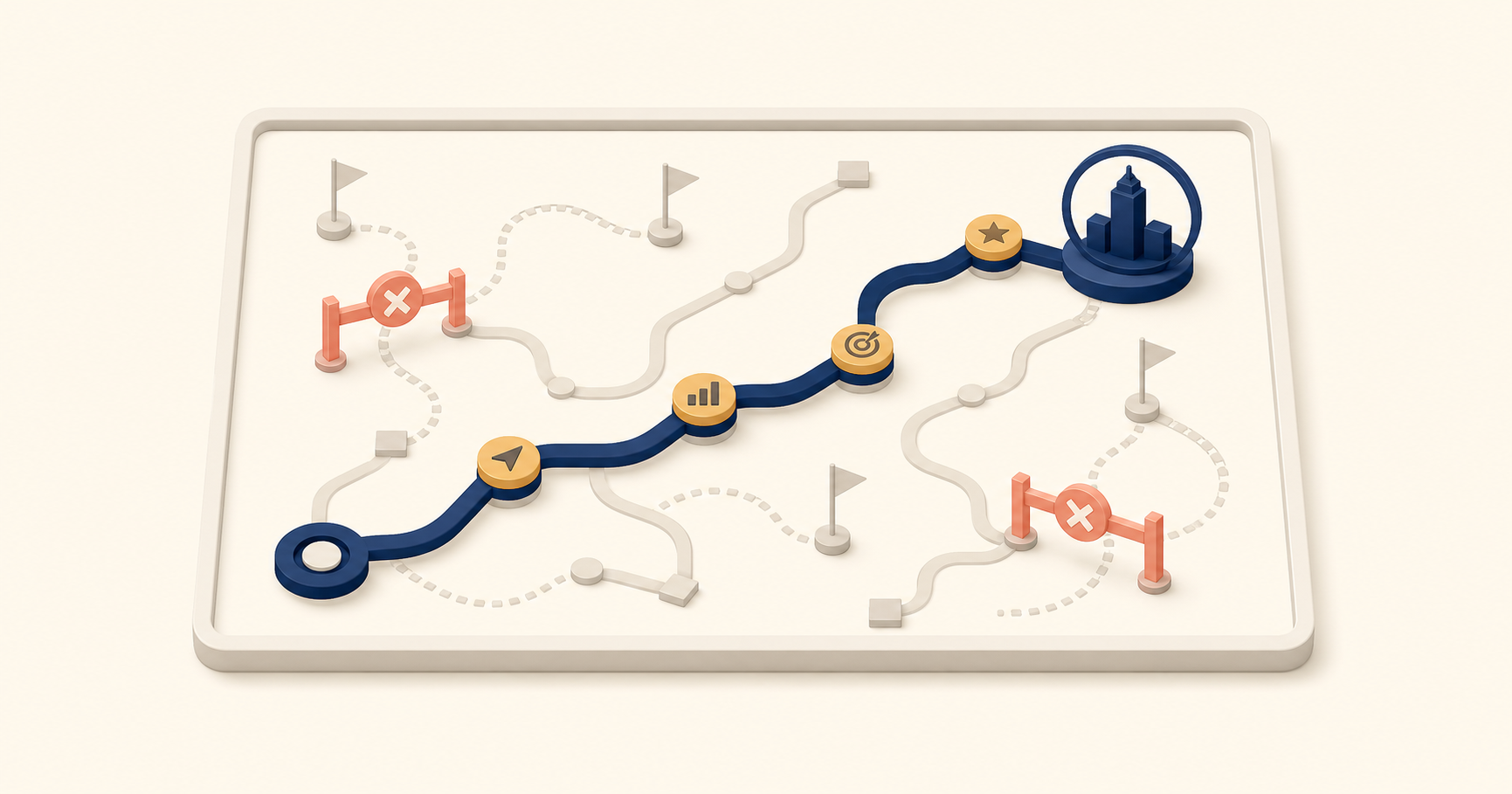
“Our strategy is to become number one in the market.”
Most product leaders have heard a sentence like this in a meeting. It sounds reasonable, but it isn’t a strategy. Most organizations don’t actually have one. They have ambitions, plans, and a long list of initiatives — but they lack a coherent strategy that guides meaningful decisions.
This is the first post in the Strategy Playbook series, a practical guide to what strategy actually is and how to build one that works. The foundations come first: the definition of strategy, the discipline of choice and focus, and the difference between vision and strategy. From there, two more questions: why most strategies fail, and the five most common misconceptions that keep teams from getting strategy right.
What is Strategy? More Than Just a Plan
Strategy is a coherent set of choices made to succeed in a chosen market.
It is not a mission statement, not a list of goals, and not an inventory of projects. Strategy is a deliberate positioning — a way of creating and capturing value that competitors cannot easily copy.
A useful way to frame strategy is to treat it as the answer to one question:
How will we create a sustainable competitive advantage?
The key word is sustainable. Anyone can win temporarily through luck, timing, or a large round of funding. Strategy is about building a position that compounds rather than decays — one that becomes harder to attack as time passes, not easier.
When making product decisions, ask yourself: “Does this choice strengthen our differentiated position, or does it just add one more item to a pile of features?”
Strategy Is Choice and Focus
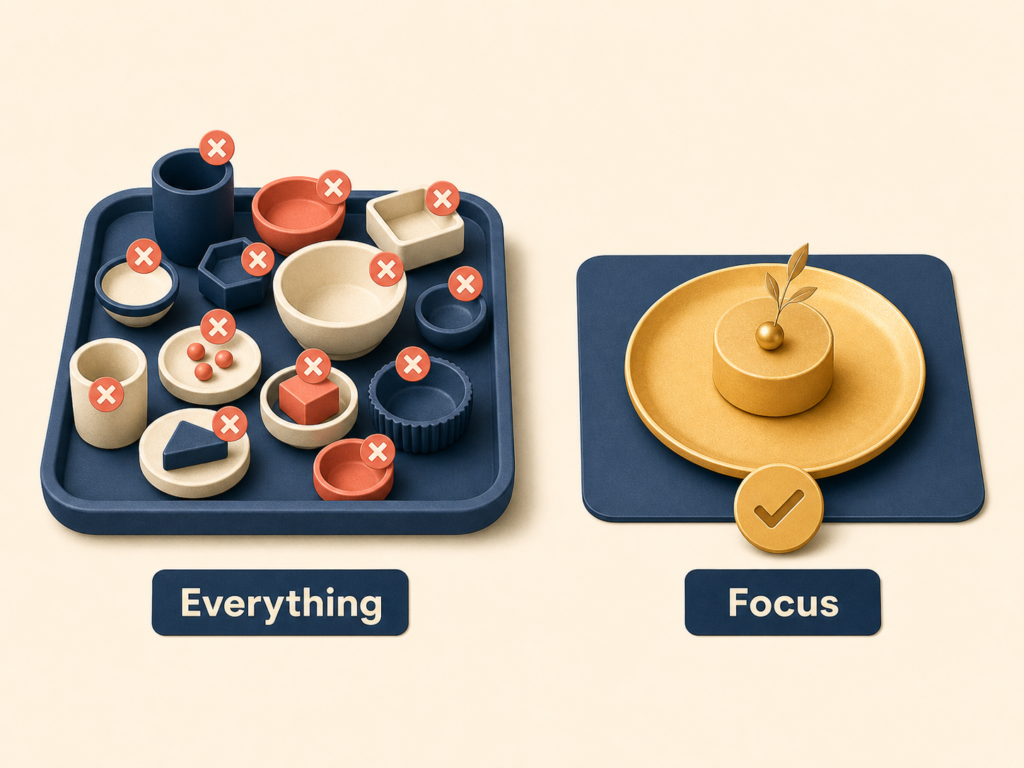
Strategy is not about doing more. It is about doing less, and doing it well.
Every time you say “yes” to one choice, you are implicitly saying “no” to many others. This is what strategists call opportunity cost. If you decide to win enterprise customers, you give up the small-business focus. If you decide to compete on user experience, you accept that you may not win on price. A real strategic choice always closes some doors so that one stays open.
The companies that struggle most are the ones that refuse to make these choices. They chase every market, build every requested feature, and react to every competitor move. The result is the same: they are average at everything and excellent at nothing.
Three Questions to Validate a Real Strategic Choice
A useful test for whether a decision is actually a strategic choice:
- What are you explicitly choosing not to do? If you can’t name the opportunities you are giving up, you haven’t made a real choice.
- Could a reasonable competitor make the opposite choice? If every company in your industry would make the same decision, it isn’t a differentiated strategy — it’s table stakes.
- Does this choice create internal tension? Real strategic choices involve real trade-offs, so they should feel uncomfortable. Easy decisions are usually not strategic decisions.
Consider a productivity app deciding between two paths: optimizing for individual power users or building deep collaboration features for teams. Neither path is inherently better. But pursuing both at the same weight typically results in a product that does neither well.
A useful analogy: choice and focus is the difference between a buffet and a specialty restaurant. A buffet offers dozens of dishes, but rarely is any one of them memorable. A sushi specialist or a steakhouse, by contrast, builds a reputation for one thing done well. Strategic choice works the same way. Deciding what not to do is as important as deciding what to do.
Vision vs. Strategy: What’s the Difference?
Vision is the destination. Strategy is the route to get there.
Vision describes the future you want to reach. It inspires people, gives them a reason to commit, and rarely changes. Strategy, in contrast, describes how you will move toward that vision given your current resources, the market, and the competitive landscape.
This distinction matters because the two operate on different timelines and call for different reactions:
- Changing the vision signals that the company’s fundamental beliefs or values have shifted. It should be a rare, weighty event — not a quarterly habit.
- Changing the strategy is a natural response to new information, market shifts, or a better way of getting to the same destination. It happens when the route no longer fits the terrain, even though the destination remains the same.
A simple way to think about it: vision is to strategy what leadership is to management. The best product leaders do both. They paint a picture of a future people want to be part of, and they make hard choices about how to allocate limited resources to get there.
Why Most Strategies Fail: Thinking-Only or Action-Only
A pattern repeats across companies. The leadership team spends a few days in offsite meetings, builds a polished deck, and returns convinced they have a winning strategy. Six months later, the organization is fragmented across dozens of disconnected initiatives, teams are confused about priorities, and there is little meaningful progress.
What went wrong?
Two Failure Patterns
Most strategy failures fall into one of two categories:
- Thinking-only: The leadership team produces extensive analysis, frameworks, and slides — but never commits to a clear set of choices. Strategy stays in the document and never translates into action.
- Action-only: The team is busy. New features ship, partnerships close, the company enters new markets. But there is no coherent logic connecting the activity. Each decision is reasonable in isolation, yet the portfolio doesn’t add up to a position.
Both failures share the same root cause: the absence of real strategic choice. In the first case, leaders hide behind analysis to avoid making hard decisions. In the second, leaders say “yes” to everything to avoid the discomfort of saying “no.”
The Comfort of Fake Strategy
Why do smart leaders fall into these traps? Because real strategy is uncomfortable. Building a real strategy requires you to:
- Accept that you cannot satisfy everyone.
- Accept that you might be wrong.
- Disappoint stakeholders whose priorities lose out.
- Commit to a direction without complete information.
It is psychologically much easier to maintain the illusion of strategy through vague ambitions (“we will become customer-centric!”) or through nonstop activity (“we shipped this many features this quarter!”). Fake strategy feels safer because it postpones the discomfort. But the cost shows up later, when the team realizes the activity didn’t compound into a position.
Five Common Misconceptions About Strategy
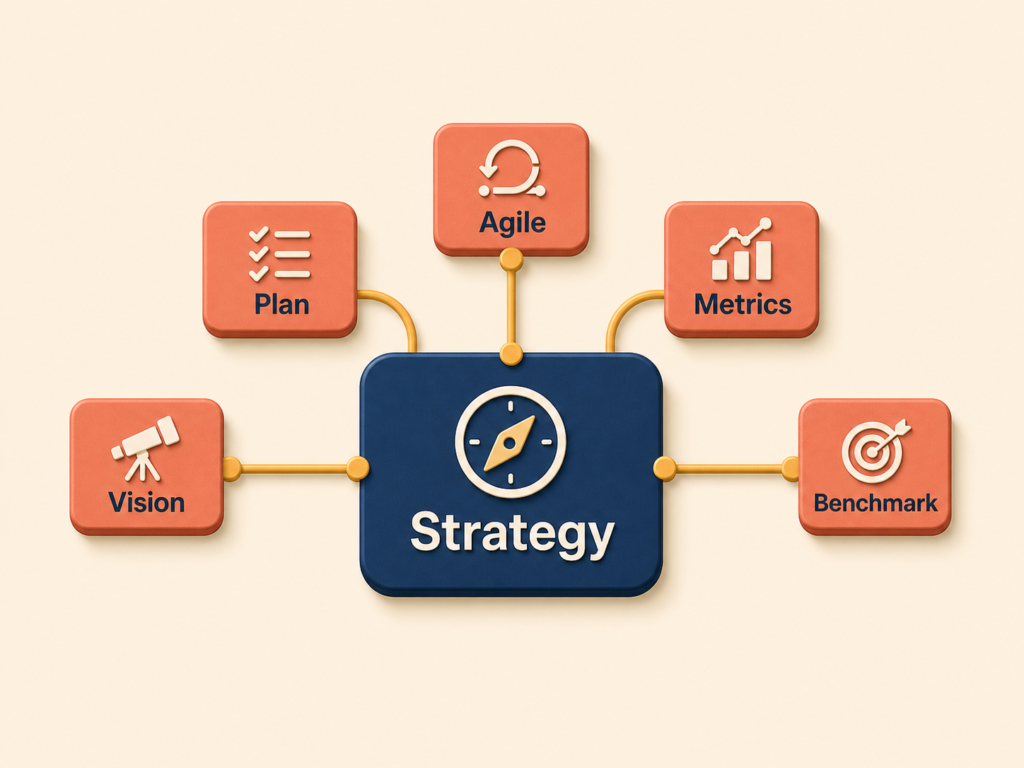
Recognizing what strategy is not is often the first step to building one that works. Here are the five most common misconceptions, each with an example, the underlying mistake, and a fix.
Misconception 1: Vision = Strategy
“Our strategy is to become the leading platform for creative professionals.”
Vision tells you where you want to go, but says nothing about how you will get there. Vision and mission statements are essential inputs to strategy, but they are not the strategy itself. They name the destination; they don’t draw the route.
Fix: After stating the vision, ask: “Given our current resources and market position, what specific choices will we make to move toward this vision? What will we do differently from competitors?”
Misconception 2: A Plan = Strategy
“Our strategy is to enter three new markets, hire 50 engineers, and ship the mobile app by Q3.”
A plan is a list of actions. Strategy is the logic that connects those actions to a competitive advantage. Without that logic, a plan is just an activity list that may or may not work. A roadmap tells you what to build and when; strategy explains why this set of choices is better than the alternatives.
Fix: For every major initiative in the plan, you should be able to complete the sentence “this action strengthens our competitive position because…” If you can’t, the activity may have no strategic purpose.
Misconception 3: Long-Term Strategy Is Impossible in a Fast-Changing World
“The market moves too fast. We can’t plan past next quarter. We just stay agile.”
This misconception confuses strategic direction with detailed planning. Tactics and timelines should adapt. But a company without a strategic direction — one that only reacts to the market — ends up being pulled in every direction. It follows every trend, reacts to every competitor move, and eventually loses to a competitor with a clear strategic direction.
Fix: Separate strategic direction (relatively stable, 2–5 years out) from tactical planning (flexible, adjusted quarterly). Strategy should be firm enough to guide decisions when specifics change.
Misconception 4: Optimization = Strategy
“Our strategy is to improve conversion by 20%, reduce churn by 15%, and lift NPS by 10 points.”
Optimization makes your existing business run better. Strategy builds a position competitors can’t easily reach. They are not the same. Pouring all your effort into optimizing existing metrics is like running faster on the same track — while a strategic competitor lays a new track entirely.
Optimization has two weaknesses. First, competitors can copy it relatively quickly. Second, it can trap a team at a local maximum — a point that looks good in isolation but blocks the larger opportunity.
Fix: Balance optimization investments with strategic ones. Ask: “Beyond improving current metrics, are we placing larger bets that could reshape the competitive landscape?”
Misconception 5: Benchmarking = Strategy
“Our strategy is to apply the best practices of industry leaders. It worked for Spotify/Amazon/Salesforce, so it will work for us.”
Strategy is contextual. A move that worked for a company with different resources, market position, customer base, and history does not automatically work for you. Adopting a competitor’s playbook means fighting on ground they have already cultivated; their trade-offs were tuned to their situation, and by the time you catch up, they have already moved on.
The result of benchmarking alone is usually a slightly worse version of whoever you copied.
Fix: Study competitors — but use that study to understand the market landscape, not to inherit their choices. Build your strategy from your own strengths, constraints, and opportunities. Ask: “Given the choices they have already made, what would be especially hard for them to copy?”
What Good Strategy Actually Looks Like
If strategy is not vision, not a plan, not optimization, and not benchmarking — then what is it?
Strategy is an integrated set of choices that positions us to win in a chosen market.
This definition has four parts worth unpacking.
An Integrated Set of Choices
The choices must fit together as a system.
- Your target market should fit your value proposition.
- Your value proposition should fit your capabilities.
- Your capabilities should fit your go-to-market motion.
A collection of individually good decisions does not add up to a strategy. Coherent, mutually reinforcing choices do.
Positioned to Win
Strategy is grounded in competitive advantage. Showing up in a market isn’t enough. You should be able to explain why customers will pick you over the alternatives, and why competitors will find it hard to replicate your success.
In a Chosen Market
Notice the word “chosen.” Part of strategy is deciding where to compete, not just how. The choice of arena often matters more than the playbook used within it. A strong strategy in a weak market beats a brilliant strategy in the wrong market.
Where Strategy Formulation Begins
Strategy formulation starts by surfacing the options. Before you can make a choice, you need to know what choices exist: which markets are open to you, which customer problems you could solve, which capabilities you could build or acquire, which competitive positions are achievable.
Once the options are on the table, strategy is the act of concentrating resources on the few choices that together create a defensible position. This is why strategy takes courage. It is not picking the most attractive-looking option from a list. It is consciously setting aside other viable options and committing your limited resources to one path.
Conclusion
Strategy is a coherent set of choices that creates a sustainable competitive advantage in a chosen market. It is not a vision statement, not a plan, not a list of optimization targets, and not a copy of someone else’s playbook. Most strategies fail because they either stop at analysis or substitute activity for choice. The fix is to make real strategic choices — the kind that close some doors so that one stays open.
The next post in this Strategy Playbook series looks at how to set strategic goals and a vision that actually drives decisions: what makes a goal motivating, the ten principles of a strong vision, and the most common mistakes teams make when setting goals.