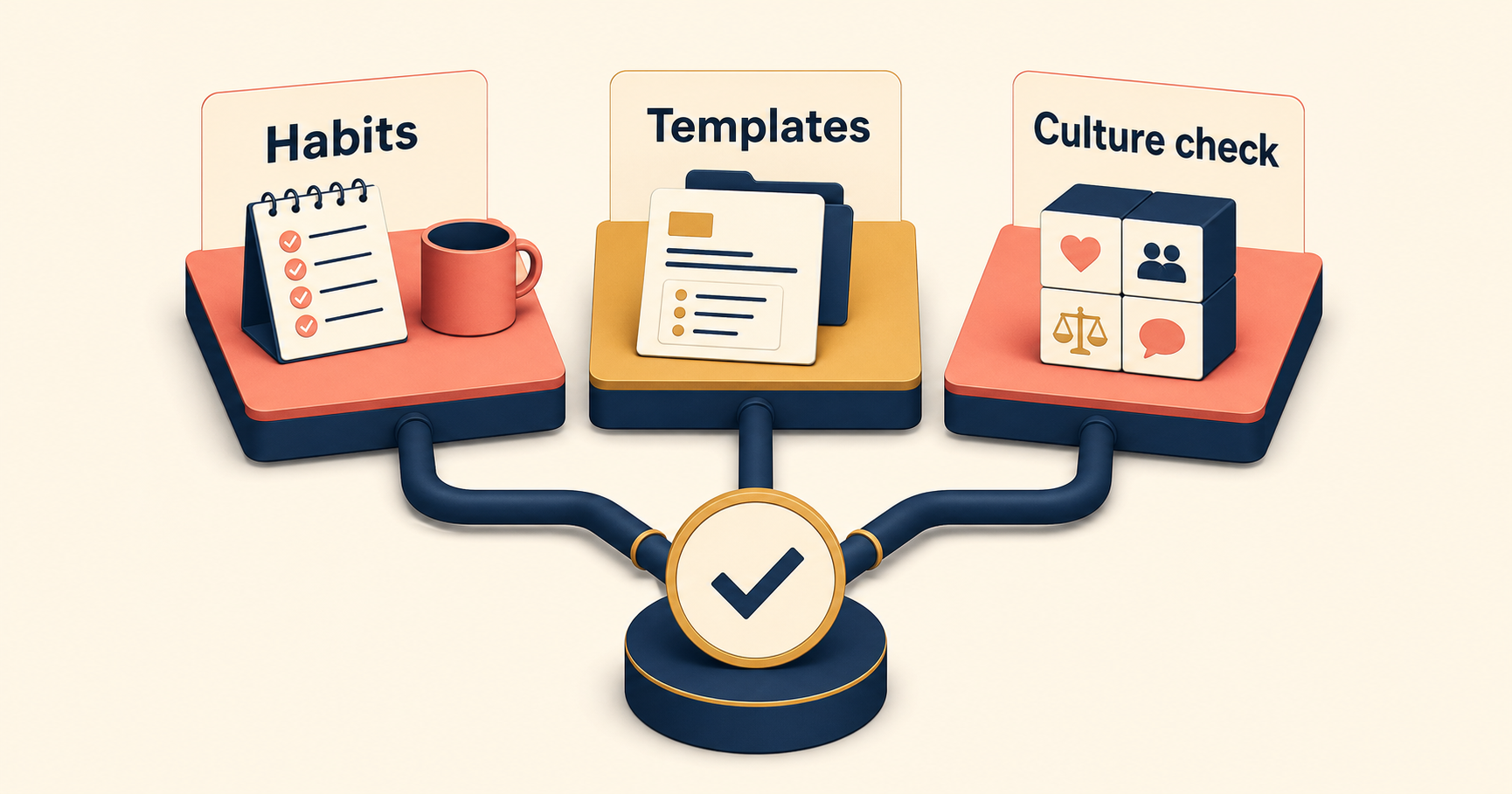
The earlier articles in this series covered the principles, the questions, and the meetings that shape decision-driven productivity. None of that becomes real without the small, daily choices each person makes about their own attention, the templates a team reaches for under pressure, and the cultural checks that catch slippage before it spreads.
Three things turn the framework into practice: the personal habits that protect decision quality, the decision canvas templates and other tools that reduce friction at the exact moments teams normally stall, and a lightweight audit checklist for the wider culture. The previous article on running effective meetings handled the most expensive shared resource on the team. This closing article zooms back out to the conditions that decide whether any of it sticks.
Decision-driven productivity is less about working harder than about creating the environment where good decisions are easy to make and bad decisions are hard to hide.
Personal Habits That Improve Decision Quality
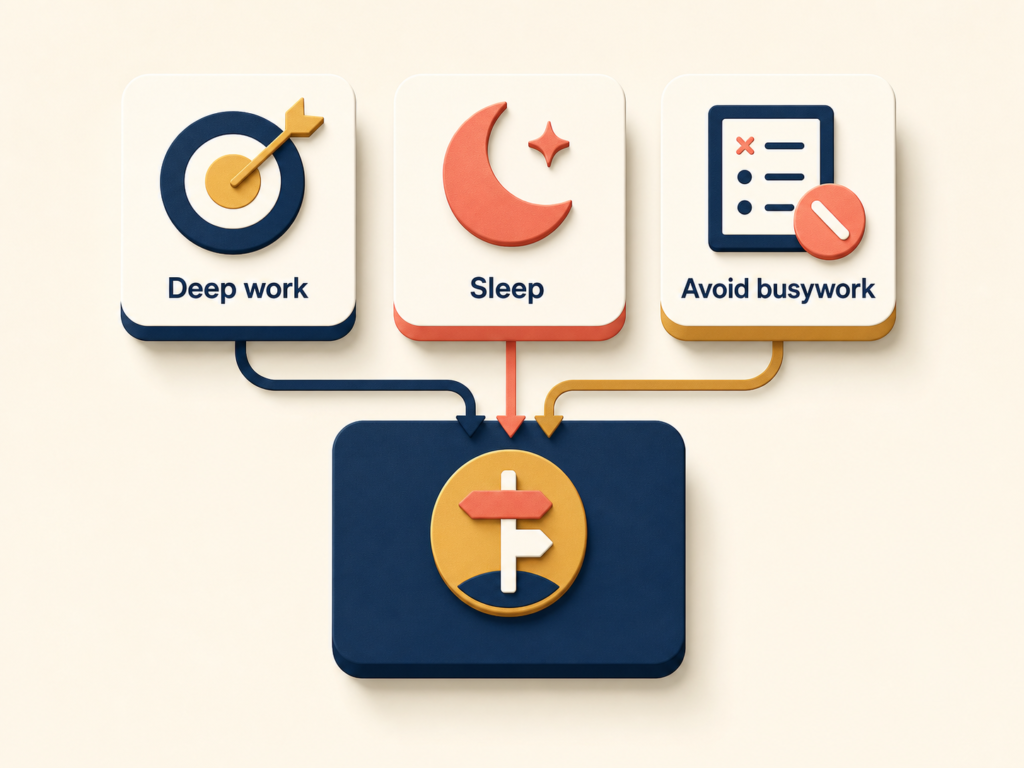
Team productivity ultimately comes from the decision quality of individual people. And decision quality degrades faster than most teams realize — through chronic fatigue, frequent interruptions, and cognitive overload that compound quietly across the week.
The habits below are not about productivity hacks. They protect the conditions a person needs to make a non-trivial decision well.
Why deep work is essential to good decisions
Decisions require holding several constraints in mind at once, reasoning about second-order effects, and imagining user behavior that cannot be observed directly. That does not fit into a five-minute gap between meetings.
Deep work — extended, uninterrupted time on a single problem — is where assumptions become visible, tradeoffs get expressed clearly, and simpler solutions start to surface. When calendars are completely fragmented, people default to reactive work. They respond instead of think.
The result is not only slower progress but shallower decisions. Without time to consider, choices drift toward the defensive and the short-term.
Why sleep affects product decision quality directly
Occasional late nights are part of the job. Chronic sleep loss is a different problem entirely.
When people consistently do not get enough rest, a predictable pattern emerges:
- Resistance to new approaches
- Preference for familiar solutions, even when they no longer work
- Higher emotional reactivity
- Lower-quality collaboration
This is not a character flaw but a biological response. In product teams it shows up as clinging to old roadmaps, over-reacting to minor feedback, and arguing over details instead of outcomes.
A culture that quietly rewards exhaustion ends up rewarding rigidity. Well-rested teams adapt faster, and adaptability is a competitive advantage.
The myth of heroic productivity
Many organizations still romanticize the always-on employee — the late-night message, the weekend push, the around-the-clock availability. It looks like commitment. Over time, it creates fragility.
Heroic effort tends to mask structural problems: unclear priorities, too much work in progress, and decisions made in the wrong order. Instead of fixing the system, the team leans harder on the individual. Decision quality drops, and burnout spreads.
Sustainable productivity does not come from endless intensity. It comes from steady pacing.
How to avoid busywork
The most socially acceptable productivity problem is also the hardest to detect: being busy for its own sake. Busywork rarely looks irresponsible. It looks diligent, thorough, even impressive. That is what makes it dangerous.
Over time, a team can pour enormous energy into work that feels productive but creates almost no value. A few common warning signs:
- Tasks that exist without a clear definition of done
- Endless polishing of internal documents that nobody reads
- Solutions that add complexity without reducing pain
- Pulling several people into work that one person could do alone
Each behavior looks reasonable on its own. Together, they drain focus and momentum. The reason this kind of work survives is simple: no one asks the uncomfortable question.
When purpose is unclear, people default to visible effort. Adding feels safer than subtracting, elaborating feels safer than simplifying, and moving feels safer than stopping to reconsider. In teams this shows up as endless roadmap tweaking, dashboards that get watched but never acted on, and process layers added to compensate for uncertainty.
None of these are wrong by themselves. They become waste when they stop connecting to outcomes.
Avoiding busywork is not about pointing at people. It is about building soft checkpoints into the rhythm of work:
- Weekly retros: Can each person explain why this week’s work mattered?
- The two-week rule: If something has taken more than two weeks, invite a fresh perspective.
- Value framing: State the expected benefit before starting. Revisit after.
These habits normalize reflection without slowing shipping. Sometimes the most productive action is to stop. Challenging low-value work can feel political, but tolerating it creates a different risk: the team stops believing that effort leads to impact. Clarity protects morale. When people understand why something was deprioritized, they usually feel relief rather than offense.
Practical Templates for Better Decisions
Templates do not make good decisions by themselves. A good template reduces friction at the exact moment a team normally stalls. The goal is not standardization but making clear thinking the default.
A useful decision canvas template and a few related tools turn fuzzy moments into structured ones without adding bureaucracy.
Decision Canvas
Use this when a decision needs alignment but does not need a meeting.
Structure:
- Problem: What is actually not working?
- Options: What are the realistic choices?
- Criteria: What matters most in this decision?
- Decision: What is chosen, and why?
- Owner: Who is accountable?
- Revisit: When, if ever, to revisit?
This structure focuses the conversation on reasoning, not persuasion.
Pre-mortem Template
Helpful before high-stakes or high-visibility decisions. Inspired by Gary Klein’s pre-mortem method:
- Imagine, six months from now, this decision has failed.
- What caused the failure?
- Which of those risks are within our control?
- What early signals would warn us?
A pre-mortem does not slow a decision down. It prevents the avoidable mistakes that show up in retrospect.
Decision Log
A running record of the decisions a team makes, with a few standard fields:
- Date
- Decision
- Context
- Owner
- Expected outcome
- Actual outcome (added later)
Over time, the log becomes organizational memory and reduces re-litigation of past calls.
Meeting Template
Meetings should be rare, but when they happen, structure matters.
Pre-read document:
- Decision type (inform / approve / collaborate)
- Background and constraints
- Proposals or options
- Open questions
Meeting notes:
- Decisions made
- Action items
- Owners
- Deadlines
This template is not bureaucracy. It serves as a guardrail.
A Decision-Making Audit Checklist for Product Culture
Principles only matter when they change behavior. A decision-making audit is a lightweight way to reveal where productivity is leaking right now, without blaming people or redesigning everything.
Think of it as a diagnosis, not an evaluation. It works at five layers: before a decision, when meetings are needed, after a decision, in a daily check, and in a weekly review.
Before a decision
Stop and check the foundation before work begins. These questions catch most low-value work early.
Purpose check:
- Have you clearly answered why this work exists?
- Is the problem real and observable today?
- Who specifically benefits if this succeeds?
Value check:
- What changes for users, the team, or the business?
- What breaks if this is delayed by a month?
- Is this the highest-impact use of time right now?
Simplicity check:
- Is there a smaller version that still delivers value?
- Are you choosing complexity out of habit?
- If this takes more than two weeks, have you invited another perspective?
When meetings are needed
If a decision triggers a meeting, the bar should be higher.
Meeting necessity:
- Could this be resolved asynchronously?
- What specifically improves by meeting in real time?
- Is the urgency real, or only perceived?
Decision clarity:
- Is the decision type clear (inform / approve / collaborate)?
- Is the decision owner identified?
- Are required and optional attendees clearly separated?
Readiness:
- Was context shared at least 24 hours in advance?
- Do attendees know what outcome is expected?
- Are constraints and tradeoffs visible?
After a decision
Many teams stop too early. A decision without follow-through quietly unravels.
Closing check:
- Is the decision documented in a shared space?
- Are action items explicit, with owners and deadlines?
- Do people know how success or failure will be evaluated?
Learning loop:
- What outcome was expected?
- What signal would tell us we were wrong?
- When should this decision be revisited?
This turns each decision from a one-time event into a learning asset.
Daily check (5 minutes)
At the start or end of the day, pause and ask:
- Can I clearly explain why my top task today matters?
- Who benefits when it is done?
- Is there a simpler way to reach the same outcome?
These questions are not for guilt. They serve alignment.
Weekly review (30 minutes)
1. Decisions made:
- Did we make any meaningful decisions this week?
- Which decisions unblocked progress?
2. Decisions deferred:
- What did we delay?
- Why did the call feel hard to make?
3. Subtractions:
- Did we explicitly decide not to do something?
- What did we stop or postpone?
4. Pace and health:
- Did our pace feel sustainable?
- Were we reacting, or choosing?
This review reframes productivity as a pattern of choices, not a task list.
From Busywork to Real Impact: Closing the Loop
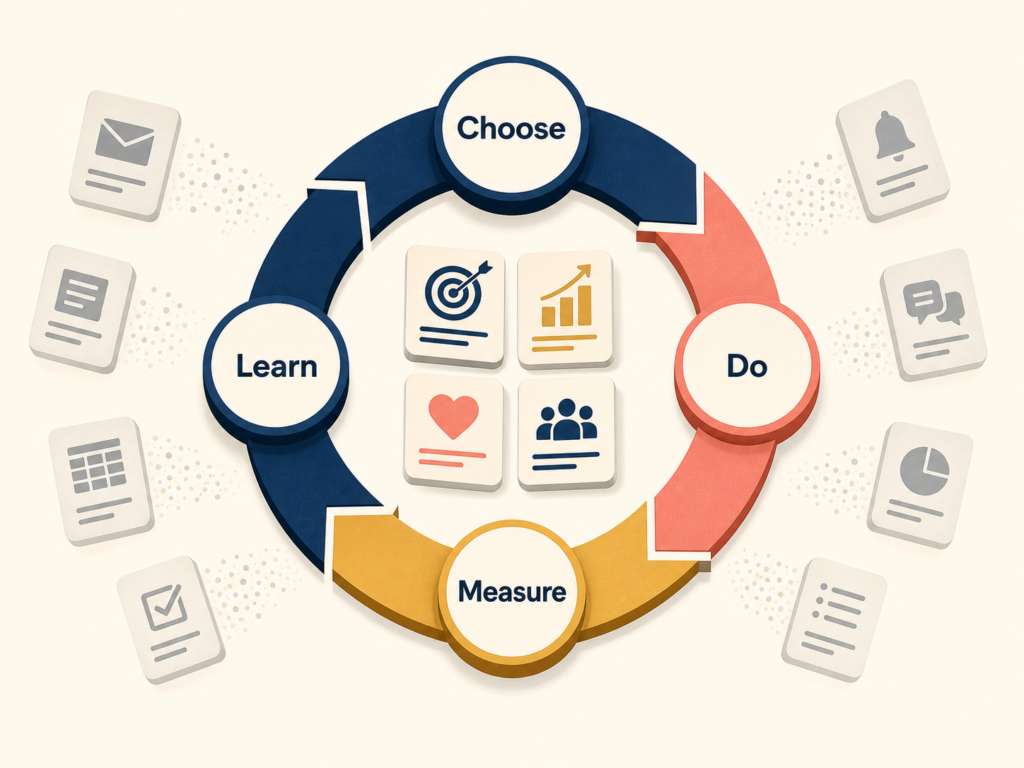
Organizational momentum comes from decisions that move work forward, not from activity that looks productive. Productivity is not about being perfect. It comes from deciding, acting, learning, and deciding again.
Teams do not move because they are certain. They move because they are willing to decide and adjust. That is the quiet strength of a decision-driven culture.
The series in summary:
- Seven principles: decisions over ideas, concrete over abstract, outcomes over effort, timeliness over perfection, constraints as strategy, small steps that compound, and the separation of individual thinking from collective deciding.
- Three pre-work questions: Why are we doing this? Is there real value? Is there a simpler way?
- Decision-making framework: separate thinking alone from deciding together; three decision types (inform / approve / collaborate); the urgency × complexity matrix.
- Meetings: recognize their true cost; the five pillars (purpose, attendees, preparation, facilitation, next steps); awareness of common anti-patterns.
- Personal habits and tools: deep work, sleep, the trap of heroic productivity, avoiding busywork, plus the Decision Canvas, Pre-mortem, Decision Log, and Meeting Template.
- Checklists: before, during, and after a decision, plus the daily five minutes and the weekly thirty.
It all reduces to one principle: decisions, not ideas, create progress. And good decisions stand on good systems.
Conclusion
Decision-driven productivity is not a productivity hack. It organizes attention, conversations, and follow-through so the team’s most expensive resource — the quality of its decisions — does not erode under the weight of busy work. Personal habits protect the individual’s ability to decide well. Templates lower the cost of deciding clearly under pressure. The audit checklist keeps the system honest over time. Together, they close the loop from principle to practice.
Decision-Driven Productivity Series
(1) 7 Core Principles of Decision-Driven Team Productivity
(2) Decision-Making Framework: Three Questions and Tools for Better Decisions
(3) How to Run Effective Meetings: 5 Pillars and Anti-Patterns to Avoid
(4) Decision-Driven Productivity in Practice: Personal Habits, Templates, and Culture Checklists