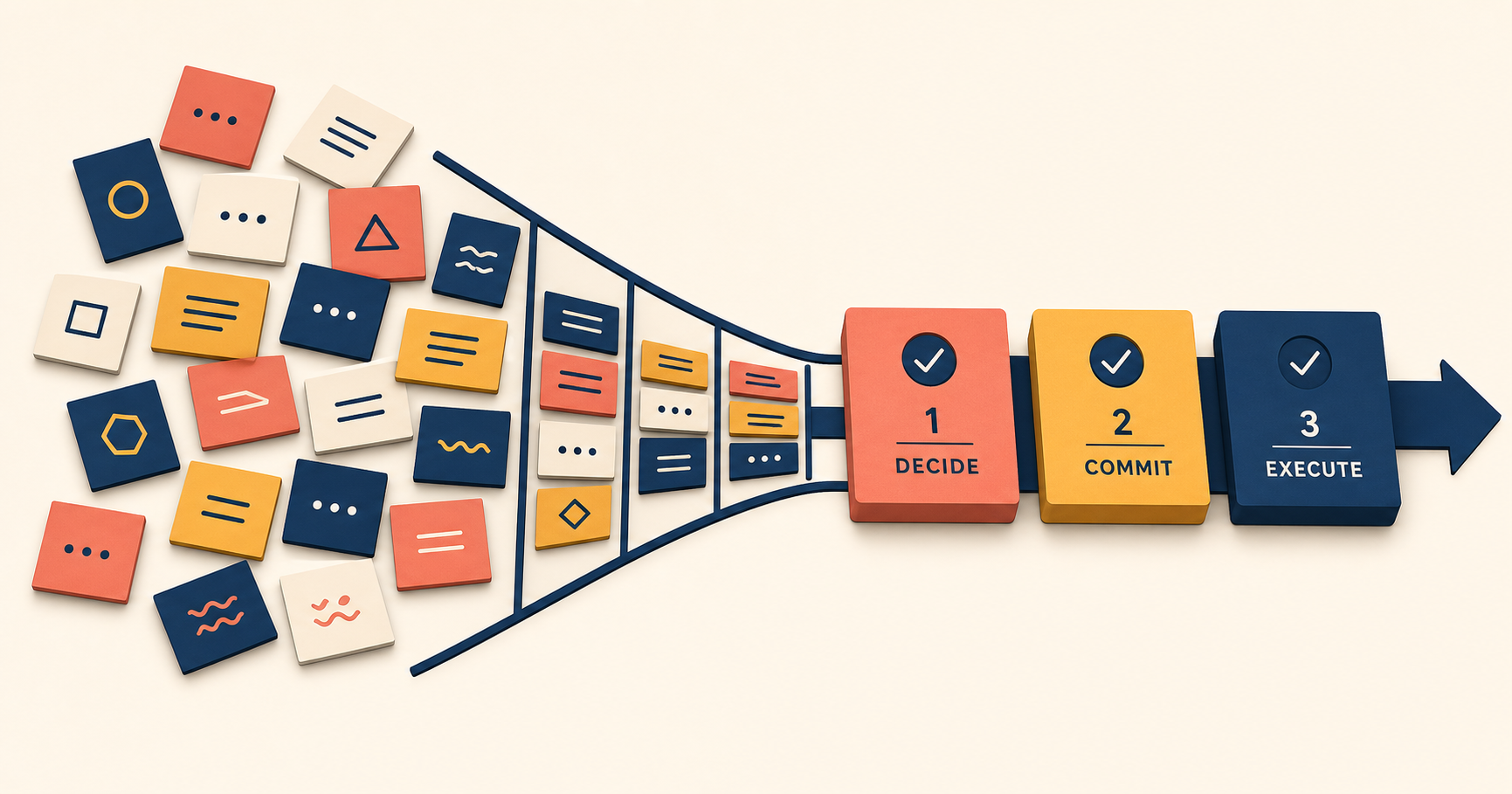
Most teams do not struggle because of laziness. They struggle because they are busy in a way that does not move them forward.
The pattern shows up in a familiar way. Calendars are packed, but the output is unclear. “Good ideas” pile up, but few of them ever ship. “We don’t have time, we don’t have budget, we don’t have headcount” becomes the default answer. Workload grows, ownership shrinks, and important decisions keep getting pushed to “next week.”
This pattern creates a quiet form of burnout. Not the dramatic kind, but the slow loss of energy that comes from working all day and feeling that nothing changed. From the outside, it looks productive. There are meetings, documents, and Slack threads. Yet the direction of the team stays blurry.
This series is about decision-driven productivity — a re-framing of what it means for a product team to be productive. The core claim is simple: progress does not come from ideas or from raw effort. It comes from decisions. This first article covers the 7 core principles of team productivity that show up again and again in teams that convert work into impact.
What Decision-Driven Productivity Actually Means
Productivity is not “doing more.” A more accurate definition is this:
Creating the most value for customers and the business with the time and resources you actually have.
If value is the goal, then activity only counts when it leads to one of three things:
- A decision
- An action
- A learning loop (ship → feedback → improve)
Decisions are the fuel in this loop. Ideas are cheap and abundant; what turns an idea into motion is a decision. You cannot control every constraint, but you can design the conditions under which decisions happen faster, on better context, and with clear follow-through.
Tools and frameworks help, but culture decides whether they stick. The principles below are the ones that show up repeatedly in teams that convert effort into impact.
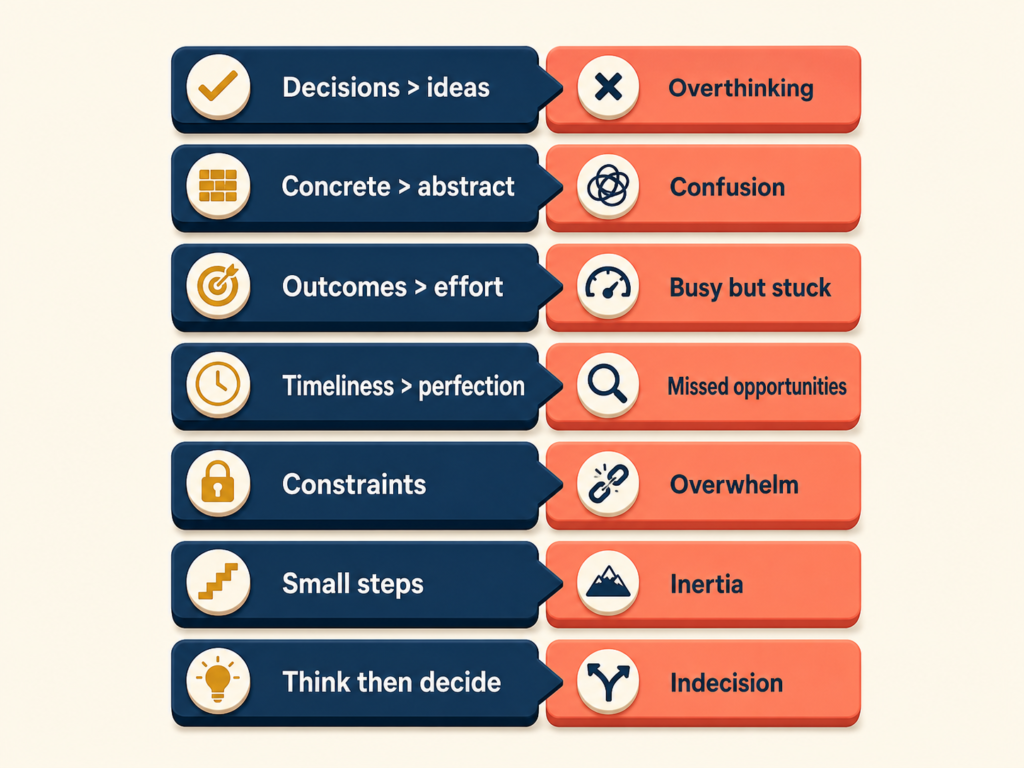
| Principle | Core Idea | Problem It Prevents |
|---|---|---|
| 1. Decisions > ideas | Progress comes from committing, not from generating options | Endless discussion, idea inflation, decision paralysis |
| 2. Concrete > abstract | Concrete language enables action and alignment | Vague agreement, hidden disagreement, stalled execution |
| 3. Outcomes > effort | Results matter more than visible busyness | Rewarding activity instead of value, performative work |
| 4. Timeliness > perfection | Value depends on when you ship | Missed timing, over-engineering, delayed learning |
| 5. Constraints as strategy | Constraints are a prioritization tool, not an excuse | Waiting for ideal conditions, scope creep |
| 6. Small steps, big progress | Momentum comes from small, reversible decisions | Overwhelming goals, energy-draining long projects |
| 7. Individual thinking, collective decisions | Thinking and deciding need different environments | Shallow meetings, groupthink, collaboration fatigue |
These seven principles are not a checklist. They are a system that works because each one reinforces the others. The rest of this article walks through them one by one.
Principle 1: Decisions Matter More Than Ideas
Most teams do not lack ideas. They have too many of them.
Documents pile up, conversations circle back, and weeks pass without anything concrete changing. The difference between progress and stagnation is not creativity. It is commitment. Ideas live comfortably in conversation. Decisions force reality to respond.
Why ideas feel productive but often aren’t
Ideas are attractive because they are safe. No one has to be wrong yet. Trade-offs are not locked in. No one carries responsibility. An idea-rich environment feels energetic, but it is often quietly avoiding risk.
Decisions are different. A decision creates a before-and-after. What was not true is now true, even if imperfectly. A direction is chosen.
This matters because the market does not respond to intent. It responds to what actually ships. Until a decision is made, there is nothing to test, learn from, or improve. The goal is not to generate options forever — it is to help the team pick one and learn from it.
Decisions as building blocks, not final answers
A useful way to view a decision is as a brick in a larger structure, not the structure itself. Each decision adds one piece, and only after the piece is in place can you see whether the structure holds.
This is why delaying decisions in search of certainty often backfires. Many truths only emerge after something exists in the world. Decisions are not permanent, either. Most can be revised once new information arrives. The cost is not in making a wrong decision. The cost is in making one decision so large it cannot be undone, or in making no decision and learning nothing.
Right-sizing decisions: one-way doors and two-way doors
Not all decisions are equal. Size matters.
A decision that feels too large feels irreversible. Teams hesitate, over-analyze, and stall, because the cost of being wrong feels catastrophic. The right size of decision has two properties: it is large enough to create real learning, and small enough to adjust without much disruption.
Jeff Bezos proposed a useful classification: two-way door decisions and one-way door decisions.
| Type | Characteristics | Approach |
|---|---|---|
| Two-way door | Reversible, limited blast radius | Move quickly |
| One-way door | Hard to undo, structural | Slow down and review carefully |
Most good decisions belong to the first type. Treating reversible decisions as if they were irreversible is one of the most common reasons teams get stuck. Speed comes from learning to recognize which decisions can safely be revisited later.
“Where should I emigrate to?” is a one-way door. It deserves careful thought. “Where should I get lunch today?” is a two-way door — if it’s bad, you’ll pick somewhere else for dinner. The problem is that many teams treat lunch-level decisions with emigration-level deliberation, and end up going nowhere.
Principle 2: Concrete Beats Abstract
Abstract conversations feel safe. Concrete conversations move work forward.
This distinction matters because most teams do not get stuck during execution. They get stuck in the fog before execution. When language is abstract, everyone can nod and quietly imagine a different outcome.
Abstract language sounds like this:
- “We need to improve the experience.”
- “This needs to be more scalable.”
- “Let’s align on the vision.”
These statements feel productive. They show interest and ambition. But they do not trigger action, because they do not specify what to do, who does it, or by when.
Concrete language sounds like this:
- “Users drop off at step three because setup takes too long.”
- “This workflow adds two manual steps per customer.”
- “We’ll test with five users by Friday.”
The difference is not about being rigid or literal. It is about creating a shared understanding that survives outside the meeting room.
Why abstraction feels safe but blocks progress
Abstraction has a role in strategy. Thinking broadly is useful before narrowing down. The risk appears when abstraction starts replacing decisions.
Teams stay abstract for a few reasons. It lets them avoid responsibility, because no one can be wrong yet. It postpones conflict, because the trade-offs stay hidden. And it gives the appearance of deliberation without action.
The problem is that abstract goals cannot be tested. They float above reality and become immune to feedback. Concrete goals collide with the world immediately. They reveal what works and what doesn’t. That is uncomfortable, but it is also how learning happens.
Think of it like a doctor’s visit. “I don’t feel well” is abstract — there is almost nothing the doctor can do with it. “My right knee has a sharp pain whenever I climb stairs, and it’s been two weeks” is concrete — examination and treatment can start immediately. Team discussions work the same way. You cannot act on “let’s improve the experience,” but you can act on “find out why three-day retention dropped below 30% after signup.”
Moving from abstract to concrete
Becoming concrete is a skill that improves with practice. In most cases, three questions are enough.
- What is the real problem? Not “engagement is low” but “users stop logging in after the first week because the daily summary doesn’t feel useful.”
- What is the next action? Not “we need to fix this” but “interview five churned users by Wednesday to understand why.”
- Who owns this, and by when? Not “someone should look into it” but “Alex will prototype a revised summary by Friday.”
This level of specificity does not mean planning everything. It means that the next step is clear enough for someone to begin immediately.
How concrete language accelerates progress
When language stays abstract, disagreement hides. Everyone leaves the meeting believing they agreed, while each person imagined a different result. The disagreement surfaces later, as confusion, conflict, or duplicated work.
Concrete language surfaces disagreement early, when the cost of resolving it is lowest.
Consider this example:
- Abstract: “Let’s improve the onboarding flow.”
- Concrete: “Let’s reduce required input fields from eight to three.”
The second version forces the team to confront trade-offs immediately. Are the other five fields important? What do we lose if we remove them? This friction is productive. It turns hidden assumptions into explicit choices.
Concrete language works like an architectural blueprint. If a client says “build me a pretty house,” the architect’s picture and the client’s picture may have nothing in common. “A two-story, three-bedroom, south-facing house with a terrace, around 1,100 square feet” gives both sides the same starting point. Concrete language is the blueprint that lets a team see the same picture.
Practical techniques to stay concrete
Simple habits prevent abstract drift.
- Point to real users or scenarios. Not “customers want this” but “a beta user said yesterday she couldn’t find this feature.”
- State observable outcomes. Not “make it faster” but “reduce load time from three seconds to under one second.”
- Set deadlines, even tentative ones. Not “we’ll explore this” but “we’ll decide whether to proceed by Thursday.”
These techniques do not add bureaucracy. They add clarity, which reduces wasted effort.
A decision-driven culture has a bias toward the concrete — not because abstraction is useless, but because abstraction without conversion blocks execution.
“Add a pinch of salt” produces different results for every cook. “Add half a teaspoon of salt” produces a consistent taste. Team instructions work the same way. Specific numbers, names, and dates are what let different people execute in the same direction.
Principle 3: Outcomes Over Effort
Effort is visible. What matters is outcome.
This distinction is harder to maintain than it sounds, because organizations naturally drift toward rewarding what they can see. In many teams, people are implicitly rewarded for:
- Looking busy
- Responding quickly
- Working long hours
None of these guarantees value.
- The person working late every night may be compensating for poor prioritization.
- The person responding to every message instantly may be breaking deep work.
- The person with the longest to-do list may be avoiding the hard decisions.
Activity is not progress.
The subtle shift from effort to outcome
A decision-driven culture changes the question. From “How hard did we work?” to “What changed because of this?”
This does not mean ignoring effort. It means treating effort as an input, not a result.
A useful re-definition:
- Effort measures what you spent.
- Outcome measures what you got.
You can spend effort without producing outcome. You cannot produce outcome without spending some effort. The goal is not to maximize effort itself, but to maximize return on effort.
Why effort-based culture stagnates
When effort is the dominant signal, several problems appear.
Visible work outranks valuable work. People drift toward tasks that look impressive, even if those tasks do not move the business.
Simplification gets punished. Someone who finds a simpler solution gets less credit than someone who builds an elaborate system.
Learning slows down. Teams optimize for looking smart rather than for discovering what works.
This dynamic is subtle. No one intentionally rewards busyness over impact. But without deliberate focus on results, effort becomes the default proxy.
A taxi meter charges by distance and time. What the passenger wants, though, is not a higher number on the meter — it’s to reach the destination. Sitting in traffic for two hours pushes the meter up but creates no value. Organizations work the same way. Performance should be judged by the destination reached, not by the time spent on the road.
Practical ways to shift toward outcomes
In practice, an outcome-oriented approach looks like this.
- Drop vanity metrics. Replace “we shipped 12 features” with “which features actually changed user behavior?”
- Hold outcome-focused check-ins. Replace “what did you do this week?” with “what did you learn, or what changed?”
- Celebrate work that gets removed. Recognizing someone for simplifying a process should carry the same weight as recognizing someone for building something new.
This kind of cultural shift does not happen through mission statements. It happens through consistent, repeated behavior around what actually matters.
Principle 4: Timeliness Over Perfection
Delays rarely come from laziness. They come from carefulness.
People want to get it right. They want to be confident before they ship. They want to avoid embarrassment and rework. Paradoxically, that mindset is often what causes them to miss the moment when the work would have mattered most.
Perfection is an appealing goal. But what changes outcomes is timing.
Iteration beats perfection
An elaborate plan that never touches reality teaches nothing.
In real environments, assumptions break quickly. Customers behave differently than expected. Constraints surface late. Second-order effects appear. This is normal. It is not a failure of planning.
What matters is creating something concrete early enough that reality can push back on it.
Early decisions should prioritize:
- Clarity over completeness
- Direction over detail
- Learning over elegance
Detail is most valuable after the broad shape of the solution has been proven. Perfection is expensive. Iteration compounds.
Why “good now” beats “perfect later”
Shipping early creates compounding effects that are easy to underestimate. When something is out in the world:
- Users react
- Feedback appears
- Assumptions get corrected
- The team regains a sense of agency
That loop creates momentum. Momentum matters because it keeps teams engaged and adapting.
Long stretches of internal work, in contrast, build a fragile kind of confidence. Everything feels coherent until reality intervenes — and reality often arrives suddenly. A product that shipped early can be improved. A product that shipped too late often arrives already irrelevant.
Execution momentum is a strategic asset. It is not built through internal talk. It is built through visible outcomes.
Complexity as a form of self-protection
Sometimes complexity is not about solving the problem better. It is about protecting the people doing the work.
A complex solution can:
- Demonstrate expertise
- Delay exposure to feedback
- Reduce the chance of being “obviously wrong”
A simple solution does the opposite. It invites real-world review into the process.
A useful checkpoint, when scope keeps growing: Are we solving the problem, or are we protecting ourselves?
The question is uncomfortable, but it often surfaces the real reason a timeline is stretching.
Timing as part of the solution
Problems have intensity and frequency.
A small daily annoyance may need faster action than a serious issue that happens once a year. Timeliness means aligning effort to impact at the moment it matters most.
A modest fix released during peak usage can outperform a perfect fix released after users have either adapted or churned. Product work happens inside a moving system. Waiting for certainty is often the same as waiting for the opportunity to pass.
Principle 5: Use Constraints as Strategy
When productivity drops, constraints are usually the first thing teams complain about.
- “If we had more time, we could do this properly.”
- “If the budget were bigger, we could build something better.”
- “If we just had one or two more senior people…”
These statements sound reasonable. They are also misleading. Most product failures do not come from having too little. They come from not knowing what actually matters.
Constraints are not the enemy of good product work. They force clarity.
Accepting limits instead of negotiating them
Whether a team is early-stage or part of a large company, resources are inherently scarce. Time is fixed, attention is limited, and talent is unevenly distributed.
Many teams still treat constraints as a temporary inconvenience rather than a permanent design factor. That mindset creates risky patterns:
- Planning as if ideal conditions are around the corner
- Postponing decisions until “we have more data”
- Designing solutions that only work in a hypothetical future organization
But product work happens in the present. The team you have today is the team that has to deliver value.
A more useful question than “What are we missing?” is this:
With what we have, what would create the highest impact?
This re-framing changes behavior quickly. It forces trade-offs, surfaces assumptions, and reduces wishful thinking.
Why more resources don’t yield better results
It is tempting to believe that scale solves problems. In reality, scale amplifies what already exists.
- More people can mean more coordination cost.
- More money can mean more scope creep.
- More time can mean more hesitation.
Without a strong sense of what not to do, extra resources often increase noise faster than they increase value. This is why return on investment matters more than raw output. A modest solution that reaches customers and produces learning beats an elaborate system that never ships.
The power of subtraction
One of the most underrated productivity tools in product teams is deliberate removal.
Think of a well-curated product or experience. What makes it feel clear and focused is not the number of features it has. It is the number of features that have been intentionally left out.
Subtraction works because it:
- Reduces cognitive load for users
- Sharpens the core value proposition
- Makes quality achievable within limited resources
A useful process:
- List everything that could go into the product or initiative.
- Circle the few elements that would break the core value if removed.
- Treat the rest as optional, deferrable, or eliminable.
This is not minimalism for its own sake. It is about protecting the core of the product.
Saying “no” is not a failure of leadership. It is one of the most customer-friendly decisions a team can make.
Using constraints to make better decisions
When constraints are explicit, decisions improve.
Instead of debating endlessly, a team can ask:
- Which options fit our current time and capacity?
- Which choices keep future options open?
- What can we ship without creating long-term debt?
Constraints translate abstract strategy into concrete action. They also reduce the emotional weight of decisions. When trade-offs are shaped clearly by reality, they feel less like personal judgments.
Principle 6: Small Steps Compound Into Big Progress
A big goal feels heavy not because it is impossible, but because it is vague.
When work feels overwhelming, the reason is usually that the next action is unclear.
- “Build a new product.”
- “Improve retention.”
- “Fix onboarding.”
These describe outcomes, not steps. Progress begins when a goal becomes actionable.
Why long projects quietly kill momentum
Ambitious goals trigger two predictable behaviors.
Over-planning. Teams try to plan everything up front. Dependencies multiply, unknowns accumulate, and confidence drops.
Avoidance disguised as busyness. People drift toward safe, familiar tasks. Activity goes up; progress doesn’t.
Both responses are not capability problems. They are cognitive overload problems.
Breaking work down reduces that load. It converts uncertainty into a sequence of decisions that can be made one at a time.
Long timelines also carry hidden costs:
- Confidence weakens
- Energy disperses
- Ownership blurs
Teams do not become more careful in long projects. They become cautious because feedback is too far away to sustain motivation. Short cycles produce visible progress. Progress builds belief, and belief sustains effort.
Turning impossible into doable through progressive decomposition
A useful approach to complex work is progressive decomposition.
Instead of asking “how do we solve this?”, ask:
- What has to be true for this to work?
- What is the first assumption we can test?
- What could be done in days, not months?
For example, “ship a new feature” can break down into:
- Clarify the specific user problem
- Find the smallest behavior change that would help
- Sketch a low-fidelity solution
- Test it with a few users
- Decide whether to invest further
Each step is modest. Together, they move the system forward.
If the next step feels overwhelming, it is probably still too large.
Small decisions compound
Progress rarely comes from a single heroic decision. It comes from a sequence of small, directional decisions.
Small decisions have several advantages:
- They are easier to commit to.
- They produce faster feedback.
- They reduce the fear of being wrong.
They also create a starting point for momentum. Finishing something builds confidence, which makes the next decision easier.
This compounding effect is why teams that “move fast” often look calm rather than rushed. They are not sprinting. They are continuously removing friction.
Principle 7: Individual Thinking, Collective Decisions
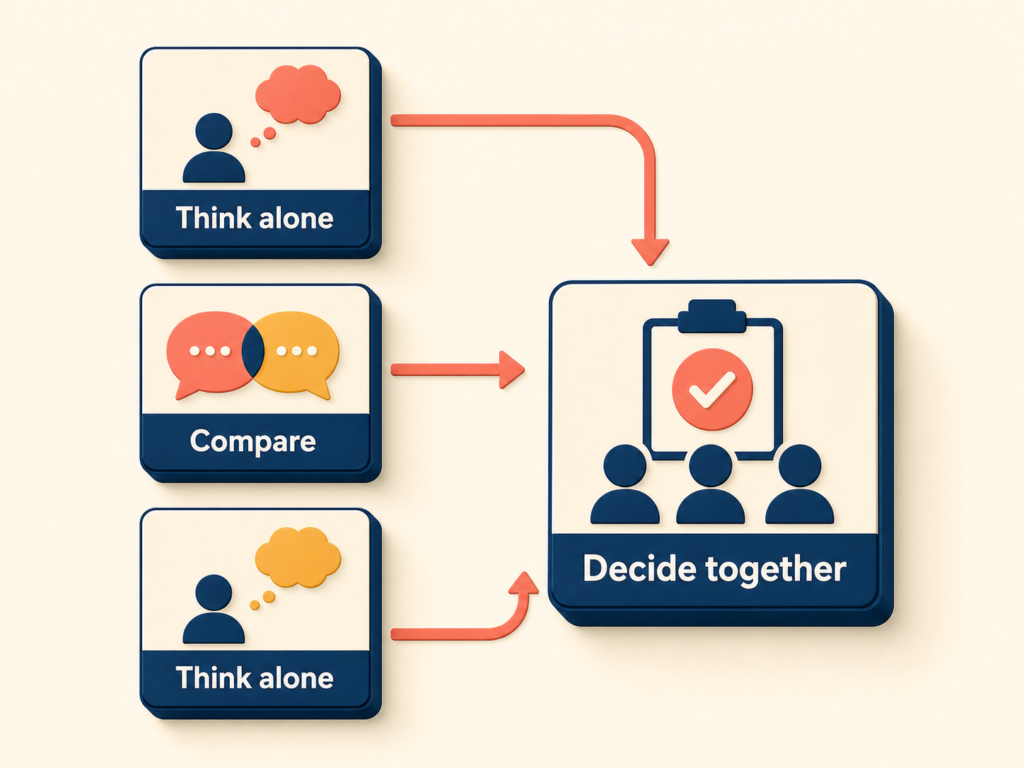
This principle ties together several of the earlier ones.
A healthy culture separates two activities:
- Thinking — work that benefits from solitude and focus
- Deciding — work that benefits from shared context and diverse perspectives
If everything is done in groups, thinking gets shallow. If everything is done alone, alignment breaks. Decision-driven teams design deliberately for both.
Why separating thinking from deciding matters
In many organizations, the same forum handles both. The meeting becomes the place where people think and decide. This creates problems.
Shallow thinking. Real insight requires focus. Group settings divide attention, and complex problems get simplified too quickly.
Groupthink. When thinking happens in groups, the first perspective tends to dominate the conversation. Alternative views fade — not because they are wrong, but because the social cost of disagreement feels high.
Meeting fatigue. People spend hours in discussions that could have been documents, leaving no time for the focused work that produces real breakthroughs.
The solution is not fewer meetings or more solo work. It is deliberately designing each interaction to match the outcome it needs to produce.
How to actually separate them
Decision-driven teams build systems that respect both modes.
For individual thinking:
- Allow quiet time to think before discussion.
- Write thoughts in notes before the meeting begins.
- Handle non-urgent decisions asynchronously (chat, shared docs) instead of in meetings.
For collective decisions:
- Define a clear decision owner after gathering input.
- Run time-boxed discussions focused on choosing, not exploring.
- Make explicit what requires group consensus and what can be decided by an individual.
This structure removes the hidden costs that hide behind the word “collaboration.”
The culture that emerges
Teams that master this separation show distinct traits.
Meetings feel efficient, because the exploratory work has already happened. Conflict resolves faster, because disagreement is about shared ideas, not about ego. Decision quality improves, because choices benefit from diverse perspectives without ownership becoming diluted.
Most importantly, people feel more heard and more productive at the same time.
This is not a trade-off. It is what happens when collaboration is designed deliberately, instead of left to habit.
Conclusion
These seven principles are not a checklist. They are a coherent system for shifting a product team from “busy” to “effective.”
- Decisions matter more than ideas, because ideas are abundant and decisions create motion.
- Concrete beats abstract, because shared understanding survives outside the room only when the language is specific.
- Outcomes outweigh effort, because activity is not progress.
- Timeliness beats perfection, because shipping creates learning that planning cannot.
- Constraints work as strategy, because clarity comes from what you choose to leave out.
- Small steps compound, because momentum is built one decision at a time.
- Individual thinking, collective decisions, because thinking and deciding need different environments.
Together, these principles describe what decision-driven productivity looks like in practice. The next article in this series moves from principles to practice, covering the three questions to ask before starting any piece of work, and a framework for faster and better decisions.
Decision-Driven Productivity Series
(1)
(2)
(3)
(4)