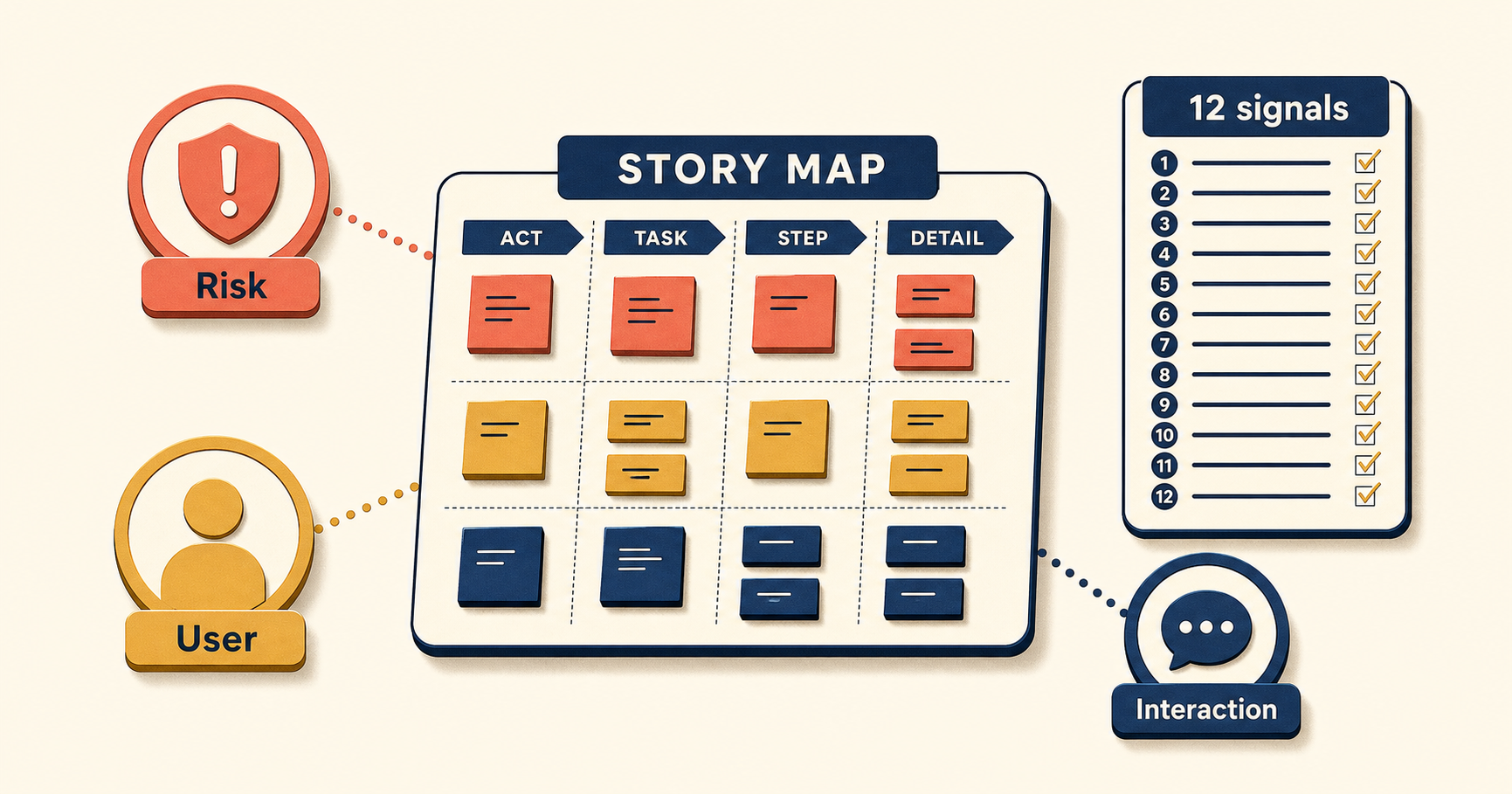
Most teams that “do user story mapping” don’t actually get its benefit. The wall looks right — sticky notes arranged left to right, vertical priority columns, a backbone of activities at the top — but the thinking underneath isn’t shared. The map ends up as a wall decoration rather than a working agreement.
This is the closing post in the user story mapping series, and it focuses on the two checks that decide whether a team’s story mapping is actually working:
(1) the three roles that must be present in the conversation
(2) the 12-signal diagnostic checklist for the map itself.
The first half is about who needs to be in the room. The second half is a user story mapping checklist you can run against any existing map to see where the thinking is still tacit, fragmented, or missing.
The point isn’t to score perfect. The point is to find the one or two weak signals that tell you where to improve next.
Story Mapping Is a Team Sport: Why One Person Can’t Hold the Whole Story
Try mapping a product alone and one limit shows up fast: no single person can hold the entire product story in their head. This isn’t a tool problem. It’s a collaboration problem.
User story mapping works not because one person writes better stories, but because different perspectives surface at the right time. A user’s story carries at least five lenses no single role owns:
- User intent and motivation
- Experience flow and behavior
- Edge cases and failure modes
- Technical feasibility
- Operational and business impact
No one role can carry all five. Strong product leaders don’t succeed because they know everything. They succeed by drawing better conversations and surfacing the right information at the right moment.
A second misconception is worth clearing up: story mapping is often treated as a delivery artifact, the final output a team hands off before building. It’s not. Story mapping lives in product discovery, not delivery. Discovery is about understanding the opportunity space, exploring possible solutions, validating assumptions, and derisking before commitment. Delivery is about implementing the chosen solution, optimizing quality, and shipping reliably.
The map influences delivery, but it’s built to improve discovery. When discovery is weak, delivery absorbs the cost later — as rework, scope changes, and missed outcomes. The analogy that captures this best: discovery is to delivery what architecture is to construction. If the architectural drawings are thin, you end up tearing down walls mid-build to redo them. Story mapping is a tool for designing well before construction starts.
The Three Roles Every Effective Story Mapping Session Needs
Effective story mapping doesn’t require a big group. It requires three different perspectives. One person can wear multiple hats, but all three need to be represented in the conversation.
1. The Risk Checker
The risk checker asks the uncomfortable but necessary questions:
- What could go wrong here?
- What assumptions are we making without evidence?
- Where could this fail in real use?
This person isn’t a blocker. They’re an early-warning system. In a story mapping session, the risk checker surfaces edge cases, failure paths, operational risks, and technical or policy constraints — the kind of issues that get expensive when discovered after the map turns into code.
2. The User Reality Checker
The user reality checker grounds stories in actual context. They focus on:
- Who the user actually is
- What situation they’re in
- What task they’re trying to complete
- Why this matters now
In the map, this role keeps stories tied to real behavior rather than imagined flows. They make sure stories aren’t abstract or assumption-based, and that outcomes stay close to actual users. Product managers and designers often play this role, but it shouldn’t be limited by title or function.
3. The Interaction Checker
The interaction checker watches consistency across the experience. They look for:
- Broken or awkward transitions
- Missing steps between stories
- Unnecessary complexity
- Friction created by details
In a story mapping session, the interaction checker often spots problems just by walking through the flow — before any code exists. Designers usually carry this lens, helping translate stories into experience.
These three roles map onto a familiar setup: a film crew. The director (user reality checker) asks “Does this scene land emotionally with the audience?” The producer (risk checker) asks “Can we actually shoot this within budget?” The editor (interaction checker) asks “Does the cut from this scene to the next feel natural?” You can compress those jobs into one or two people on a small team, but you can’t skip any of the three viewpoints and still ship a good film.
The same applies to story mapping. Skip any one perspective and the map develops a blind spot the team won’t notice until it costs something.
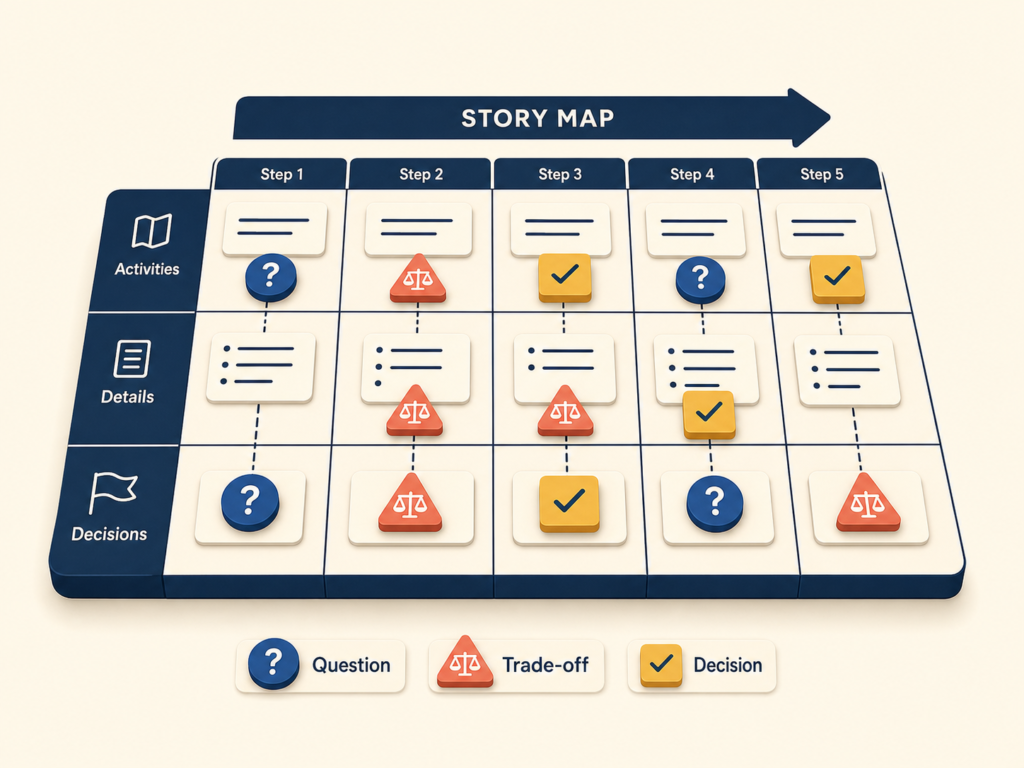
When all three roles show up, story mapping shifts character. It stops being an artifact and becomes a collaboration hub. In that space:
- Assumptions become visible instead of staying in people’s heads
- Misalignment surfaces early, while it’s still cheap to fix
- Trade-offs get discussed in context, not as abstract debates
- Decisions feel shared rather than imposed
The product manager’s role changes with it. With shared understanding in place, the PM writes fewer documents, leads more conversation, spends discovery time on the conversations that matter, and uses the converging perspectives to optimize for risk rather than for output volume.
Think of it as a jazz jam session. It’s not an orchestra where a conductor controls every note. Each musician brings their own part while listening and responding to the others. In a good jam, even when one player leads, every participant shapes the direction the music takes. Story mapping is the same — the PM leads, but every participant’s perspective shapes the result.
When users disappear from this conversation, product leadership starts to break. From the outside, the symptoms look like unclear priorities, frequent scope changes, reactive roadmaps, and frustrated teams. The root cause is usually simpler: not enough diversity of user perspective, decisions made with incomplete context, and stories treated as directives rather than questions. Story mapping with the right roles in the room fixes this directly — not by adding more process, but by making the thinking visible and shared.
The 12-Point User Story Mapping Checklist
There’s often a gap between a story map that looks right and one that actually works. This user story mapping checklist asks the harder question: are we using story mapping as a thinking tool, or as a ritual?
You don’t need a “yes” on every item. One or two weak spots usually point to the next improvement. Items 1–9 check the map itself. Items 10–12 check the team behavior around it.
1. Alignment and Intent
- Does the team agree not just on what we’re building, but on why?
- Are the intended outcomes visible at the top of the map?
- Can teammates describe the goal in roughly the same words?
2. User Definition
- Have we explicitly chosen the target user?
- Would other people on the team picture roughly the same person?
- Is the user defined by context and the task they’re trying to complete, not by demographics?
- Does the map have a clear center of gravity around this user?
3. Conversation Quality
- Do the stories trigger discussion, or shut it down?
- Are “why” and “what if” questions welcomed?
- Are developers and designers actively challenging assumptions?
- Does misalignment surface early, while it’s still cheap?
4. Story Coherence
- Does the map read as a real user journey, left to right?
- Does the story still make sense if you remove every detail?
- Are there steps that feel vague, overloaded, or suspiciously empty?
5. Epic, Story, and Task Clarity
- Are epics framed as meaningful user activities?
- Do stories tie clearly back to those activities?
- Do tasks act as implementation detail?
- Can you trace from a task back up to a user story without effort?
6. Focus and Prioritization
- Is vertical placement actually being used to signal importance?
- Can the team explain why something is at the top or bottom?
- Are “not now” decisions explicit and visible?
- Does prioritization feel grounded in use context, not politics?
7. MVP and Release Scope
- Does the current release slice represent a journey that lets users do a complete job?
- Can users complete something meaningful, even if incomplete?
- Is the MVP framed as learning and survival, not feature minimum?
- If this MVP fails, does it still set up something better next?
8. Risk Visibility
- Are technical, policy, and operational risks marked on the map?
- Do risky stories surface early enough?
- Are assumptions treated as testable, not as implicit truths?
9. Learning Loops
- Does the map get updated after releases or user research?
- Do new insights actually change release scope or priority?
- Is learning visible on the map, not trapped in people’s heads?
10. Roles in the Room
- Is someone actively playing the risk checker role?
- Is someone grounding the discussion in user reality?
- Is someone watching flow and experience consistency?
- Is the PM drawing the conversation out rather than dominating it?
11. Leadership Signals
- Do decisions feel shared, not imposed?
- Does the map reduce the need for control and escalation?
12. Persistence
- Is the map revisited during planning and review?
- Can new teammates understand the product faster by reading the map?
- Is the map a living artifact, not a forgotten one?
The point of this user story mapping checklist isn’t to grade the team. It’s to point at the next thing worth fixing. If most items in the same section are weak, that’s a stronger signal than a scattered “no” across the list.
Reading the Checklist: “No” Is Feedback, Not Failure
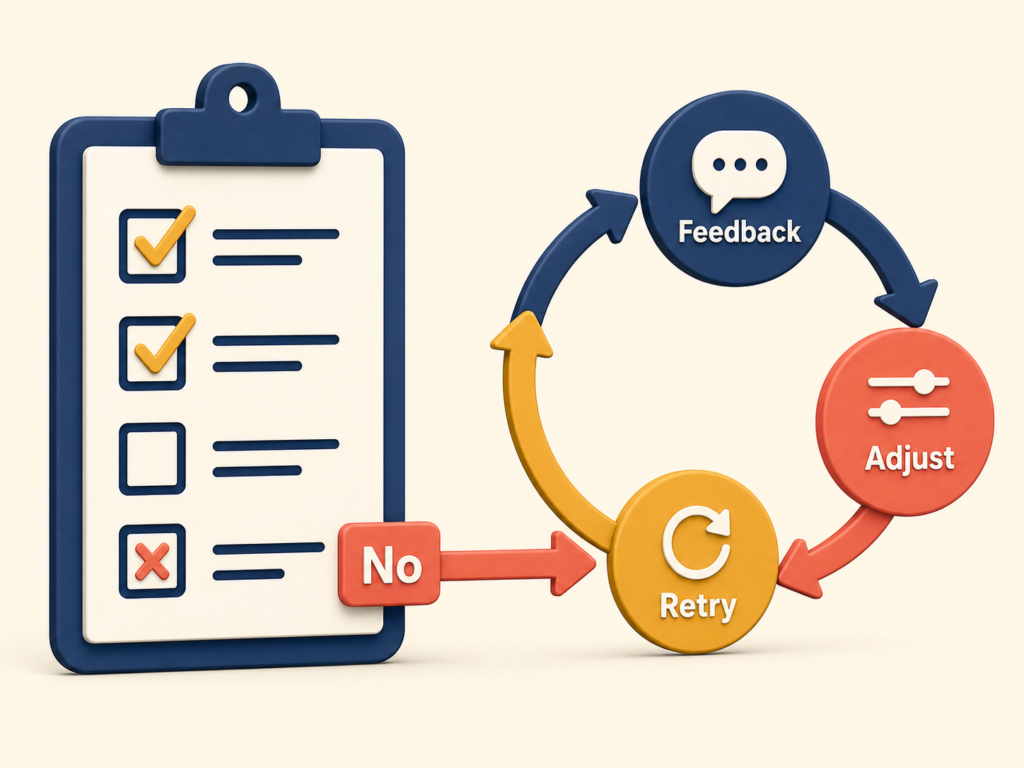
Several “no” answers on the checklist aren’t failure. They’re signal. A checklist with weak spots usually points at one of three underlying conditions:
- The team’s thinking is still tacit — people know things but haven’t made them visible on the map.
- The thinking is fragmented across people — different roles hold different pieces, and no shared picture exists yet.
- The work has been over-optimized for shipping — the map exists, but its job has quietly shifted from sense-making to output tracking.
Each of those has a clear next move. Tacit thinking needs to be drawn out into the map. Fragmented thinking needs the three roles in the same conversation. Over-optimized work needs the team to ask, out loud, what they’re actually trying to learn from this release.
Story mapping isn’t about getting everything right in one workshop or running the perfect session. It’s about making real user context visible — user intent, assumptions, trade-offs, risks, and what “done” actually means inside a complete journey. When the map is alive, the team stops depending on heroic PMs, endless meetings, or documents-as-memory. Stories stay on the wall, decisions stay traceable, and scope gets shaped deliberately rather than by accident.
The goal isn’t a prettier backlog. The goal is shared understanding strong enough to let the team say, with confidence:
- This is who we’re building for.
- This is the smallest coherent experience we’re willing to ship.
- This is what we’re not doing yet, and why.
That clarity is what enables improvement — not more process, but clearer thinking together.
Conclusion
User story mapping works when two things are true: the three roles — risk checker, user reality checker, interaction checker — are in the room, and the 12-point checklist points more “yes” than “no.” Everything else is decoration.
This is the closing post in the user story mapping series. Across the six posts, we moved from diagnosing how stories get misused in agile teams, to redefining what a story actually is, to defining the map and the steps to build it, to applying it in product planning, and now to checking the conditions and signals that tell you whether your map is doing its job.
Better products don’t come from heavier process. They come from clearer thinking together — surfaced on a map, shaped by three perspectives, and revisited until “done” means the same thing to everyone in the room.
User Story Mapping Series
(1) Why Agile User Stories Fail: From Tickets to Shared Understanding
(2) Requirements vs User Stories: How Story Mapping Shifts Teams From Outputs to Outcomes
(3) What is a Story Map? Definition and AS-IS vs TO-BE Story Maps
(4) User Story Mapping: A 6-Step Practical Guide to Building a Story Map
(5) How to Use Story Mapping for Product Planning: MVP, Scope, and Release Strategy
(6) User Story Mapping Checklist: The Team Roles and 12 Signals of a Map That Actually Works