A story map is not a template, a Jira trick, or a deliverable that belongs to the product manager alone. A story map is a structured way for a team to tell the story of a product together — and to make decisions about scope, priority, and trade-offs visible while doing it.
The previous article in this series showed how user story mapping shifts a team from output to outcome. The artifact itself is the next piece: what a story map is (and is not), why every story map should start with a clear user, and the line between two distinct types — the AS-IS story map of the journey today and the TO-BE story map of the journey ahead.
What is a Story Map? The Complete Visualization of the User Journey
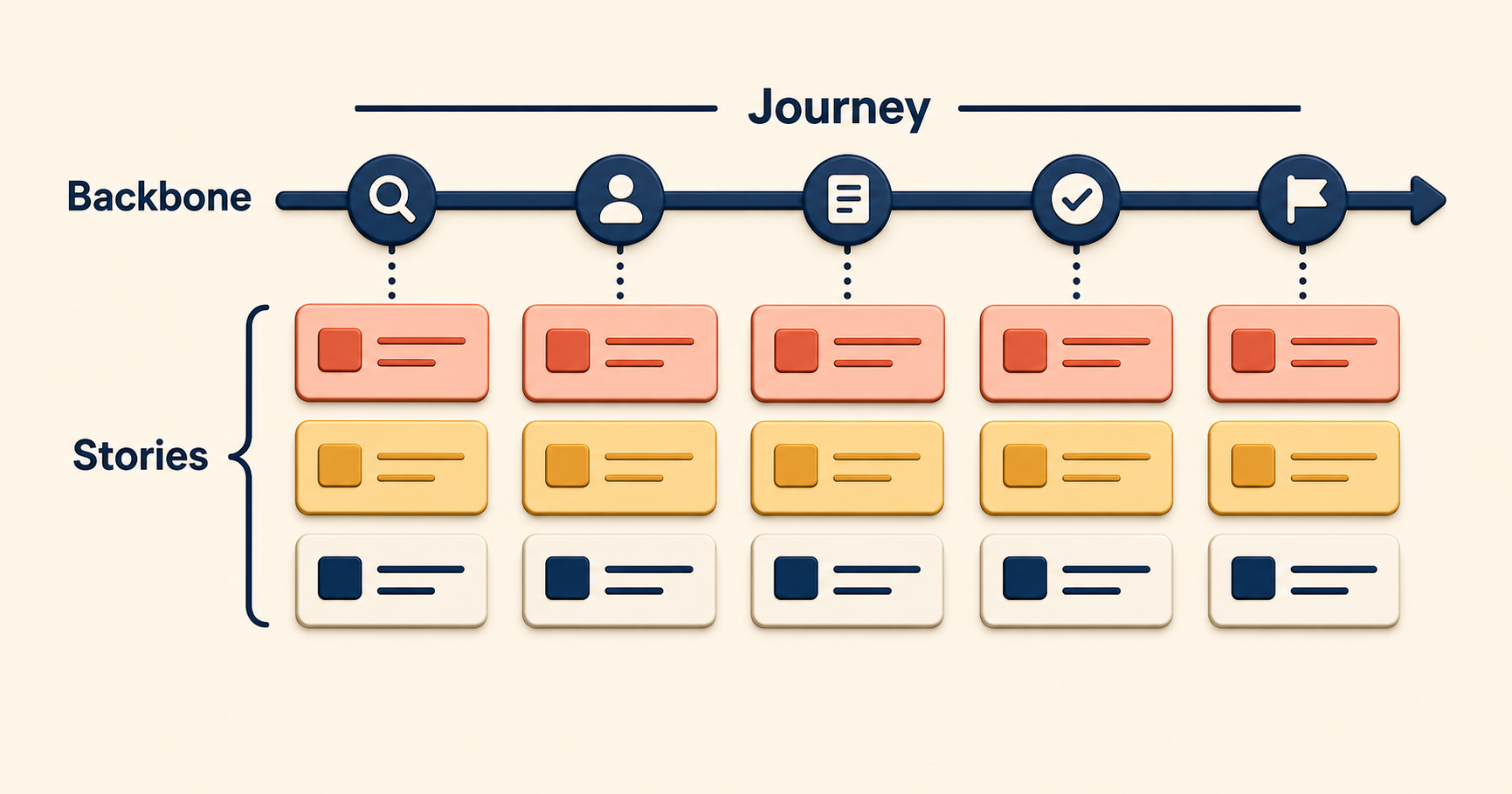
A story map is a visual representation of a product’s story, organized on two axes.
- Narrative flow (left to right): the order in which a user experiences the product over time
- Hierarchy (top to bottom): the way the story is broken down, with each lower row adding detail or completeness
That definition is short on purpose. Most disagreements about story maps come from people quietly meaning different things by the term, so it helps to mark the boundaries early.
A story map is not:
- a substitute for sprint planning
- a one-time workshop artifact
- a detailed feature spec
- the product manager’s private document
A story map is a collaborative thinking tool. Once a team has one, it becomes the underlying structure for several other product activities:
- roadmap discussions
- release slicing
- product discovery conversations
- risk assessment
- onboarding new team members
The mindset shift behind all of this is simple.
Stories are not artifacts to be manufactured. They are accounts of what real users actually do.
When storytelling fails in product planning, the cost is not only financial. It is emotional and organizational. People stop trusting the plan, stop trusting the roadmap, and sometimes stop trusting each other.
A useful comparison is a film storyboard. A director draws each scene before shooting begins so the entire crew can see, at a glance, how the story unfolds. Looking at individual shots (tickets) tells you almost nothing about the film. Looking at the storyboard (the story map) makes it easy to spot a missing scene, a redundant scene, or a scene that sits in the wrong place.

Start with the User: Who Is This Story For?
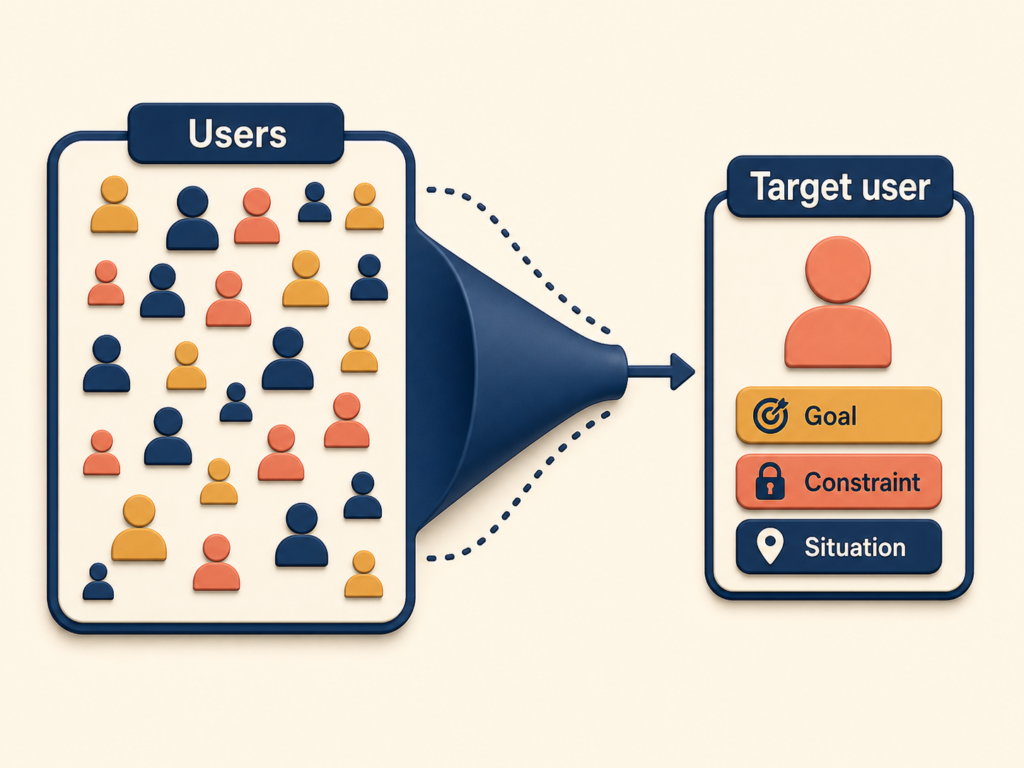
Before drawing a single card on a story map, a team has to make one decision explicit: who this story is for. The point of user story mapping is not to produce better documents. It is to build less, more deliberately. And building less, more deliberately, requires a clear user.
Why narrowing the target user is essential
Time, headcount, and attention are limited. The moment a team tries to design for every possible customer or user at once, the story map bloats. Intent dilutes. The product starts to feel generic rather than useful to anyone in particular.
So a story map starts with narrowing.
In practice, teams begin by externalizing the different customer or user types they could serve. They write each one down, describe it briefly, and group them by meaningful differences in behavior, needs, or context.
The goal at this stage is not precision. It is visibility. Once the user types are visible side by side, their overlaps and differences come into view, and the conversation can move from abstract debate to a more honest question:
Among these users, which one is most worth building for right now?
The team is not ignoring the others forever. It is choosing a starting point that makes focus possible.
How to choose the right target user for story mapping
Choosing a target user is less about accuracy than about intent.
A meaningful target is not the “average user” and not the largest segment. It is the group whose problem, if solved now, would create the most meaningful change.
A few questions help a team make a stronger choice:
- Who experiences this problem most often, or most painfully?
- Whose behavior — not just satisfaction — would change if the experience improved?
- If this group succeeds, does the product have a real chance to survive or grow?
- Which group will let us learn fastest whether we are on the right path?
These are not market-sizing questions. They are focus questions. A useful gut check:
If we build well for this group, does the effort feel worth it?
When the answer is lukewarm, the target is usually too broad or too abstract.
A useful comparison is how doctors choose a specialty. A surgeon who focuses on knee replacements produces better outcomes for those patients than a generalist who tries to treat everyone. Products work the same way. “For everyone” is a weaker starting point than “for this person, with this problem, in this situation.”
What a strong user definition looks like in practice
Once a target group is chosen, it has to be defined clearly enough to act as a decision filter.
A useful user definition has three traits:
- specific enough that team members picture the same person
- concise enough to be remembered during a discussion
- based on context, not demographics
Instead of relying on age, title, or industry, story mapping works better when the definition includes:
- the role or responsibility the person holds
- the situation in which they use the product
- the job to be done
- constraints such as time pressure, risk, or frequency
For example:
“A marketing manager who checks campaign performance every morning and has to decide quickly where to shift ad spend.”
A definition like that gives the story map a clear center of gravity. It helps the team decide what belongs on the map, what does not, and what can wait.
The definition does not need to be perfect. It needs to be shared.
AS-IS vs TO-BE Story Maps: Understanding Current and Future Journeys
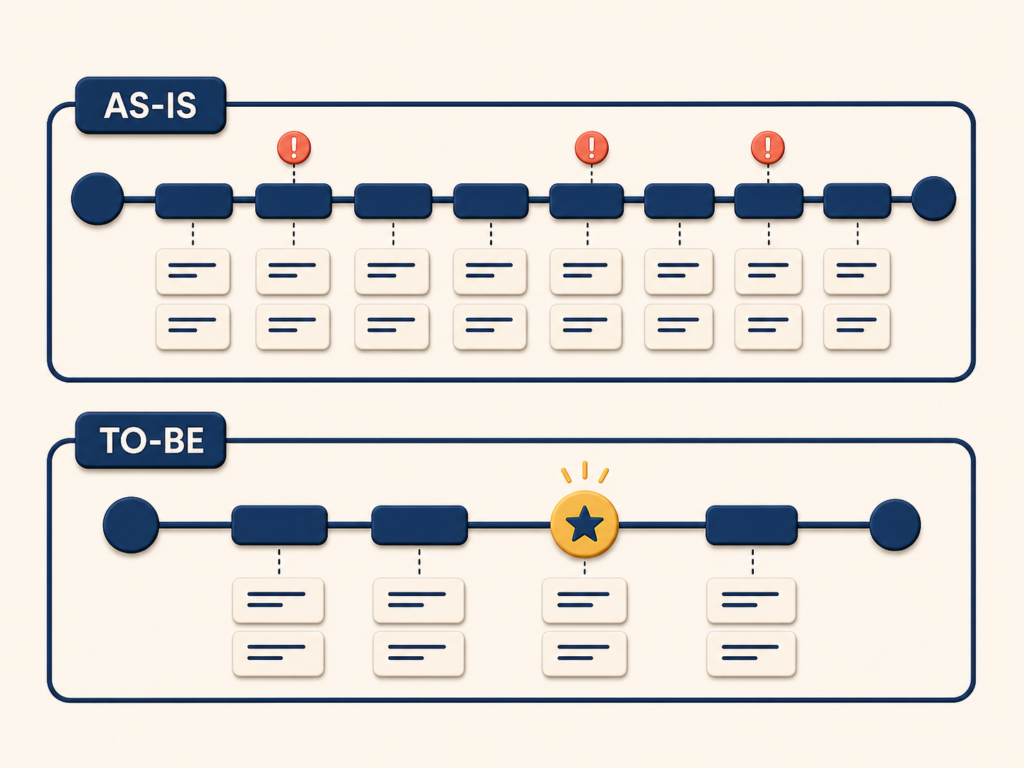
Teams that talk about story mapping are often, without realizing it, talking about two different things. The distinction worth making early is between an AS-IS story map and a TO-BE story map.
AS-IS story map
An AS-IS story map describes how things actually work today.
It captures the current user journey as it really is:
- the workarounds users rely on
- the manual steps hidden behind “the system”
- the delays, confusion, friction, and constraints that feel normal only because they are familiar
The point of an AS-IS map is not criticism and not optimization. It is shared understanding. Everyone on the team starts looking at the same reality instead of carrying around private mental models.
It is especially useful when:
- a product has grown organically and no one can explain why
- different teams are working from different versions of the user journey
- customers are clearly unhappy but the actual source of pain is unclear
An AS-IS map answers a simple question:
“What is today’s experience actually like for the user?”
A useful comparison is mapping the current patient flow in a hospital. From check-in to consultation, the team draws the route patients really walk, where they wait, and where they get confused. Not what should happen — what does happen. Improvements only become visible once that picture is honest.
TO-BE story map
A TO-BE story map, by contrast, describes a future state.
It starts from intent rather than from reality:
- what users should be able to do
- which outcomes should improve
- which parts of the journey are worth changing
A TO-BE map is expected to have blanks. Assumptions are visible. Trade-offs are explicit. Prioritization, release-scope decisions, and roadmap conversations all surface naturally at this stage.
A TO-BE map answers a different question:
“Given our constraints, what should this experience become?”
The most effective story mapping uses both, usually in order. The team grounds the conversation in reality with an AS-IS map, then explores change with a TO-BE map.
Skip the AS-IS map and the plan tends to drift into wishful thinking. Skip the TO-BE map and the team ends up with detailed understanding but no direction.
A useful comparison is renovating a house. An accurate floor plan of the current house (AS-IS) has to come first before anyone can credibly say “if we remove this wall, the living room opens up” (TO-BE). Without the current floor plan, the dream blows the budget and runs into structural problems. Without the future plan, the renovation never starts.
Conclusion
A story map is a shared visual model of a product’s story, anchored on a clearly defined user. Two axes — narrative flow and hierarchy — let a team see the journey, the trade-offs, and the priorities at once, rather than arguing over them in the abstract.
The two flavors do different work. The AS-IS story map grounds the team in how the product is actually used today. The TO-BE story map turns that grounding into direction. Most teams need both, in that order.
The next article walks through the practical side: a six-step guide for building a story map, from externalizing ideas to slicing the map for release.
User Story Mapping Series
(1) Why Agile User Stories Fail: From Tickets to Shared Understanding
(2) Requirements vs User Stories: How Story Mapping Shifts Teams From Outputs to Outcomes
(3) What is a Story Map? Definition and AS-IS vs TO-BE Story Maps
(4) User Story Mapping: A 6-Step Practical Guide to Building a Story Map
(5) How to Use Story Mapping for Product Planning: MVP, Scope, and Release Strategy
(6) User Story Mapping Checklist: The Team Roles and 12 Signals of a Map That Actually Works