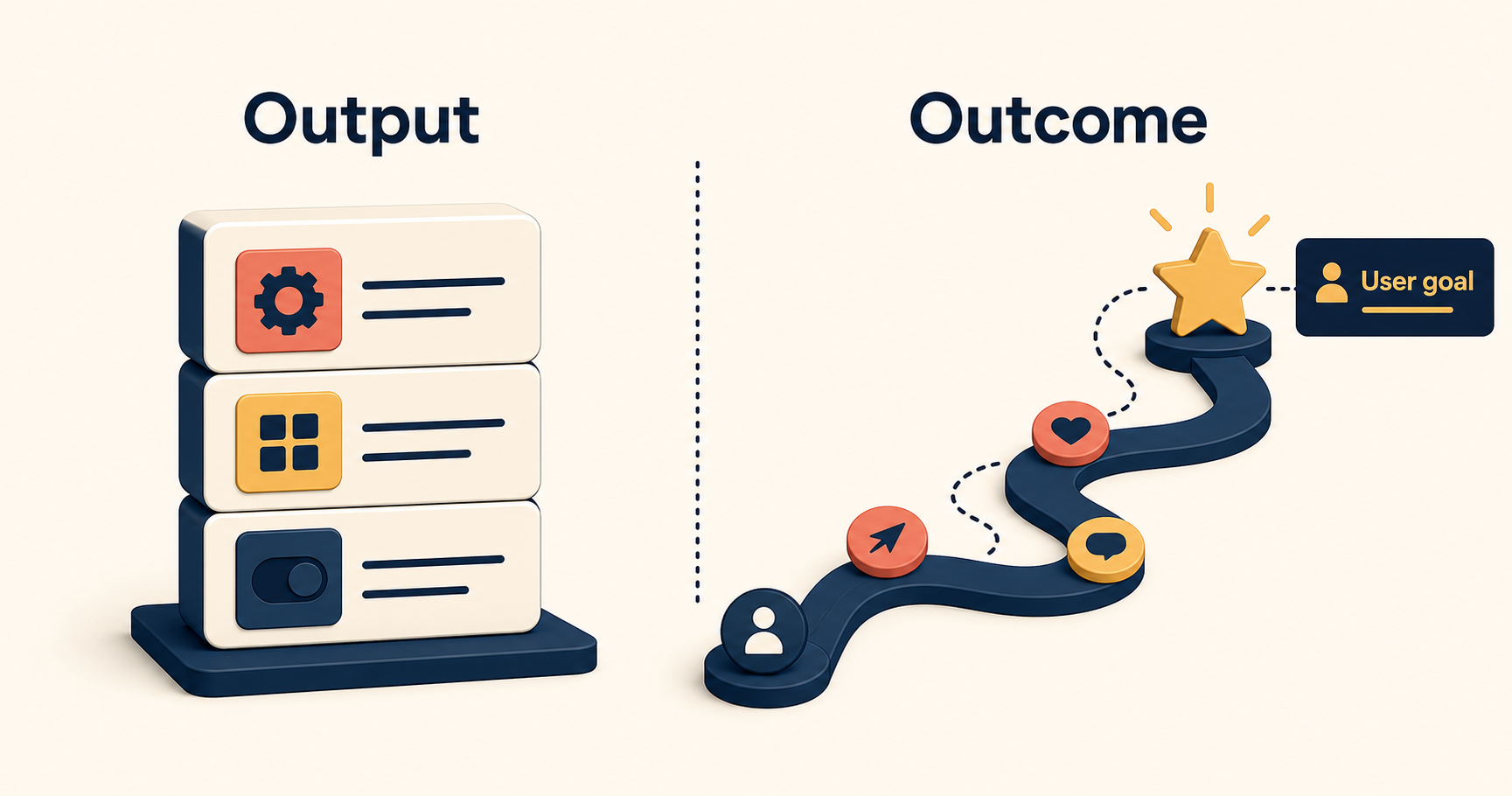
The word “requirements” quietly kills conversations on agile teams. No one intends it that way, but the pattern repeats: someone decides what to build, the decision becomes “the requirement,” discussion turns optional, and shipping the requirement becomes the main measure of success. The team optimizes for outputs while still expecting outcomes — and wonders why the metrics never move.
In part one of this series, we looked at how user stories get misused on agile teams and why “we’re agile, so we don’t write things down” usually means a team has lost the conversation, not the documents. This part takes the diagnosis one step further. The deeper problem behind misused stories is the requirements mindset itself — and story mapping is what shifts teams out of it.
The argument has four moves. First, requirements language shuts down the dialogue a team needs to ship good products. Second, the shift from outputs to outcomes is the real mindset change story mapping enables, and AI has made it more urgent, not less. Third, documents are memory triggers, not information dumps — and a story map is one of the best memory triggers a product team has. Fourth, outcome-led teams talk about success differently, and that talk is how you can tell the shift has actually happened.
The thread tying these together is a single question that story mapping pulls a team back to:
“Why are we building this in the first place?”
When Requirements Shut Down the Conversation
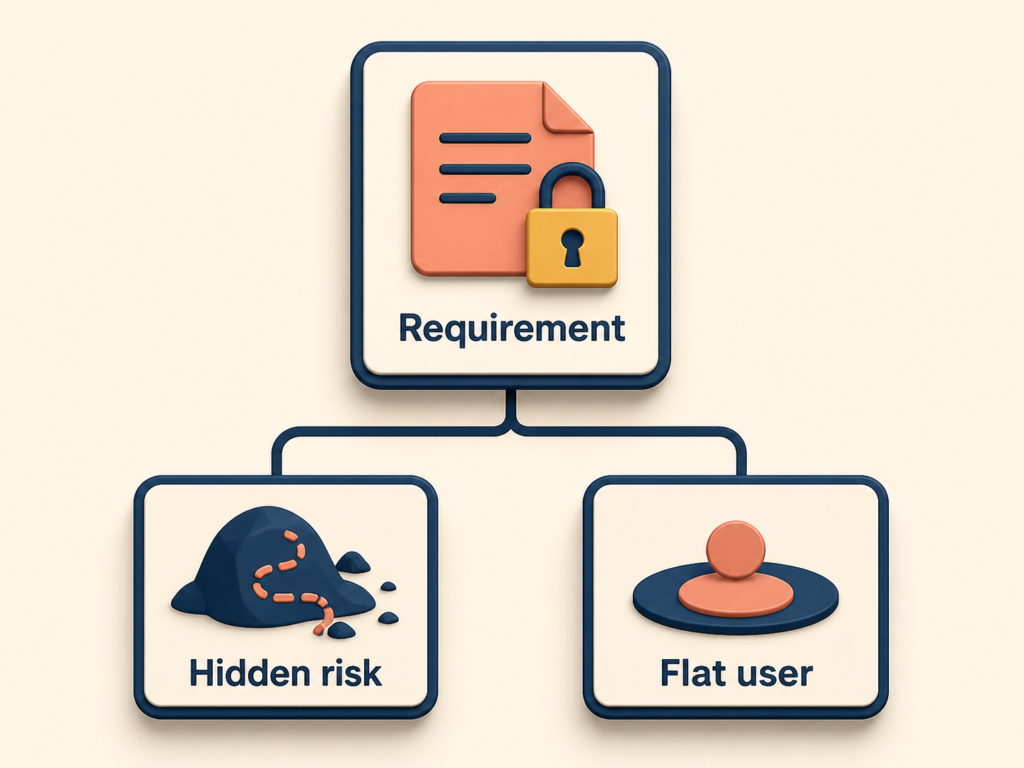
Healthy requirements clarify a decision. Unhealthy requirements end the discussion. The difference is audible in what happens right after the requirement is shared.
- Healthy framing: “Here is the problem we’re trying to solve, and here’s our current thinking. What assumptions are we missing?”
- Unhealthy framing: “These are the requirements. Let me know if you have questions.”
The second framing looks polite, but it tells designers and engineers that the decision is locked. Two downstream effects follow, and both are expensive.
People stop raising risk
When a requirement is treated as final, designers and engineers learn that raising a concern slows things down. So they stop. The risks they would have flagged early surface later, usually in less convenient forms:
- Unexpected delays
- Quality issues
- Metrics that refuse to move
- “I should have said this earlier” moments in the retrospective
None of these are a discipline problem. They are a structural consequence of closing the conversation too soon.
The team loses the real user
When requirements dominate, the user dissolves into the words on the document. Three placeholders do most of the work:
- “the user”
- “the admin”
- “the customer”
These words appear frequently, but the actual user is not in the room. Real products exist for specific people, in specific contexts, under specific constraints. Agile user stories were supposed to keep those specifics alive in the conversation — the requirements mindset is what flattens them out.
The healthy pattern is not to abandon written specifications. It is to keep the specification subordinate to the conversation: the document captures what the team decided after thinking together, not before.
Outputs vs Outcomes: The Mindset Shift Story Mapping Enables
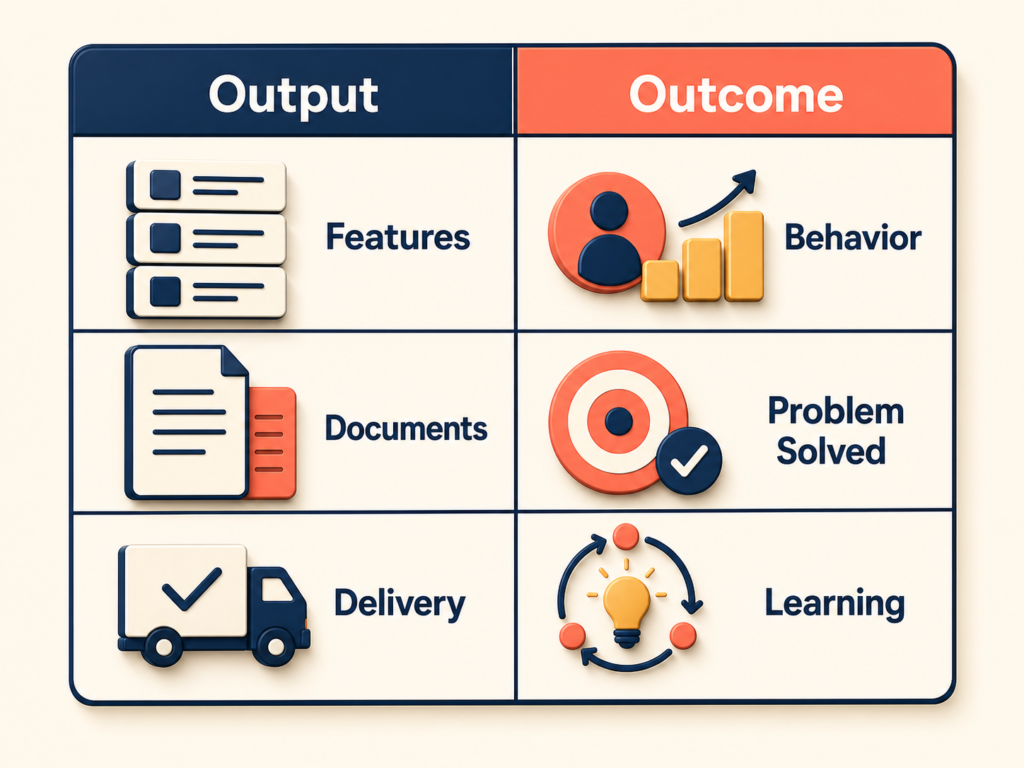
The pivot from a requirements mindset to a story mindset is, at its core, a pivot from outputs to outcomes. The clearest way to see it is side by side.
| Dimension | Output | Outcome |
|---|---|---|
| Definition | What the team ships | What changes because of what shipped |
| Examples | Documents, features, products | User behavior, business impact, problems solved |
| Typical focus | “Did we deliver on time?” | “Did anything actually change?” |
| Why it’s hard | Easy to complete and measure | Requires learning, trade-offs, and measurement |
| Why it matters now | AI makes outputs fast and cheap | Outcomes are still scarce and uncertain |
Outputs are what a team made. Outcomes are what changed in the world because of what the team made. When building a product becomes only about “making things,” outputs become the goal. Detailed requirement documents, long feature lists, and eventually a shipped product all follow — and none of them guarantee that anything meaningful changed for a user.
AI has shifted this calculation. Documents, features, and prototypes are easier to produce than they used to be, so for many teams outputs are no longer the bottleneck. The harder and more valuable work is understanding whether those outputs lead to the outcomes the team actually needs. Teams ignore outcomes not because they don’t care, but because outcomes are harder.
A useful analogy is the difference between exercise and health. “I went to the gym five times this week” is an output — it shows effort. “My body fat dropped by 5%” is an outcome — it shows change. You can go to the gym every day and see no change in your body if your diet and sleep are wrong. Shipping features works the same way: shipping is not the same as changing user behavior, and outcomes over outputs is the principle that keeps the two from being confused.
Story mapping is the artifact that turns this pivot into practice. Instead of organizing work by what gets shipped, it organizes work by what the user is trying to do — which forces the team to keep asking whether the next slice of shipping actually moves the user’s experience.
Documents as Memory Triggers, Not Information Dumps
Most teams swing between two extremes on documentation.
- Extreme 1: “No docs. We’re agile.”
- Extreme 2: “Document everything in detail.”
Both fail. The first loses context the moment a key person leaves the team. The second produces 20-page specifications that no one rereads and that calcify before the product ships. A more practical approach treats documents as context preservers: tools that let a team return to a decision later without redoing all the thinking.
Good product documentation works like a bookmark. The point is not to capture the full conversation but to capture enough that the conversation can be reconstructed. Most of the time, a document is doing its job if it can answer five questions:
- What did we decide?
- Why did we decide it that way?
- What alternatives did we consider?
- What assumptions are we betting on?
- How will we know if it worked?
This is also why story maps work well as artifacts. A few notes on a map can recall a rich discussion that produced them. The map is not the conversation — it is the index back into the conversation. People who were in the discussion read the notes and remember the why; people who weren’t can ask better questions because they can see the structure of what the team decided.
When teams use documents this way, something interesting emerges. Discussion stays where the value is — in the room — and the artifact captures just enough to keep that value compounding. What naturally appears over time is not a stack of specifications but a product narrative: a running account of what the team chose, why, and what it bet on. The narrative functions as plan, strategy, and shared understanding at once, without needing a separate document for each.
From Shipping Features to Creating Business Outcomes
The shift is easy to describe and hard to do. The clearest signal that it has actually happened is in how the team talks about success.
In a feature-led team, success sounds like this:
- “We shipped everything in the sprint.”
- “The roadmap is launched.”
In an outcome-led team, success sounds like this:
- “Activation improved, and we understand why.”
- “Retention didn’t move, but we learned which assumption broke.”
- “We shipped less than we planned, but the core flow works.”
Notice what changed. The first set reports completion; the second reports learning. The first treats the plan as the goal; the second treats the plan as a bet. Outcomes over outputs is not a slogan in the second set — it is the grammar of the standup.
This is the step-up many product managers eventually make. The shift is not writing better tickets. It is helping the organization answer one question, again and again:
“What is the smallest coherent experience that creates value and lets us learn?”
That question is what story mapping is built to answer. It pulls a team away from “everything in scope” and toward “the smallest slice that actually moves the outcome.”
A useful comparison is how Michelin-starred restaurants are evaluated. The measure is not the size of the menu (output) but whether guests come back (outcome). A 100-item menu is not the goal; a guest returning is. Product teams need the same shift in definition. The question is not “how much did we ship?” but “what changed for the user?”
Conclusion
The four moves in this article connect into one argument. Requirements language shuts down the conversation a team needs. Outputs versus outcomes is the pivot story mapping enables. Documents earn their keep when they trigger memory of the conversation, not replace it. And outcome-led talk is how you can tell the shift has actually happened on the ground.
User story mapping is one of the few practices that turns this shift from intention into routine. It gives the team an artifact that is hard to use as a requirements list and easy to use as a conversation map. The next part of the series looks at what a story map actually is — including who the user is, and how AS-IS and TO-BE maps differ in what they ask the team to think about.
User Story Mapping Series
(1) Why Agile User Stories Fail: From Tickets to Shared Understanding
(2) Requirements vs User Stories: How Story Mapping Shifts Teams From Outputs to Outcomes
(3) What is a Story Map? Definition and AS-IS vs TO-BE Story Maps
(4) User Story Mapping: A 6-Step Practical Guide to Building a Story Map
(5) How to Use Story Mapping for Product Planning: MVP, Scope, and Release Strategy
(6) User Story Mapping Checklist: The Team Roles and 12 Signals of a Map That Actually Works