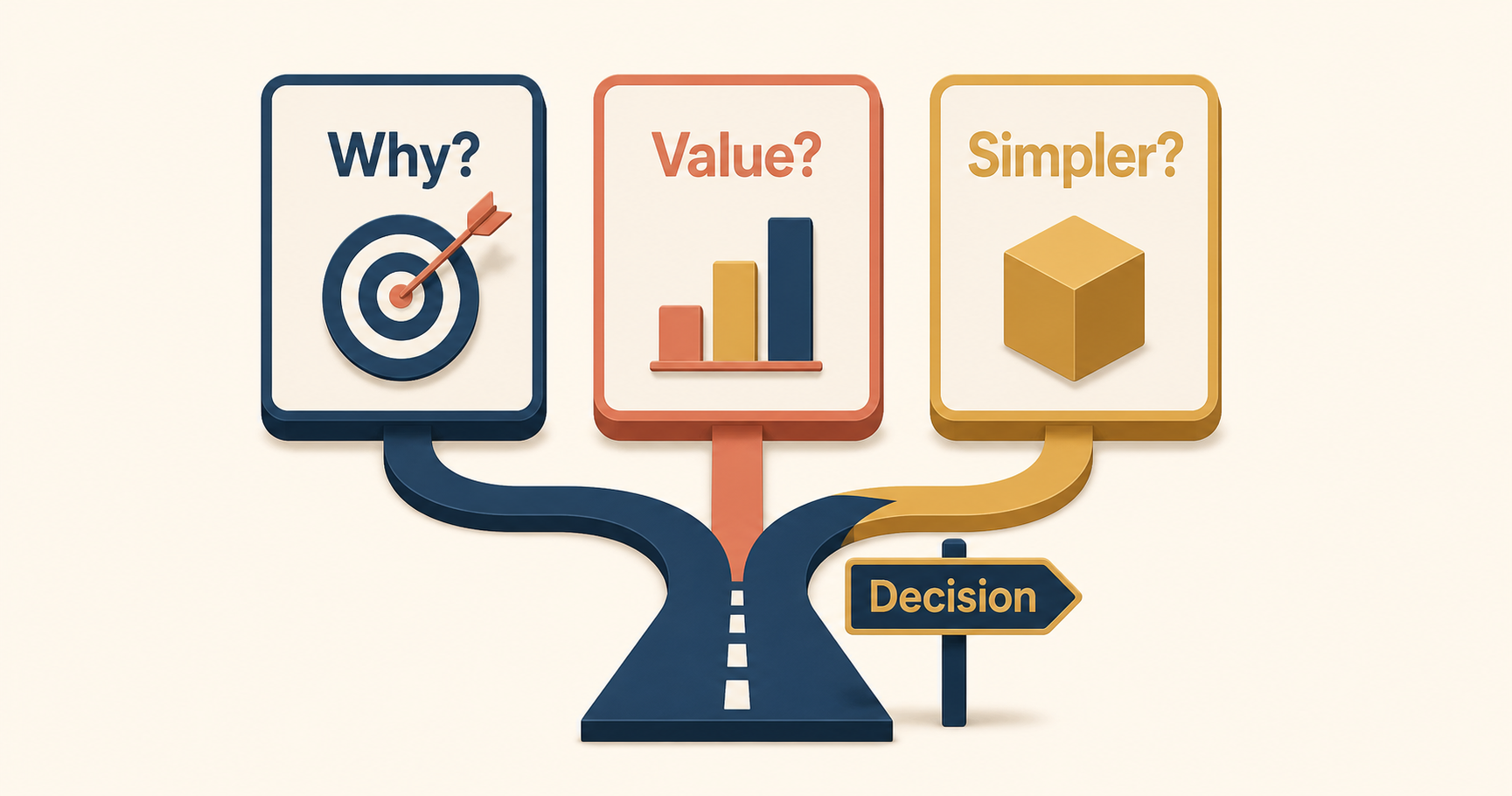
Poor decisions waste even fast execution. A team can ship in two weeks instead of six and still produce nothing of value, simply because the work itself never deserved to enter the backlog. Most productivity drains do not start in execution. They start much earlier, at the quiet moment a task slips into the queue and no one stops to ask why.
A healthy team does not start work with “How fast can we do this?” It starts with “Should we be doing this at all?” That single shift is what a good decision-making framework is built to protect.
The framework has two halves. The first half is a set of three questions to ask before any work begins — questions that surface the hidden waste most organizations carry without noticing. The second half is a structure for how decisions enter the system: who thinks alone, who decides together, and which tool fits which decision. Together, they turn the seven core principles of decision-driven productivity into something a team can use on Monday morning.
Three Questions to Ask Before Starting Any Work
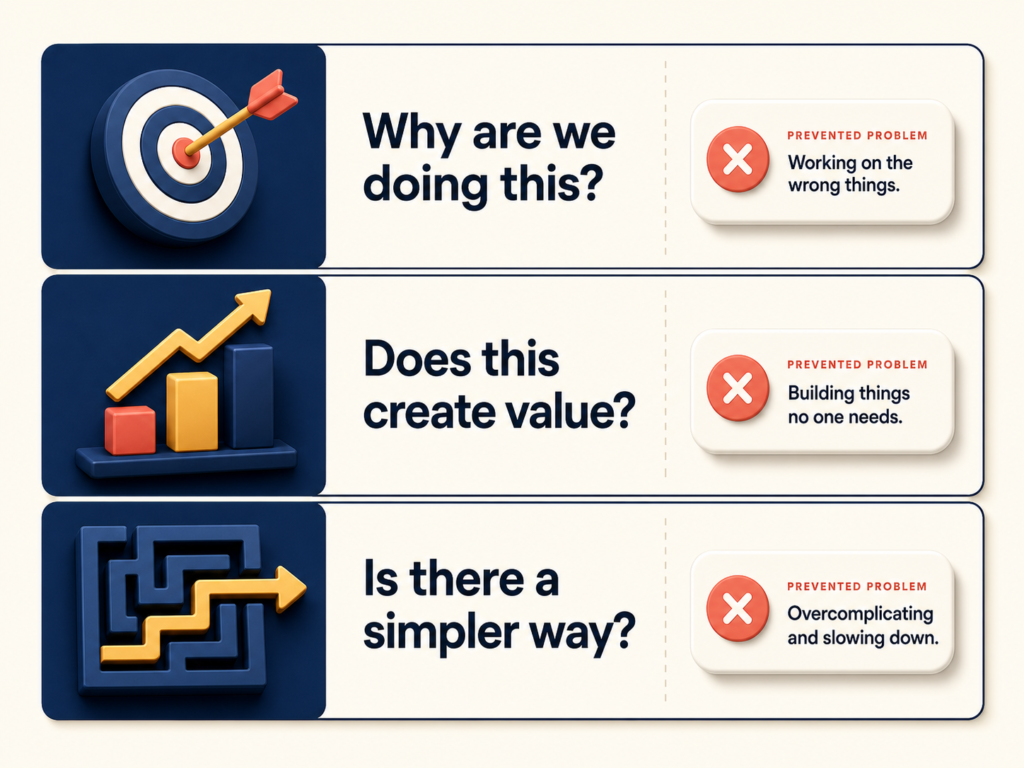
Most productivity problems do not begin with bad execution. They begin much earlier, when work quietly enters the backlog and no one challenges it. Before committing time, people, and attention, three short questions tend to expose where the real waste is. They sound simple, but they catch most of the silent drag a team accumulates over a quarter.
| Question | What it checks | What it prevents |
|---|---|---|
| Why are we doing this? | Whether the work is grounded in a real, current problem | Solving imagined problems, request-driven work, an aimless backlog |
| Does this create real value? | Whether anyone is meaningfully better off when this exists | Performative productivity, impressive but low-impact work |
| Is there a simpler way? | Whether the chosen approach fits the situation | Over-engineering, late releases, perfectionism that kills momentum |
These three questions are the core of the decision-making framework. The sections below unpack each one, with concrete sub-questions and decision-making examples teams can use as a diagnostic.
Question 1: Why Are We Doing This?
If a team cannot explain why a piece of work exists, it is probably absorbing noise on behalf of the organization. The most common reason work happens in most companies is also the most expensive one: “Someone asked for it.”
This is not a moral failing. It is a systems problem. In many organizations, requests flow freely, but purpose does not. Tasks arrive faster than the thinking that should justify them.
When a request shows up, the “why” usually falls into one of three categories:
- A real customer problem. A user is blocked, confused, or unable to reach a goal.
- An internal coordination problem. Teams are misaligned, information is missing, or ownership is unclear.
- An imagined problem. A hypothetical risk, an assumption, or something that feels important but has not been validated.
The trap is overinvesting in the third category. Teams design flows for edge cases no one has hit. They optimize dashboards no one checks. They solve problems that mostly live in someone’s head.
A practical test helps:
- Right now, who specifically is struggling?
- What can they not do without this work?
- How will we know the problem actually decreased?
If those answers stay vague, the work probably has not earned its place in the queue yet. A doctor does not put a patient on the operating table the moment they say “my stomach hurts.” They ask where, how much, and since when. Work deserves the same triage — not “who asked for this,” but “what is the real problem, and does it need to be solved now?”
Question 2: Does This Create Real Value?
Effort is not value. Value exists only when someone on the receiving end is meaningfully better off than before. A team can run hard for a sprint, ship cleanly, and still produce nothing anyone benefits from. That is the difference a decision-making framework has to enforce before work starts, not after.
When evaluating work, it helps to make the value test explicit, stakeholder by stakeholder.
| Stakeholder | What is different because this exists? |
|---|---|
| Customer | Do they save time, make fewer errors, or reach their goal faster? |
| Internal team | Is something clearer, faster, or less manual? |
| Business | Does learning speed, revenue, or risk reduction improve? |
If the answer is “it might be useful someday,” that is not value yet. That is optional exploration, and it should not compete with work that has a clear receiver.
A second useful lens is the substitution test:
- If we don’t do this, what actually breaks?
- Would anyone notice in the next month?
- Can we delay it without a real penalty?
Work that cannot survive these questions is usually work for the sake of work. A backlog crowded with “might be useful someday” items is like a fridge stuffed with condiments saved for a hypothetical recipe — there is no room left for what the team actually needs to cook this week.
Question 3: Is There a Simpler Way?
Complex solutions feel satisfying. They look like rigor, craft, and intelligence at work. Unfortunately, this is also where most productivity quietly dies.
Most problems do not need the most sophisticated answer. They need the minimum sufficient answer, delivered at the right time. Consider two framings:
- One approach: “Let’s build a fully automated system that handles every edge case.”
- Another approach: “What is the smallest thing we can do this quarter that meaningfully reduces the pain?”
Both can be valid, depending on context. The mistake is defaulting to the first without checking whether the second would have been enough. Every hour spent perfecting one solution is an hour not spent somewhere else, and opportunity cost is the part of the equation teams forget first.
A simple team rule helps:
- If a piece of work will take more than two weeks and is blocking other work, ask someone outside it for a second look.
Fresh eyes often find a simpler path that the people deep in the problem can no longer see. The most underrated move in product work is subtraction. The simplest solution that actually works is the one that protects room for everything else that matters. When a city has traffic congestion, redesigning the entire road network is one option — but adjusting signal timing often reduces the same congestion at a fraction of the cost. Try the simpler intervention first, and reach for the complex one only when the simple one is genuinely not enough.
A Framework for Faster, Better Decisions
The biggest silent productivity killer in most organizations is not bad ideas. It is confusion about who should be thinking and who should be deciding. When that is unclear, teams default to the option that feels safest: everyone gets pulled into a meeting, usually early, usually unprepared. It feels inclusive. It also slows everything down.
A better decision-making system separates two activities that get tangled together by default: idea generation and decision-making. Each works best under different conditions, and treating them the same is the most common reason organizations feel busy but rarely move forward.
Thinking Alone vs. Deciding Together
Group brainstorming has a strong reputation. It looks energetic, collaborative, and creative. But groupthink consistently lowers decision quality, and a pattern shows up reliably across the research: individuals tend to generate a wider range of ideas alone, while groups evaluate options better once they share context.
This is not because teams cannot think. It is because group dynamics interfere with how ideas form. The same patterns show up across organizations:
- Reduced individual effort. When responsibility is distributed, people unconsciously put less into the question.
- Early anchoring. The first idea sets the direction for the rest of the conversation, even when it is a weak one.
- Conformity pressure. Once a socially accepted direction emerges, alternatives quietly disappear.
- Forgotten thoughts. In a fast-moving discussion, ideas that did not get airtime get dropped.
- False confidence. Groups tend to overrate the quality of what they produced together.
The result is usually not a small number of strong ideas. It is a large number of average ones.
Why thinking alone produces better ideas
Solo thinking creates space. Space to explore unconventional angles. Space to reason without interruption. Space to discard bad ideas privately before they ever enter a room. This does not mean ideas should stay private. It means they should start there.
A reliable pattern works like this:
- Share the problem clearly, in advance.
- Give individuals time to think and write.
- Bring the ideas back together to evaluate and combine.
Silence before discussion is not inefficiency. It is often where the best ideas form. A student who quietly works through an exam question first, and then compares answers with classmates afterward, usually ends up with a stronger answer than one who talks through every step in real time.
When group decisions shine
Once ideas exist, the group becomes valuable. Teams are better than individuals at:
- Spotting blind spots.
- Stress-testing assumptions.
- Weighing trade-offs across functions.
Decisions benefit from multiple perspectives, especially when the impact crosses team boundaries. The mistake is asking the group to do both jobs at once — to create and decide in the same room. When those roles separate, meetings get shorter and outcomes get clearer.
A practical operating model
A simple but effective model:
- Idea generation: individual, asynchronous.
- Evaluation and decision: group, structured.
In practice, this looks like:
- The owner writes a short pre-read at least one day before the meeting.
- Individuals think through the agenda quietly, on their own time.
- The meeting itself focuses on choosing, not exploring endlessly.
This approach respects deep thinking without giving up organizational alignment. It is one of the highest-leverage habits a team can install.
Three Types of Organizational Decisions: Inform, Approve, Collaborate
Not all decisions are equal, but many organizations treat them as if they are. This is one of the main reasons calendars fill up and work slows down. When every topic triggers the same discussion pattern, the team over-communicates where clarity alone would have been enough, and under-communicates where real collaboration was needed.
A useful way to reduce that friction is to recognize that most organizational decisions fall into three broad types.
| Decision type | Primary purpose | When to use it |
|---|---|---|
| Inform decision | Share direction, context, and intent | A decision has been made and others need to understand it |
| Approval decision | Unblock progress across teams | A solution has formed but cross-functional sign-off is needed |
| Collaborative decision | Solve a complex or ambiguous problem together | The problem or solution is unclear and multiple perspectives help |
Inform decisions
These are about alignment, not debate. Someone has already decided. The goal is to make sure others understand what is happening and why. The productivity risk is mistaking an inform decision for a collaborative one — treating something already settled as if it is still negotiable, which wastes energy on outcomes that will not change. For this type, clarity matters more than consensus: the reason behind the choice, the impact on each team, and what actually changes in practice.
Approval decisions
These need sign-off from a stakeholder who owns the risk or the resource. The most common reason approval meetings stall is missing context. Stakeholders hesitate not because they dislike the idea, but because they cannot see the trade-offs. Without background, assumptions, and constraints, approval becomes slow and defensive.
A well-designed approval decision includes:
- A written description of the problem.
- The options considered and the reason for the preferred one.
- The known risks and how they will be monitored.
This shifts the conversation from “Do you like this?” to “Given what we know, is this a reasonable bet?” — which is a much faster question to answer.
Collaborative decisions
These are the decisions that genuinely need multiple perspectives — when the problem is unclear, constraints compete, or systems behave in unexpected ways. Collaboration is only valuable when it is structured. Without structure, discussions drift, scope expands, and time runs out before anything is decided. Effective collaborative decisions usually start with three things:
- A clearly framed problem statement.
- The boundaries of what is in and out of scope.
- A working definition of what a good decision looks like.
The goal is not to exhaust every idea. It is to converge on a path that can actually be executed.
Decision-Making Tools and When to Use Them
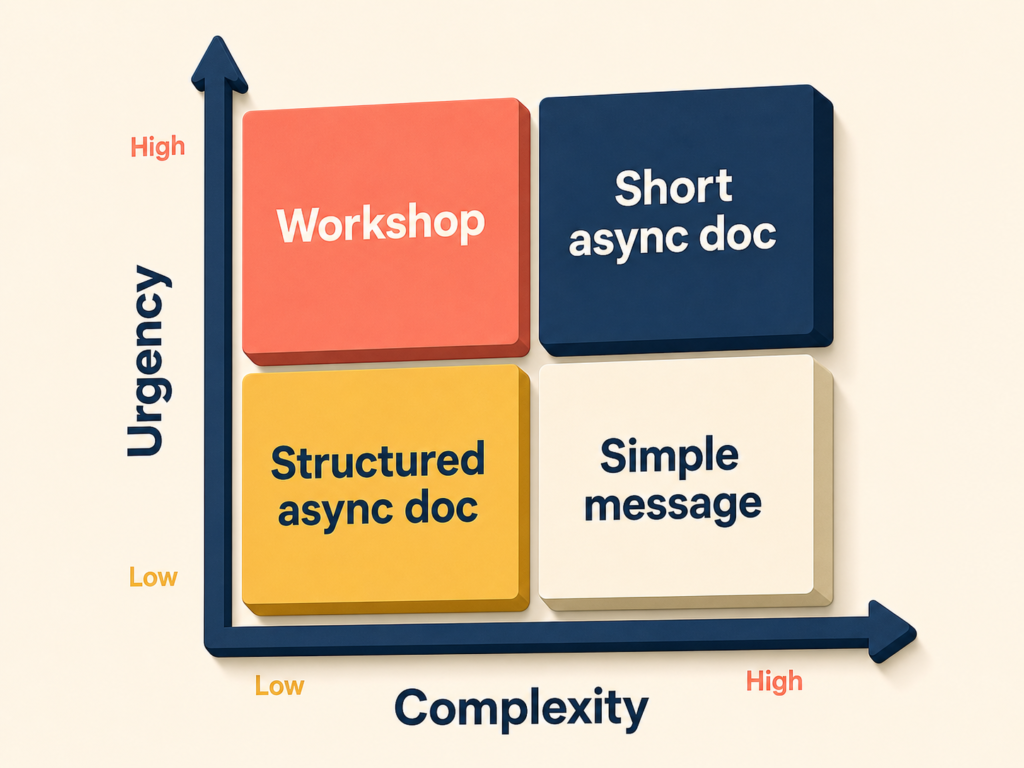
What is the right tool for this decision?
Most teams do not choose their decision-making tools deliberately. They default to meetings because meetings feel safe and familiar. But every tool has a cost, and meetings are one of the most expensive. A good decision-making system matches urgency and complexity to the right communication format, instead of treating every conversation as a calendar invite.
Asynchronous tools: thinking-friendly
Async tools let people engage on their own time and in their own mental space. This makes them especially good for clarity and depth.
- Written documents. Best for sharing context, reasoning, and trade-offs. They scale well and leave a lasting record.
- Internal wikis (Notion, Confluence, and similar). Useful for evolving decisions, collecting feedback, and avoiding repeated explanation.
- Email or long messages. Effective for clear updates that need simple approval or limited back-and-forth.
- Recorded video or screen walkthroughs. Helpful when visual context matters or when tone could be misread in text.
The main advantage of async is not speed. It is quality of thinking. People can read carefully, consider, and respond thoughtfully — which is hard to do when the conversation is real-time. A letter gives the writer time to organize their thoughts and the reader time to consider the response. A phone call is immediate, but thinking happens while talking, which often makes it shallower. Not every conversation needs to be a phone call.
Synchronous tools: expensive but sometimes necessary
Meetings are inherently synchronous. Everyone has to focus on the same topic at the same time. That is what makes them powerful in specific situations and wasteful in many others. A meeting is the right call when:
- The decision is both urgent and complex.
- Misunderstandings need to be resolved quickly.
- The conversation is emotional or nuance-heavy.
- Real-time alignment is essential.
The hidden cost is easy to miss. A one-hour meeting with eight people is not one hour. It is eight hours. That cost demands intention. A meeting is only justified when real-time interaction will meaningfully improve the decision.
A simple decision matrix
One way to make this choice more explicit is to map decisions on two axes: urgency and complexity.
| Urgency | Complexity | Recommended tool |
|---|---|---|
| High | High | Real-time discussion or workshop |
| High | Low | Short async doc or message |
| Low | High | Async doc with structured feedback |
| Low | Low | Simple message, or no discussion needed |
The matrix is not rigid. It is a forcing function: it makes the team choose deliberately instead of defaulting to a meeting. Hospitals use triage for the same reason. They do not put every patient in one queue. They route by urgency and severity, because a mild cold sitting in the emergency room delays care for someone with a real emergency. Decisions deserve the same routing.
Designing async decisions so they don’t stall
Async work fails when it is vague. To prevent endless threads and unclear outcomes, async decisions need their own structure:
- A clear problem statement.
- A proposed recommendation.
- A deadline for feedback.
- A named owner who will make the call.
These elements make participation easy and expectations clear. Without them, async work becomes shouting into a void. Async does not mean leaderless. Ownership becomes more important, not less.
What happens when meetings become the default
Teams that lean too heavily on meetings show the same symptoms:
- Discussions start before anyone has thought independently.
- Decisions get pushed to “next time.”
- Attendance grows while ownership shrinks.
This is not a meeting problem. It is a decision-design problem. The fix is not fewer meetings on the calendar. It is changing how decisions enter the system in the first place.
Conclusion
Better decisions come from two shifts. The first is asking the right questions before work begins: Why are we doing this? Does it create real value? Is there a simpler way? Most of the silent waste in an organization can be caught by these three questions alone, applied honestly.
The second shift is designing how decisions move through the system. Separate idea generation from decision-making. Recognize that informing, approving, and collaborating are three different things, and stop treating them the same. Match tools to urgency and complexity, instead of defaulting to a meeting. These are the building blocks of a decision-making framework that actually changes how a team works.
The next article in the series turns the focus to the most expensive decision-making tool of all — the meeting itself — and looks at the five pillars of effective meetings and the anti-patterns to avoid.
Decision-Driven Productivity Series
(1) 7 Core Principles of Decision-Driven Team Productivity
(2) Decision-Making Framework: Three Questions and Tools for Better Decisions
(3) How to Run Effective Meetings: 5 Pillars and Anti-Patterns to Avoid
(4) Decision-Driven Productivity in Practice: Personal Habits, Templates, and Culture Checklists