
As a product grows, even a well-designed set of entities and services becomes hard to navigate. The question quietly shifts. It stops being “Is this logic correct?” and becomes “Where does this logic belong?” That shift is where modules enter the picture.
In Domain-Driven Design (DDD), a module is not just a folder. It is a meaningful chunk of the domain — the implementation form of a bounded context. A bounded context says where one model holds, and a module is how that boundary shows up in the product. When modules carry clear concepts, teams can reason about the product in domain terms instead of file paths. When they blur, the product story loses its chapters and every change starts to cross territory it should not need to.
What a module actually is, what good module design looks like, how modules relate across bounded contexts, and when to refactor them — these are the questions that decide whether a domain stays understandable at scale. A corporate learning platform makes a useful running example, because it has enough surface area to show real boundary tension without getting lost in detail.
What is a Module in Domain-Driven Design?

A module is a way to organize the domain so it stays understandable as the product grows. It is tempting to think of a module as a folder or a package, because that is how it appears in code. But folders and packages are containers. A module is defined by meaning, not by syntax.
A useful way to picture a module is as a chapter in the product’s domain story. Each chapter focuses on a specific topic or responsibility, can mostly be understood on its own, and interacts with other chapters in limited, intentional ways. In a recruiting product, for example, concepts around applications and interview scheduling naturally form one module, while candidate evaluation and feedback form another. When each module tells a coherent part of the domain story, readers do not have to jump constantly between unrelated concerns.
A well-shaped module answers a single question: “What kind of problem does this part of the system exist to solve?” If that answer is shared across the team, the module is doing its job. If the answer changes depending on who you ask, the module’s identity is drifting.
A useful analogy is a department store. The first floor holds cosmetics, the second floor women’s clothing, the third floor men’s clothing, the fourth floor home appliances. Each floor has one coherent theme, and a customer who wants something specific only needs to visit that floor. If every product were mixed together with no categories, finding anything would mean walking the whole building.
Good Module Design: High Cohesion and Low Coupling

Three principles do most of the work in module design.
| Principle | What it means | Why a PM should care |
|---|---|---|
| Concept-based grouping | The module is organized around a domain concept, not a technical layer | The team can reason in product language instead of code structure |
| High cohesion | Concepts inside a module are closely related and tend to change together | The impact of a feature or change becomes easier to predict |
| Low coupling | Modules interact through limited, intentional boundaries | Cross-team coordination and unintended ripple effects go down |
Concept-Based Grouping (Not Technical Layers)
Grouping code by technical buckets like ui/, services/, and database/ is convenient for the runtime, but it hides the real structure of the product. When a module is named after a domain concept — Scheduling, Reporting, Onboarding — the conversation around it shifts. Decisions get framed in domain language instead of implementation detail, and a PM can join the discussion without first translating it.
High Cohesion: When Concepts Belong to the Same Conversation
Concepts inside a good module naturally belong to the same conversation. When a product change consistently affects the same set of concepts, that is a signal the boundary is right. When small changes scatter across unrelated areas, the module boundary is probably wrong. Cohesion is what makes a module feel like a chapter rather than a loose pile of files.
Low Coupling: Bounded, Intentional Interactions
Even well-shaped modules become hard to work with if they depend heavily on each other’s internals. Clear, minimal connections between modules keep changes local and reduce the need for constant alignment between teams. This is how modules extend not just the codebase, but the team’s capacity to reason about the product. The fewer hidden ties between modules, the more teams can move in parallel without breaking each other’s assumptions.
Example: Learning Platform Modules (Catalog, Enrollment, Progress, Billing)

Consider a corporate learning platform that a large company uses to train its employees. Four modules cover most of what the product does.
Learning Platform Modules
─────────────────────────

┌────────────────────────┐
│      Catalog (Module)  │
│────────────────────────│
│ courses                │
│ learningPaths          │
│ prerequisites          │
└────────────────────────┘

┌────────────────────────┐
│    Enrollment (Module) │
│────────────────────────│
│ enrollments            │
│ eligibilityRules       │
│ capacityLimits         │
└────────────────────────┘

┌────────────────────────┐
│     Progress (Module)  │
│────────────────────────│
│ completionTracking     │
│ assessments            │
│ certifications         │
└────────────────────────┘

┌────────────────────────┐
│      Billing (Module)  │
│────────────────────────│
│ plans                  │
│ invoices               │
│ usageLimits            │
└────────────────────────┘
Each module tells a coherent part of the product story.
- Catalog answers what can be learned.
- Enrollment decides who can access what, under which conditions.
- Progress tracks what actually happened over time.
- Billing defines what the organization pays for, and which limits apply.
Each chapter is self-contained enough that a team can work inside it without holding the entire platform in their head. A change to certification rules belongs in Progress. A change to how seats are sold belongs in Billing. The boundaries make ownership obvious before the work even starts.

Modules do not exist independently. They form a system, and they carry a direction in how they relate to each other. DDD names three patterns for these relationships.
- Upstream/Downstream: One module defines rules, and the other follows them. The upstream module shapes the model; the downstream module adapts to it.
- Shared Kernel: A small set of concepts that two or more modules share and agree to maintain together.
- Anti-Corruption Layer: A translation layer used when a model must not leak across a boundary. It protects the downstream module from being reshaped by the upstream one.
In the learning platform, these relationships look like this.
Module Relationships (Learning Platform)
────────────────────────────────────────

┌────────────────────────┐
│      Catalog (Module)  │
└──────────┬─────────────┘
           │ defines available learning content
           ▼
┌────────────────────────┐
│    Enrollment (Module) │
└──────────┬─────────────┘
           │ creates learning records
           ▼
┌────────────────────────┐
│     Progress (Module)  │
└────────────────────────┘

┌────────────────────────┐
│      Billing (Module)  │
└──────────┬─────────────┘
           │ constrains access and limits
           ▼
┌────────────────────────┐
│    Enrollment (Module) │
└────────────────────────┘
The pattern is straightforward: some modules set rules, and other modules adapt to them.
- Catalog defines what exists. Enrollment does not change that definition.
- Billing imposes constraints. Enrollment has to respect them.
- Progress observes outcomes. It does not redefine access rules.
Which module owns the rule, and which module has to adapt to it?
When that answer is unclear, rules start to drift quietly through the product. The same constraint gets implemented in two places, slightly differently, and a change in one breaks the other. Naming the upstream side of a relationship is one of the cheapest ways to keep a bounded context honest. For a deeper treatment of how these patterns sit inside a context map, Martin Fowler’s note on bounded contexts is a good companion read.
Refactoring Modules: When Boundaries No Longer Match Reality
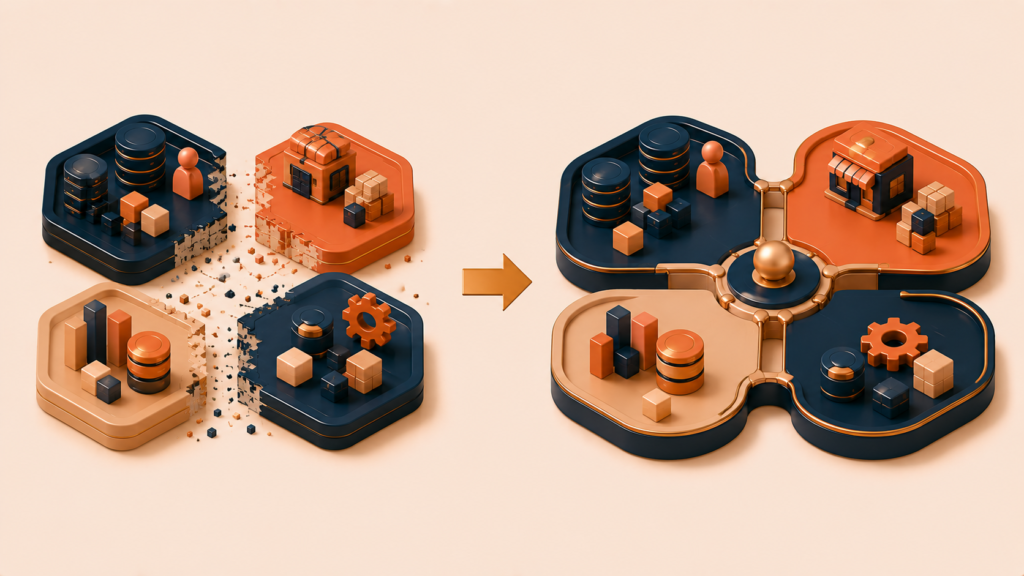
Module structure is not permanent. As a product grows, the way features cluster often shifts. A module that once had a clear identity slowly loses it. Responsibilities accumulate, ownership becomes ambiguous, and changes that should be small start to span several areas. Roadmap scoping gets harder. Estimates carry less confidence. Teams collide more often.
This is rarely because the work itself got harder. It is because the boundaries no longer match the reality the product is dealing with. Refactoring a module is the process of letting the model catch up to that reality.
Refactoring usually takes one of three shapes:
- Splitting a module that now holds two different ideas
- Merging modules that always change together
- Redrawing boundaries so a decision can become local again
None of this means the original design was wrong. It means the organization and the product have evolved. Refactoring a module is not the correction of a past mistake. It is a response to a new understanding of the domain.
The analogy is rearranging seats in an office. Early on, marketing and sales sat together because that was the natural pairing. As the company grew, sales started collaborating with customer success much more often. Moving sales next to customer success is not an admission that the original seating was a mistake. It is a response to how the work has changed. Modules behave the same way. A boundary that was right last year may need to move this year, and that movement is healthy.
Conclusion
A module is not a code structure. It is a tool that extends the team’s ability to reason about the product. A well-defined bounded context — expressed as a module — divides the domain story into chapters, keeps complexity localized, and makes ownership obvious before a decision has to be made.
When concept-based grouping, high cohesion, and low coupling are in place, modules let teams work in parallel without stepping on each other. When module relationships are explicit — upstream, downstream, shared kernel, anti-corruption layer — rules stop drifting through the product. And when boundaries no longer match the work, refactoring is not a sign of failure; it is the model catching up to reality.
The next article in this DDD series moves to Aggregates, the building block that defines consistency boundaries inside a module: how an aggregate root works, where its boundary sits, what lives inside it, and how to decide its size.
Domain-Driven Design Series
(1) Domain-Driven Design as a Product Management Framework
(2) What is a Domain Model? Definition, Quality Criteria, and Examples
(3) DDD Layered Architecture: The Role of Each Layer in Domain-Driven Design
(4) Object in DDD: Building Blocks of the Domain Model
(5) Service in DDD: When Business Logic Doesn’t Belong to a Single Entity
(6) Modules and Bounded Contexts in DDD: Structuring Domains for Scale
(7) Aggregate Root Pattern in DDD: Consistency Boundaries Explained
(8)Factory Pattern in DDD: Controlling How Aggregates Come Into Existence
(9) Repository in DDD: Pattern, Principles, and the Domain Model Checklist