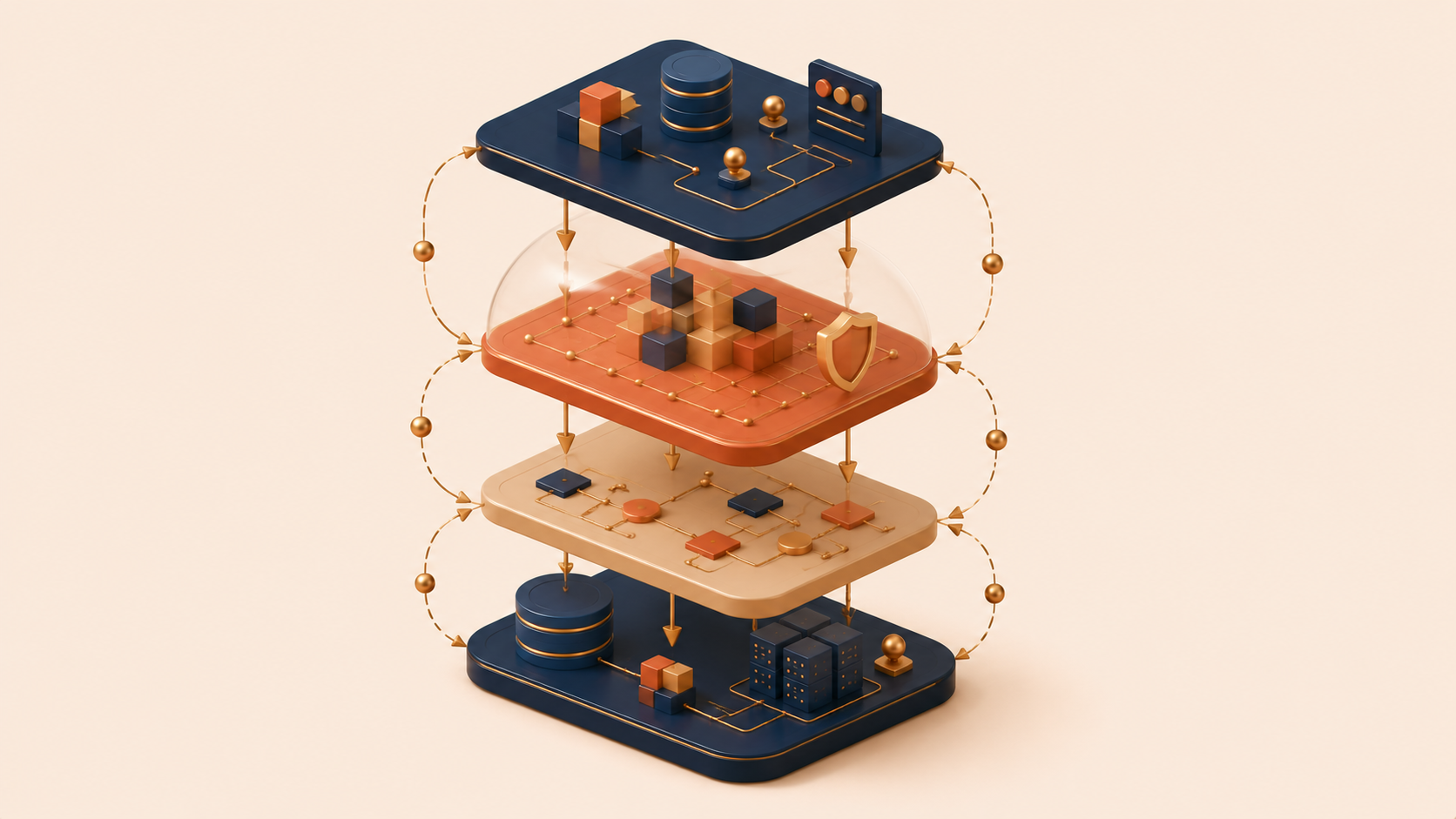
A domain model defines what the business is. The next question is where that domain logic actually lives inside the system. This is what layered architecture in Domain-Driven Design (DDD) answers.
Once a team starts working with a domain model, the question is unavoidable:
“How is all this domain logic organized, and where does it live in the system?”
DDD layered architecture answers that question by separating responsibilities so the domain stays understandable as the product grows. Products feel unstable when domain rules do not live in one place. The same rule shows up in the UI, in a controller, in a service, and in a database query — and each version drifts slightly from the others.
The core idea behind layering is separation of concerns. Instead of mixing everything together, the team splits the system into layers with distinct roles. Each layer answers a different question:
| Layer | Core Question It Answers |
|---|---|
| Presentation | How does the user interact with the system? |
| Application | Which use case is running right now? |
| Domain | What are the business rules and concepts? |
| Infrastructure | How is this supported technically? |
When these concerns get mixed in one place, small changes start breaking things they should not touch. A minor UI tweak alters a business rule. A technical convenience leaks into product behavior and changes the user experience.
A useful way to picture this is a hospital. The front desk (Presentation) talks to patients. Nurses (Application) coordinate the flow of care. Doctors (Domain) make the diagnosis and treatment decisions. The lab and pharmacy (Infrastructure) provide technical support. The system stays reliable only when each role stays in its lane. A front-desk clerk does not diagnose, and the lab does not decide a treatment plan.
What is Layered Architecture in Domain-Driven Design?

Layered architecture is the structural pattern DDD uses to keep business logic in one place over time. It is not a stack of folders. It is a contract about which kind of decision belongs where.
The four layers — Presentation, Application, Domain, and Infrastructure — each own a different question. Presentation owns how the user sees and inputs things. Application owns which steps run in which order. Domain owns the rules that define the business. Infrastructure owns the technical support that makes the system run.
The reason the layering matters is what happens when it breaks. Imagine a scheduling product where the “overlap check” rule lives partly in the form validator, partly in the API controller, and partly in a database constraint. A change to the form quietly breaks the API. A change to the database quietly changes what users can book. The “real” rule becomes hard to find because no single layer owns it.
Layering prevents that drift. When each layer answers only its own question, a UI change stays a UI change, and a rule change stays a rule change.
Presentation Layer: UX Guardrails
The Presentation layer is where users and external systems first meet the product. Screens, public APIs, admin tools, and partner interfaces all live here. What matters is not what appears in this layer, but what role it plays.
The Presentation layer has three responsibilities:
- Show the current state of the system in a way the user can understand
- Collect user input and signals
- Translate that interaction into a request the Application layer can handle
From a product management perspective, this is where user experience flows get designed, where UX trade-offs get made, and where language, affordances, and constraints get communicated to the user.
Core business rules should not be enforced here. In a scheduling product, disabling a “Book” button is a UX guardrail — it guides the user away from an invalid action. But deciding whether a booking actually violates the overlap rule belongs to the Domain layer, because that decision has to hold regardless of whether the request comes through the UI, an API, or a partner integration. When business logic moves into Presentation, the same rule gets re-implemented in several places, and the boundaries start to disagree.
A useful comparison is the front of a restaurant. A waiter can tell a guest, “This dish is unavailable because we ran out of an ingredient” — that is a UX guardrail. But the kitchen, not the waiter, decides whether a combination of ingredients carries an allergy risk and cannot be served. If the waiter starts making that call independently, the front and the back of the house end up applying different rules to the same situation.
Application Layer: Orchestrating Work
The Application layer sits between user interactions and domain logic. It does not define business rules. It coordinates how work gets done.
When a request arrives from the Presentation layer, the Application layer decides three things:
- Which domain operations to invoke
- In what order
- Inside which transaction boundary
In other words, this layer asks: “When a user books a meeting room, what actually has to happen?” “Which domain concepts does this flow touch?” “How do these steps fit together?”
One of the core principles in DDD is to keep the Application layer thin. Thin does not mean unimportant. It means this layer does not own business rules or long-lived state — it focuses on orchestration. Application services are the technical counterpart of use cases. Actions like creating a booking, canceling a booking, or rescheduling a booking each map to an application-level use case that coordinates domain behavior.
When business rules start to leak into this layer, the same logic ends up duplicated across flows. Similar actions begin to behave slightly differently, and the team loses the ability to reason about the rule from one place.
A useful comparison is the triage nurse in an emergency room. When a patient arrives, the nurse coordinates the sequence: intake, vital signs, doctor assignment. But the nurse does not decide whether a blood pressure reading is dangerous or which treatment is needed — that is the doctor’s call. When the nurse starts making those calls directly, the boundary between roles breaks, and patients get different decisions depending on who is at the desk.
Domain Layer: Business Rules That Make the Product Work
The Domain layer is where the product’s core logic lives. Entities, value objects, domain services, and invariants come together here to express how the business actually works. This layer captures:
- What the product really allows and forbids
- What has to stay consistent over time
- Why certain changes carry disproportionate cost
The reason this layer matters most is that it encodes the assumptions the business depends on. Rules like “a booking cannot be modified after it starts,” “a facilitator cannot run overlapping sessions,” or “a license belongs to a workspace, not an individual” are not implementation details. They are statements about how the business operates.
For product management, the Domain layer is the most important layer for three reasons:
- Clarifying domain rules up front reduces rework downstream
- Understanding invariants helps with sequencing the roadmap
- Clear boundaries defend against accidental scope expansion
This is the heart of the system. A useful comparison is a country’s constitution. Ordinary laws (other layers) shift with circumstances, but the constitution (the domain) is the foundation that other laws rest on. The constitution can change, but the change is deliberate and its effects ripple through everything. Domain rules work the same way: changeable, but only with full awareness of what else moves when they do.
Infrastructure Layer: The Foundation That Lets the System Run
The Infrastructure layer supports the system but does not define its meaning. Databases, external APIs, messaging systems, file storage, and third-party services all live here. These elements let the product run, but they should not decide how the business behaves.
In product management, infrastructure usually shows up as conversations about performance constraints, cost trade-offs, and reliability or scalability concerns. In DDD, the domain should not depend on infrastructure details. Ideally, the domain does not care which database stores the data or which service delivers a notification.
This separation makes several things easier:
- Evolving the product without rewriting core logic
- Swapping vendors or technology when constraints change
- Scaling the system without distorting business rules
A useful comparison is the backstage crew at a theater. The crew handles lighting, sound, and stagecraft. When they swap one lighting technology for another or upgrade the sound system, the play’s script (the domain) and its story stay the same. The audience sees the same story regardless of which technology runs behind the curtain.
Dependency Direction: How Layering Isolates Change
┌─────────────────────┐
│ Presentation Layer  │◀─ UI, API,
└──────────┬──────────┘   Controllers
           │ depends on
           ▼
┌─────────────────────┐
│ Application Layer   │◀─ Use Cases,
└──────────┬──────────┘   Orchestration
           │ depends on
           ▼
┌─────────────────────┐
│ Domain Layer        │◀─ Business Rules,
└──────────┬──────────┘   Invariants
           │ supports
┌─────────────────────┐
│ Infrastructure Layer│◀─ DB, Messaging,
└─────────────────────┘   External APIs
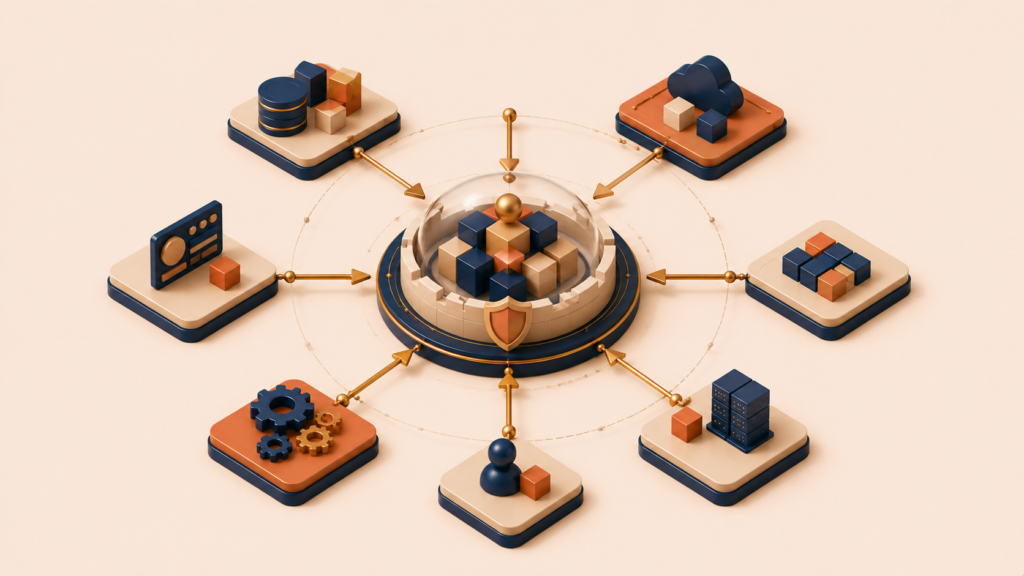
The most important rule in layered architecture is the direction of dependencies. Teams intentionally constrain dependencies so that outer layers depend on inner layers, and not the reverse. This constraint limits how far the impact of a change can spread. When dependencies flow in one direction, a change in one place cannot silently rewrite the core of the product.
Concretely, this means:
- Presentation depends on Application. A change to the UI or API can change how an action is triggered, but it does not touch the fundamental rules or the foundation of the system.
- Application depends on Domain. User flows can change without rewriting business rules.
- Infrastructure supports everything but does not leak upward. A change of database or vendor must not redefine product behavior.
When teams violate this direction, strange things start happening in the outer layers. A UI-only checker begins acting like a business rule. A database schema or query pattern starts dictating what the product can and cannot do. Over time, the “real” rules become hard to find because they are scattered across layers.
DDD is ultimately about communicating intent rather than structure. The layers are useful only to the extent that they keep each kind of decision in the place where it can be understood and changed safely.
Walkthrough: A “Book Meeting Room” Action Across Layers

A “Book Meeting Room” action shows how the layers fit together in practice. Here is what that action typically looks like as it moves through the layers.
User clicks "Book"
        │
        ▼
┌──────────────────────────────┐
│ Presentation Layer           │
│ - Collect form input         │
│ - Validate format            │
│   (required fields)          │
│ - Express intent:            │
│   "I want to book this room" │
└───────────────┬──────────────┘
                │
                ▼
┌──────────────────────────────┐
│ Application Layer            │
│ - Trigger CreateBooking      │
│ - Define execution order     │
│ - Open transaction           │
└───────────────┬──────────────┘
                │
                ▼
┌──────────────────────────────┐
│ Domain Layer                 │
│ - Enforce booking invariants │
│ - Apply TimeSlot rules       │
│ - Reject conflicts           │
│ - Decide booking validity    │
└───────────────┬──────────────┘
                │
┌──────────────────────────────┐
│ Infrastructure Layer         │
│ - Persist the booking        │
│ - Send notifications         │
│ - Integrate external systems │
└──────────────────────────────┘
What matters here is not the sequence itself but where each decision gets made:
- The early layers express intent
- The Domain layer decides truth, based on business rules
- The Infrastructure layer executes the outcome
The same flow applies whether the request comes from a web UI, a mobile app, or an API integration. The entry point changes. The core decisions do not. That stability is the practical payoff of layered architecture: the product behaves the same way regardless of how the user got in.
Conclusion
Layered architecture is not about folders or stacks. It is about keeping business rules alive in one place over time. Each layer answers a different question, and the dependency direction protects the domain from accidental change driven by UI, infrastructure, or convenience.
The next piece in this series turns to the building blocks of DDD — the difference between Entity and Value Object, and how that distinction shapes product decisions.
Domain-Driven Design Series
(1) Domain-Driven Design as a Product Management Framework
(2) What is a Domain Model? Definition, Quality Criteria, and Examples
(3) DDD Layered Architecture: The Role of Each Layer in Domain-Driven Design
(4) Object in DDD: Building Blocks of the Domain Model
(5) Service in DDD: When Business Logic Doesn’t Belong to a Single Entity
(6) Modules and Bounded Contexts in DDD: Structuring Domains for Scale
(7) Aggregate Root Pattern in DDD: Consistency Boundaries Explained
(8)Factory Pattern in DDD: Controlling How Aggregates Come Into Existence
(9) Repository in DDD: Pattern, Principles, and the Domain Model Checklist