
In most products, a single user action rarely changes just one thing. Consider a hiring platform: when an application moves to the INTERVIEW stage, two changes usually happen together — the application status updates, and an interview slot gets assigned. These changes only make sense as a pair. A status of “interview” with no interview time feels broken to the user. An interview time attached to an application still marked “screening” feels equally wrong.
This is the problem the aggregate root pattern solves. An aggregate is a set of objects that must always be checked and changed together, with a single entity (the root) controlling access. Think of it as a pre-flight checklist on an aircraft: fuel check, engine status, crew assignment, runway clearance — all must pass before takeoff. “Fuel is ready, so let’s take off and verify the crew later” is not allowed. If any item fails, the entire takeoff is aborted.
The sections that follow define aggregates in domain-driven design, explain how root, boundary, and internal objects relate, lay out the six rules for designing aggregates, and trace how multiple aggregates emerge as products grow. Two extended examples — a travel itinerary planner, then the same planner once booking and payment enter the picture — show the pattern in practice.
What is an Aggregate in DDD: Things That Must Be True Together

An aggregate is a cluster of domain objects that the system checks and changes as a single unit. All related rules pass, and the change succeeds. One rule fails, and the system applies nothing. There is no in-between state.
The phrase to hold onto is “things that must be true together.” In the hiring platform example, “application status = INTERVIEW” and “interview slot assigned” must be true together. Treating them as separate updates leaves the door open to states that look reasonable in isolation but make no sense as a pair.
Inside an aggregate, changes are handled all-or-nothing:
- If every invariant holds after the change, the system commits it.
- If any invariant fails, the system rejects the whole change and leaves the prior state intact.
The pre-flight checklist analogy travels well here. The checklist is not a list of suggestions; it is the boundary of what must be true before the next state (“airborne”) is allowed. The same logic applies to product state transitions that users can see.
This reframes the aggregate. It is not a technical container for related objects, and it is not a database table. It is a decision boundary: a place where the product declares which combinations of facts are allowed to exist together and which are not.
Aggregate Root, Boundary, and Internal Objects: Who Can Change What

Every aggregate has three parts. Each part exists for a specific reason.
| Component | Definition | Why it exists |
|---|---|---|
| Aggregate root | The main entity exposed to the outside | Ensures all rules are enforced in one place |
| Boundary | The conceptual perimeter around the aggregate | Defines what must stay consistent together |
| Internal objects | Entities or value objects inside the boundary | Prevents external code from bypassing rules |
Aggregate root: the single entry point
The aggregate root is the main entity exposed to the outside world. It is the only object other parts of the system are allowed to reach for, and every change passes through it.
When another part of the system wants to modify something inside, it cannot update the internal pieces directly. It has to ask the root. This gives the product a single point that can say “yes” or “no” to a proposed change. Without this single point, the same validation logic would have to live in every caller — and the day someone forgets one of those calls is the day the invariants quietly break.
Boundary: the scope of simultaneous truth
The boundary defines the scope of what must be true at the same moment. Everything inside the boundary is assumed to change together. If one part inside is invalid, the whole change is rejected.
The job of the boundary is to block states that look fine piece by piece but are nonsense in combination. The interview-without-a-time and time-without-the-interview-state pair earlier are exactly this kind of nonsense. The boundary is what gives the team a place to put those combination rules.
Internal objects: supporting the aggregate’s behavior
Internal objects exist to support the aggregate’s behavior, not to be managed independently. They can have their own structure and rules, but they are not updated on their own.
The risk of allowing direct updates to internal objects is concrete: external code can skip important validation, and the product ends up in a broken state with no visible cause. The single entry point through the root prevents this. Internal objects can be rich and complex on the inside; what matters is that the rest of the system cannot reach in and rearrange them.
Taken together, this is what makes an aggregate a decision boundary rather than a technical container. The root decides, the boundary defines what counts as one consistent state, and the internal objects do their work without leaking control to the outside.
Six Rules for Designing Aggregates
Six rules guide aggregate design. Each rule maps to a specific failure mode it prevents.
| Rule | What it means | Why it matters |
|---|---|---|
| Invariant protection | Every rule that must always hold is enforced inside the aggregate | Prevents invalid states from entering the system |
| External access restriction | Outside code can only reach the aggregate root | Blocks the bypassing of rules |
| Identity scope | Only the root has a global identity; internal objects do not | Keeps boundaries clear and reduces coupling |
| Delete as a unit | Deleting the root removes the entire aggregate | Prevents orphaned or meaningless data |
| One transaction, one aggregate | A single transaction modifies only one aggregate | Makes the cost of consistency explicit |
| Reference roots only | An aggregate refers only to the roots of other aggregates | Prevents hidden cross-boundary dependencies |
A few notes on how these rules tend to play out in practice:
- Invariant protection and external access restriction work together. The rules live in one place because the only door into that place is the root.
- The one transaction, one aggregate rule is the one teams resist most often, because it forces them to confront which consistency they actually need. Crossing transactions across aggregates feels easier in the short term and almost always causes pain later.
- Reference roots only keeps aggregates loosely coupled. If aggregate A holds a pointer to an internal object inside aggregate B, the boundary of B has effectively leaked, and the rules of B are now harder to enforce.
These rules are not arbitrary. Each one removes a class of bugs that is hard to detect and harder to undo.
Example: A Travel Planner’s Itinerary Aggregate

Picture a personal travel itinerary planner — a product for planning multi-day trips. In this product:
- An itinerary is created and owned by a single user or team
- All planning happens inside one itinerary
- Trips are not shared, reused, or managed across itineraries
- Travelers, segments, and dates only have meaning in the context of that itinerary
- There is no need to track “which traveler booked the most hotels across all trips”
- Segment history and changes are not tracked independently; only the current itinerary state matters
- Travelers are not shared or referenced across multiple itineraries
- Two segments with the same date and location are treated as interchangeable
In other words, this product does not treat travelers, segments, and dates as independent objects. Everything belongs to the scope of “this trip.”
Itinerary as an Aggregate
At the center sits the Itinerary. An itinerary is not a simple list of dates; it is a plan that has to make sense as a whole. That makes it a strong candidate for an aggregate.
Itinerary Aggregate
─────────────────────

┌──────────────────────────────────────────┐
│   Itinerary (Aggregate Root, Entity)     │
│------------------------------------------│
│ Identifier: itineraryId                  │
│                                          │
│ Invariants:                              │
│ - Segments fit within the trip dates     │
│ - Total duration is always computable    │
│ - Traveler changes keep the plan valid   │
└───────────────┬──────────────────────────┘
                │ owns
        ┌───────┼───────────────┐
        ▼                       ▼
┌──────────────────┐   ┌──────────────────┐
│ TripSegment      │   │ TravelerDetails  │
│ (Value Object)   │   │ (Value Object)   │
│------------------│   │------------------│
│ dateRange        │   │ traveler info    │
│ location         │   │ preferences      │
└──────────┬───────┘   └──────────────────┘
           │ uses
           ▼
┌──────────────────┐
│ DateRange        │
│ (Value Object)   │
│------------------│
│ startDate        │
│ endDate          │
└──────────────────┘
Itinerary itself is the aggregate root. From the product’s perspective, it is what the user thinks of as “my trip.” All meaningful changes flow through it:
- The user creates an itinerary
- The user adds or removes segments
- The user invites or removes travelers
- The user views the itinerary as a single, coherent plan
There is no concept of editing a segment or a traveler independently of the itinerary they belong to. TripSegment and TravelerDetails are modeled as value objects because they have no identity outside this itinerary; two segments with the same date and place are interchangeable, and the same is true of traveler details.
The three invariants on the root — segments fit the trip dates, total duration is always computable, traveler changes keep the plan valid — capture what “this itinerary is in a valid state” means for the product. Any change that violates any of them is rejected as a whole.
How to Size an Aggregate: The Smallest Set That Must Stay Consistent
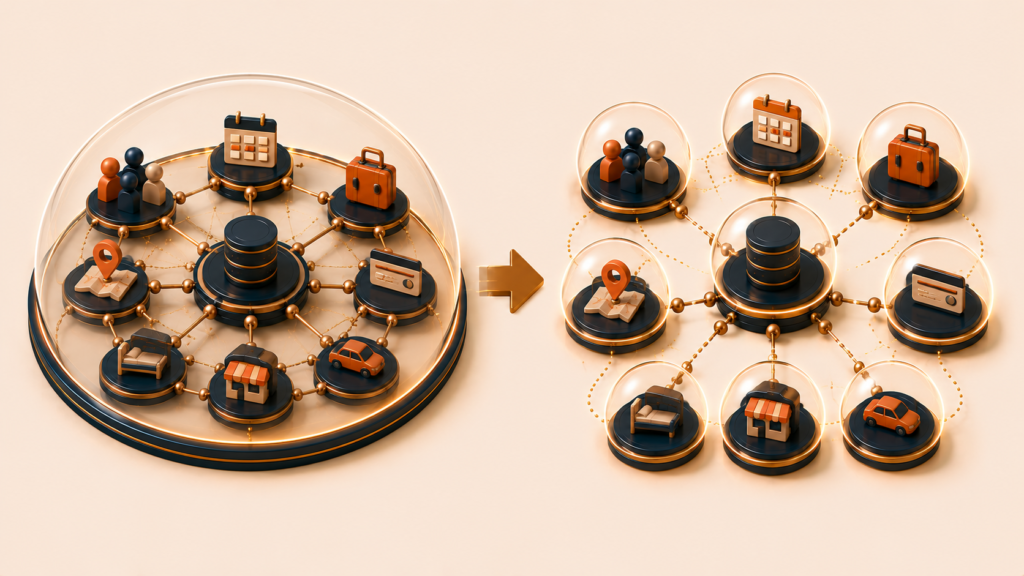
The general rule is to keep aggregates small. Large aggregates carry real trade-offs: more coupling, more contention for resources, and higher cost per transaction.
Four questions help when deciding the size:
| Question | What it reveals |
|---|---|
| Do these things always change together? | If not, they probably do not belong together |
| What breaks if they fall out of sync, even briefly? | An immediate breakage suggests one aggregate |
| Does the user notice right away? | User-visible inconsistency raises the stakes |
| Is coordination becoming expensive? | The aggregate may be too large |
The “right” size is the smallest set of objects that must change together to keep the domain rules valid. Anything larger than that, and the cost of coupling, contention, and coordination starts to climb without buying additional correctness.
In practice, teams often start too large. A common pattern is to merge several aggregates into one because the early version of the product happened to change them together. Once the product grows, those forced couplings turn into the slowest, most contended parts of the system. Starting small and merging when evidence demands it is safer than starting large and trying to split later.
Aggregate vs Module: Consistency vs Organization

At first, aggregates can look like modules. Both group related concepts, draw boundaries, and reduce complexity. Their reasons for existing, though, are very different.
| Dimension | Module | Aggregate |
|---|---|---|
| Primary purpose | Organize code and responsibility | Protect consistency rules |
| Meaning of boundary | Ownership and structure | What must be correct together |
| Transaction scope | Can span multiple modules | Limited to one aggregate |
| Failure impact | Usually technical | User-visible product inconsistency |
| Reason to change | Maintainability | Keeping the product working in use |
A module answers the question: “Where should this logic live?”
An aggregate answers a different question: “Which changes must succeed together or fail together?”
This distinction matters from a product perspective because aggregates turn consistency into an explicit product decision. Modules are about how the team works on the code; aggregates are about what the product promises to users. Drawing aggregate boundaries forces the team to choose where the product needs immediate correctness and where it can tolerate delay — and that choice belongs to the product, not to the architecture.
For a deeper look at the module side of this comparison, see the prior post on DDD modules.
Why Multiple Aggregates Emerge: Different Kinds of Product Promises
Multiple aggregates appear when a product starts making different kinds of promises at the same time:
- Some promises are about a plan
- Some are about ownership
- Some are about money
- Some are about a long-term record
Trying to enforce all of these inside one aggregate creates conflict and tension. The plan wants flexibility; the money wants strict accuracy; the record wants permanence. One boundary cannot honor all of these well at once.
A few questions usually surface once a system has crossed into multiple-aggregate territory:
- “What if this part succeeds but that part fails?”
- “Can this be retried on its own?”
- “If we delete this, does everything really go away?”
When these questions start sounding routine, the team is already dealing with multiple aggregates, whether the code has caught up to that fact or not. Each aggregate exists to protect one core set of invariants, and no single boundary can realistically contain all of them without becoming fragile.
Example: Itinerary vs Booking vs Payment (Events and Async Reality)

Imagine the same travel planner growing up. The first version only plans trips. Later, actual bookings and payments are added. At that point, the domain changes fundamentally.
Once bookings and payments enter the picture, several realities appear:
- A booking may sit outside the trip’s date window
- A payment can fail, be retried, or be refunded
- A booking can be cancelled days later
- Financial records must stay accurate even when the plan changes
Plan and execution are no longer the same thing. Here, multiple aggregates become necessary.
Three aggregates emerge:
| Aggregate | What it represents | What must always be true |
|---|---|---|
| Itinerary | The user’s trip plan | The plan makes sense as a whole |
| Booking | A real-world reservation | The status reflects the external commitment |
| Payment | A movement of money | No double-charges, no missed refunds |
A typical flow looks like this:
- The user edits the itinerary → the Itinerary aggregate updates (planning rules are validated and the change is saved atomically)
- The user confirms a segment → a Booking aggregate is created (initial state:
PENDING_PAYMENT) - The user proceeds to pay → the Payment aggregate attempts the charge asynchronously
- Payment succeeds → a payment-succeeded event is published
- Booking reacts to the payment result → the Booking aggregate updates its own state to
CONFIRMED - The user reopens the itinerary → the Itinerary reflects the updated booking status
Multiple Aggregates
At no point does one aggregate directly modify the internals of another. Each aggregate changes inside its own transaction, and they coordinate through references and events rather than shared state. The Booking does not reach into the Payment to flip its status; it listens for the Payment’s event and updates itself.
Multiple Aggregates
─────────────────

┌──────────────────────────────────────────┐
│     Itinerary (Aggregate Root)           │
│------------------------------------------│
│ Identifier: itineraryId                  │
│                                          │
│ Invariants:                              │
│ - Segments fit the trip dates            │
│ - The plan stays internally consistent   │
└───────────────┬──────────────────────────┘
                │ references
                ▼
┌──────────────────────────────────────────┐
│     Booking (Aggregate Root)             │
│------------------------------------------│
│ Identifier: bookingId                    │
│                                          │
│ Invariants:                              │
│ - Status reflects the provider's status  │
│ - Cancellation rules are enforced        │
└───────────────┬──────────────────────────┘
                │ depends on
                ▼
┌──────────────────────────────────────────┐
│     Payment (Aggregate Root)             │
│------------------------------------------│
│ Identifier: paymentId                    │
│                                          │
│ Invariants:                              │
│ - Charged exactly once                   │
│ - Refunded exactly when owed             │
└──────────────────────────────────────────┘
Each aggregate protects different invariants, and the cost of failure is different in each. A planning error frustrates the user but is easy to recover. A booking status that lies about an external reservation causes a real-world failure. A payment that charges twice — or refunds the wrong amount — is the kind of failure that costs money and trust. Putting all three under one boundary would force the loosest invariant (planning flexibility) and the strictest (financial accuracy) into the same set of rules, and one of them would have to give.
This is what “different kinds of product promises” looks like in code. Three aggregates, three sets of invariants, coordinated through events instead of forced into one transaction.
Conclusion
The aggregate root pattern is less about object modeling and more about making consistency an explicit product decision. The root names a single entry point. The boundary names what must stay true together. The internal objects do their work without leaking control. The six rules — invariant protection, external access restriction, identity scope, delete as a unit, one transaction per aggregate, and reference roots only — exist to prevent specific failures that hurt user trust.
The travel planner shows both sides of the pattern. In a single-aggregate world, the Itinerary holds the plan together as one valid whole. Once the product makes additional promises about real reservations and money, three aggregates emerge, each protecting its own invariants and coordinating through events. Drawing the right aggregate boundaries lets a product hold these very different promises at the same time without quietly drifting into invalid states.
The next post in this series covers the Factory — how objects are created in a way that respects domain rules from the very first moment they exist. Later posts then look at the Repository, which manages access to existing objects.
Domain-Driven Design Series
(1) Domain-Driven Design as a Product Management Framework
(2) What is a Domain Model? Definition, Quality Criteria, and Examples
(3) DDD Layered Architecture: The Role of Each Layer in Domain-Driven Design
(4) Object in DDD: Building Blocks of the Domain Model
(5) Service in DDD: When Business Logic Doesn’t Belong to a Single Entity
(6) Modules and Bounded Contexts in DDD: Structuring Domains for Scale
(7) Aggregate Root Pattern in DDD: Consistency Boundaries Explained
(8)Factory Pattern in DDD: Controlling How Aggregates Come Into Existence
(9) Repository in DDD: Pattern, Principles, and the Domain Model Checklist