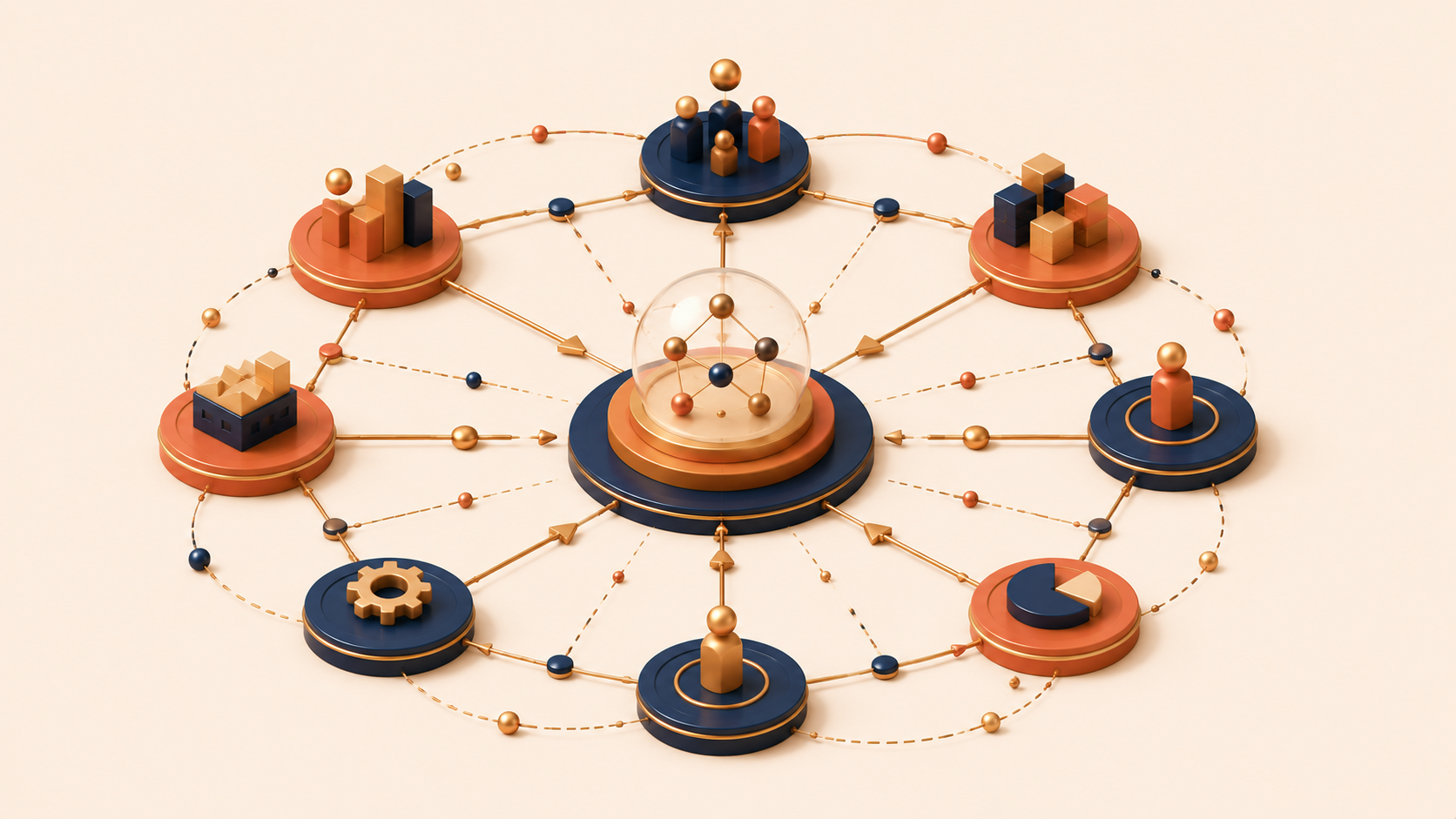
When teams first hear the term “domain model,” they tend to picture an artifact: a diagram of boxes and arrows, a UML chart, or a set of classes in code. These artifacts can be useful in practice, but they are not the domain model itself. They are only the ways a domain model gets expressed.
A domain model is something more fundamental. It is the shared understanding a team holds about the user’s world — what exists in that world, how those things relate, and what rules govern their behavior. This is the framing at the heart of Domain-Driven Design: the model is not a picture of the domain. It is how the team thinks about the domain, the language the team uses to talk about it, and the structure of the team’s improving understanding.
The sections below define what a domain model actually is (and is not), how it differs from diagrams and code, the principles that keep relationships clean, the criteria for a good domain model, the product manager’s role in shaping it, and a worked example for a meeting room booking product.
What is a Domain Model (and What it is Not)

A domain model is a structured way to represent knowledge about user activity. More concretely, it captures three things:
- A shared understanding of what exists in the user’s world
- How those things relate to each other
- Which rules govern their behavior
A domain model abstracts the user’s context. It does not specify the implementation. Consider a product that helps teams plan workshops. Users will talk about things like workshop sessions, facilitators, time slots, agendas, participants, and constraints such as room capacity or overlapping sessions.
A good domain model takes that messy reality and turns it into a coherent conceptual system by working through questions like:
- What is a session, and what makes a session valid?
- Can a facilitator run two sessions at the same time?
- Is the agenda a fixed plan, or can it change?
- When does a participant become “confirmed”?
None of this requires UI decisions or database tables yet. But without answers to these questions, any implementation will be built on guesswork.
A useful way to think about a domain model is as the rulebook for a board game. In chess, “the king moves one square, the queen moves any number of squares in any direction” is what makes the game playable. Without a rulebook, every player invents their own rules and the game falls apart. A domain model is the same kind of rulebook — a clear definition of the core concepts and rules that make a product coherent.
Domain Model vs Diagram vs Code: Where the Real Model Lives
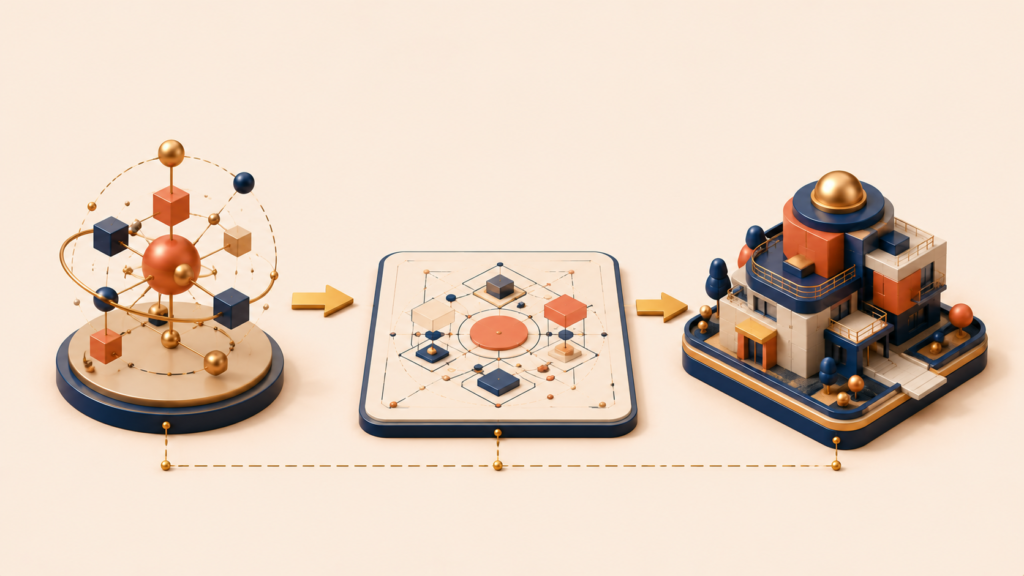
Some teams argue that the artifact itself — the diagram, the code — is the team’s understanding of the product. It is not. The artifact is downstream of the model.
- A diagram is a snapshot of how the team currently understands the domain.
- Code is one concrete expression of that understanding.
- The domain model is more foundational than either, and it keeps evolving as the team learns.
This is why a team can produce a beautifully drawn diagram and still ship a product that confuses users and developers alike. The diagram was clean, but the model behind it never defined the right goals.
Think of an architect designing an office building. The architect holds a design intent — “an office with strong natural light and efficient circulation.” That intent is the domain model. The blueprint is the diagram, a flat representation of the intent. The finished building is the code, the concrete implementation. A pretty blueprint cannot rescue a flawed design intent. The same is true for software: if the model is wrong, the diagrams and the code will be wrong too.
Designing Domain Relationships: Direction, Qualifiers, and Pruning
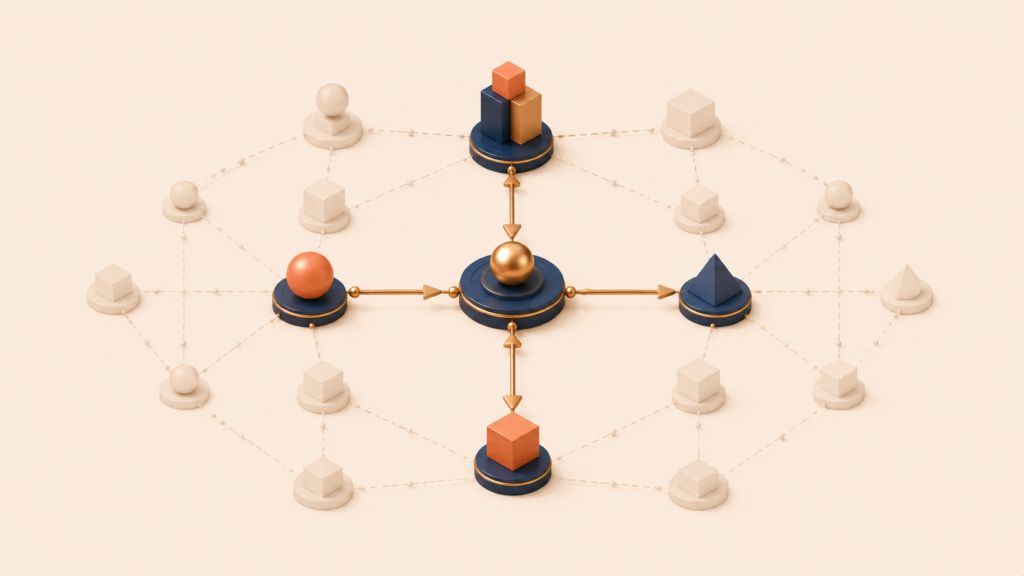
Three principles keep the model manageable as the team adds concepts and connections.
Give Relationships Direction
Default to one-way relationships. One object knows about another, but the reverse does not need to hold. This reduces conceptual coupling and makes ownership and the impact of change much easier to reason about. When everything knows about everything, every change touches everything.
Use Qualifiers to Add Context
A qualifier narrows a relationship by adding context — a date, a role, a state. What would otherwise become a vague one-to-many relationship turns into a precise domain rule with a clear access pattern. “Users have orders” becomes “users have current orders” or “users have orders for this quarter,” and the relationship becomes precise.
Remove Non-Essential Relationships
Cut connections that are not required for any behavior or decision the system actually performs. The model stays small, flexible, and easy to extend. Every relationship you keep is a relationship the team has to maintain as the model grows.
All three principles point in the same direction: keep the domain model easy to understand even as it grows. Instead of adding more structure, deliberately remove or constrain relationships so that only the connections central to behavior remain.
A helpful analogy is organizing how teams communicate inside a company. If every department talks directly to every other department, the result is noise. When the flow is explicit — “marketing hands leads to sales, sales hands customer information to CS” — direction is clear. Remove unnecessary lines and add context (qualifiers) only where needed, and the organization scales without losing clarity.
Criteria of a Good Domain Model: Explainability, Collaboration, Iteration
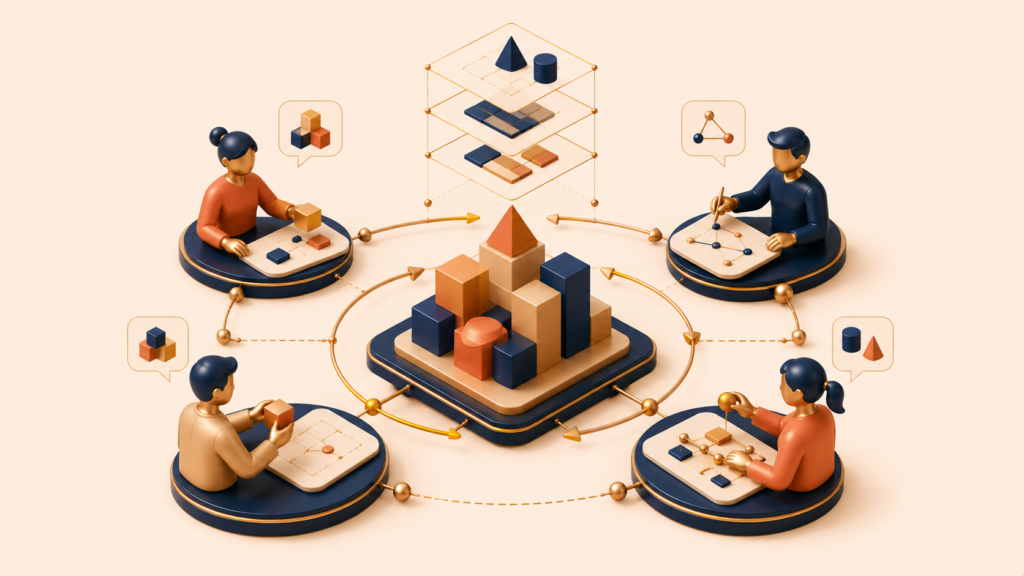
A domain model should be judged by how well it produces shared understanding and good decisions. Three traits distinguish a strong model from a weak one.
Naming is Not Enough — You Must Explain the Concept
Naming things is easy. Explaining them is hard.
A weak domain model says: “There is a Session object.”
A strong model can explain what a session actually means in this product. For a workshop scheduling product, a strong model can answer all of the following with confidence:
- When does a session start and end? A session starts when the facilitator joins. Putting it on a calendar is not enough.
- What can the team change before a session starts? The team can change the time and the facilitator before the session starts. Once the session is running, neither can change.
- What rules must always hold, even as the system grows? A facilitator can never run overlapping sessions, regardless of what new features get added.
If team members give different answers to “what is a session?”, the model is not ready yet. The label exists, but the team has not agreed on the concept underneath.
Build Models Through Collaboration, Not Collection
A strong domain model does not come from one person “gathering requirements.” It comes from an active exchange:
- The domain expert explains how they think and how they act
- The product manager asks the “why” and “what if” questions that force precision
- The developer pushes back on edge cases and constraints
This back-and-forth forces everyone’s thinking to sharpen. Even domain experts often discover their own hidden assumptions only when forced to explain them clearly to someone else. The friction is the point.
Evolve the Model Through Iteration, Not One-Time Capture
A weak domain model collapses the first time it meets reality. A strong model starts with a small but solid core, shaped by deep conversations with domain experts and users:
- A handful of core concepts grounded in real user work
- Clear ownership of responsibility
- Explicit rules that reflect how the business actually operates
The team then evolves the model by putting it to work on real product decisions. A typical cycle looks like this:
- Work closely with domain experts and users to define a small set of core concepts and rules
- Use that core in real feature and design discussions
- Watch for points where the explanation breaks down or feels forced
- Refine the language, boundaries, and responsibilities
- Iterate, without losing the original core
Iteration here is not endless rework. It is testing initial assumptions against real use. The goal is not to predict everything upfront. The goal is to build a model that holds its clarity as the product evolves and absorbs change without breaking.
The Product Manager’s Role in Domain Modeling
Product managers do not write the code, but they shape the domain model in ways that engineers alone cannot. Two practical touchpoints matter most.
Writing PRDs that Reveal Structure, Not Just Scope
A good product requirements document goes beyond listing features. It does three things:
- Defines core terms explicitly
- Distinguishes which rules are strict and which are flexible
- States invariants — the things that must always be true
For a workshop product, statements like these do more work than a long feature list:
- “Once a session starts, the team keeps the confirmed participants.”
- “Until publication, the team can freely change the agenda.”
When the team gets to technical architecture decisions, these sentences anchor the conversation. A feature list answers what to build. An invariant answers what must never break.
Stakeholder Communication: From Opinion Clash to Structural Discussion
When stakeholders disagree, the disagreement is often not about priorities. It is about mental models — different people are working from different definitions of the same word.
Domain language gives the product manager a way to surface that gap. Useful questions include:
- “Are we disagreeing about behavior, or about the definition?”
- “Does this rule apply to all ‘sessions,’ or only ‘internal workshops’?”
This shifts the conversation from opinion clash to structural discussion. The product manager becomes a translator between user reality and system reality. Building a domain model is where that translation becomes explicit.
Example: Domain Model for an Internal Meeting Room Booking Product
Consider an internal meeting room booking product. The core domain concepts might be:
- Room
- Booking
- Time Slot
- Organizer
A good domain model can answer questions like:
- Does a Booking require both a Room and a Time Slot, or can a Booking exist before a room is assigned?
- Can the same Organizer create overlapping bookings in different rooms?
- Is a Time Slot just a start and end time, or does it also include recurrence rules?
Working through these questions produces concrete rules:
- A Booking is not valid without a valid Time Slot
- A Time Slot is valid only when its start time precedes its end time
- A Booking references other concepts by ID, to avoid tight coupling
The resulting model can be sketched like this:
Core Concepts
─────────────

Room (entity)   Organizer (entity)
     │                │
     │ referenced by  │ referenced by
     ▼                ▼
┌─────────────────────────────────┐
│ Booking (entity)                │
│---------------------------------│
│ Identifier: bookingId           │
│                                 │
│ Fields:                         │
│ - roomId        → refs Room     │
│ - organizerId   → refs Organizer│
│ - timeSlot (value object)       │
│                  → must be valid│
└────────────────┬────────────────┘
                 │ contains
                 ▼
┌─────────────────────────────────┐
│ TimeSlot (value object)         │
│---------------------------------│
│ Fields:                         │
│ - startTime                     │
│ - endTime                       │
│ Invariant:                      │
│ startTime < endTime             │
└─────────────────────────────────┘
When the rules in the domain model are clear, implementation choices get constrained in the right direction. The team is not picking patterns at random; they are picking patterns that satisfy the model’s invariants. That is when the model starts paying for itself.
Conclusion
A domain model is not an artifact. It is the evolving conceptual backbone of a team’s shared understanding of the user’s world. Diagrams and code are how that understanding gets expressed at a given moment, but the model itself lives in the team’s language, definitions, and rules — and it keeps changing as the team learns.
The strongest models are explainable, built through collaboration rather than collection, and refined through iteration against real product decisions. Product managers shape these models by writing PRDs that reveal structure, defining invariants, and translating between user reality and system reality during stakeholder discussions.
The next article in this series looks at how a domain model actually shapes code through the layered architecture of Domain-Driven Design, and what role each layer plays.
Domain-Driven Design Series
(1) Domain-Driven Design as a Product Management Framework
(2) What is a Domain Model? Definition, Quality Criteria, and Examples
(3) DDD Layered Architecture: The Role of Each Layer in Domain-Driven Design
(4) Object in DDD: Building Blocks of the Domain Model
(5) Service in DDD: When Business Logic Doesn’t Belong to a Single Entity
(6) Modules and Bounded Contexts in DDD: Structuring Domains for Scale
(7) Aggregate Root Pattern in DDD: Consistency Boundaries Explained
(8)Factory Pattern in DDD: Controlling How Aggregates Come Into Existence
(9) Repository in DDD: Pattern, Principles, and the Domain Model Checklist