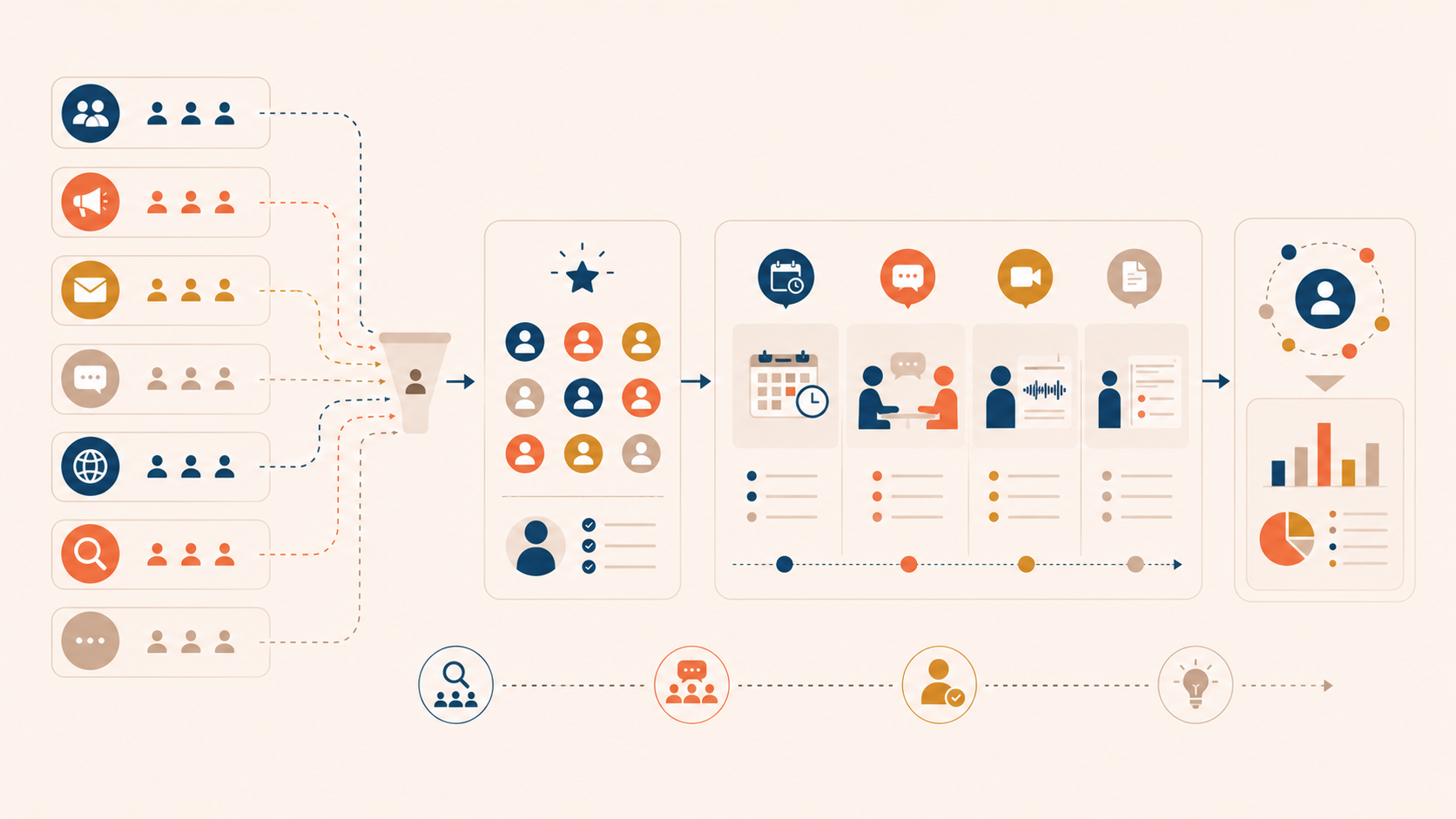
In the previous post, we covered a 3-step question framework and a ready-to-use question library. But even the sharpest questions fail when you ask the wrong people. A well-crafted interview guide cannot save a study that talks to users who don’t actually feel the problem, don’t use the product deeply, or only show up for the incentive.
This guide solves the two problems that sit upstream of every customer interview: where to find the right interviewees, and how to write outreach messages that get responses. The first half walks through internal and external recruitment channels, and a 4-dimensional framework for spotting true power users (not just users who log in often). The second half breaks down the outreach message — the four principles, the five essential elements, a ready-to-use template, and the five mistakes that quietly kill response rates.
Done well, user research recruitment shifts from a frantic, ad-hoc scramble into a repeatable process. Response rates move from single digits to 30% or higher. And the user interview techniques you’ve learned start delivering the depth they’re built for.
Where to Find Customers to Interview: Internal and External Channels
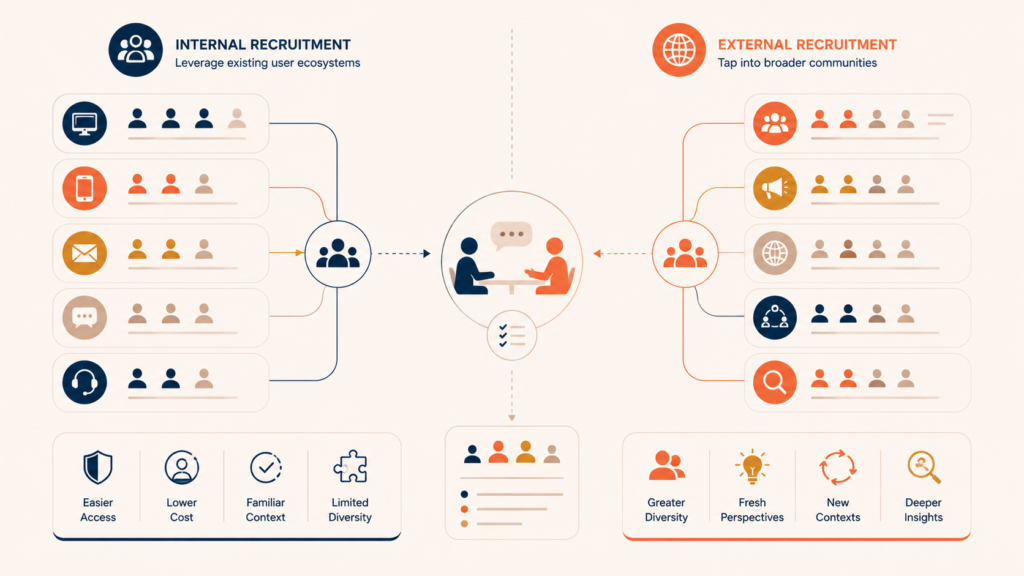
A good question asked of the wrong person teaches you nothing. Before you write a single outreach message, decide where you are sourcing candidates. The cleanest split is between internal channels (people already using your product) and external channels (prospective users who don’t know you yet).
Internal Channels: Tapping Your Current Users
Your existing users are the easiest place to start, because they already have context, opinions, and a reason to talk to you. Three internal channels consistently produce strong candidates.
Support tickets, chat logs, and email. Filter conversations for users who match what you are studying. Look for three signals: users asking about features in the area you are currently focused on, users reporting the exact problem you are investigating, and users who are visibly engaged with the product (long threads, multiple replies, detailed feedback).
Social media mentions. Search Twitter, LinkedIn, and Instagram for tags and mentions of your product. Users who voluntarily write reviews or blog posts about you are signaling deep interest. The same goes for active participants in your community forum or Slack group.
Power users. Define what “power user” means for your product, then track them in your analytics tool. The definition depends on the product:
- E-commerce: customers who have made 5 or more purchases
- SaaS: users who log in daily or use advanced features
- Media: users with sessions longer than 30 minutes
Sourcing interviews from internal channels is like recognizing the regulars at a favorite local shop. The customer who shows up every day, the one who complains but keeps coming back, the one who tags the shop on social media — they all have deeper interest than walk-ins. They respond to interview invitations at higher rates, and the insights they share have more texture.
External Channels: Reaching Prospective Users
Internal channels work for current users, but they cannot tell you what non-users think — including the people who tried a competitor, who never converted, or who don’t know your product exists. For that, you need external channels.
LinkedIn. Search by combinations of job title, industry, and skills tied to the problem area:
- Job title plus context (for example, “Product Manager” + “SaaS”)
- Industry plus location (for example, “restaurant operator” + a target city)
- Skills or interests that signal the problem you are studying
Send a connection request with a short, personalized note rather than the default invite.
Reddit and online communities. Find the subreddits and forums where your target users gather. Look for people who ask questions about the problem area, and contributors who consistently demonstrate expertise. Direct messages and comment threads both work as outreach paths.
Competitor channels. Read the reviews, social mentions, and community discussions around competing products. Users who write frequent reviews or comment actively are easy to recruit. Users who express unmet needs or frustration are even more valuable, because they have already articulated the gap you might solve. Reach out with genuine curiosity about their experience, not a pitch.
Picking an external channel is like picking where to fish. You don’t cast a line into any river — you go where the fish you want actually live. LinkedIn is the lake where professionals gather. Reddit is the valley where people with specific interests cluster. Competitor channels are where people already wrestling with the problem have congregated, which makes them especially high-signal for interviews.
The 4-Dimensional Framework for Identifying True Power Users
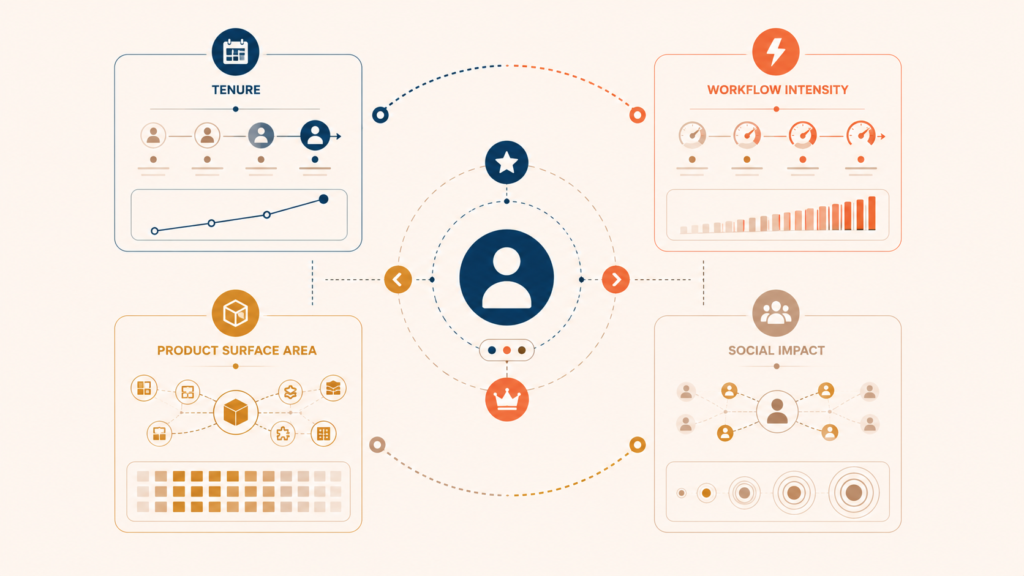
Not every “active user” is a high-value interview target. Login frequency alone cannot tell you who feels the problem most acutely. The people you want are the ones with deep exposure to your core workflow — the users who hit the limits, friction, and edge cases that reveal where the product actually breaks. Define power users by behavioral depth, not surface activity. Four dimensions are worth evaluating.
Dimension 1: Tenure. Has the user been around long enough to encounter real constraints?
- Time elapsed since signup
- Number of meaningful sessions
- Exposure to varied usage cycles
Dimension 2: Workflow Intensity. Does the user actually depend on the product for real work?
- Count of active items, tasks, or records
- Frequency of core actions
- Use during critical moments (deadlines, peak hours)
Dimension 3: Product Surface Area. Has the user explored beyond the default path?
- Use of advanced or non-mainstream features
- Settings, customization, environment changes
- Integration with other tools or data sources
Dimension 4: Social/Organizational Impact. Does the user’s behavior affect other people?
- Invites collaborators
- Distributes work or shares output
- Acts as a decision-maker or gatekeeper
No single dimension is enough. A strong interview candidate usually scores high on at least two or three of the four.
Turning Dimensions into Trackable Rules
Translate each dimension into explicit, trackable criteria that match your product. Then document these rules and track them in your analytics or CRM tool. Recruitment stops being improvisational and becomes a repeatable process.
For a project management tool, the rules might be:
- Active for 60 days or more
- Managing 3 or more projects concurrently
- Has invited at least 2 team members
- Uses 5 or more distinct features
For a fitness app, the rules might be:
- Logs workouts 3 or more times per week
- Has used the app for 90 days or more
- Has completed at least one program
- Participates in community features
Identifying power users is like finding the soloist in an orchestra. If you only look at attendance (login frequency), the player who shows up every day looks like the best candidate. The real soloist, though, is the one who takes on the hard parts (workflow intensity), plays across genres (product surface area), influences the other sections (social impact), and has years of experience (tenure). You only see the true power user when you look across all four dimensions together.
How to Write Outreach Messages That Get Responses
Response rates to cold interview requests swing wildly based on how the message is written — from single digits to 30% or more. Most outreach fails for the same three reasons: it is too long, too vague, or too salesy. The fix is structural, not stylistic.
4 Core Principles of Effective Outreach
Four principles separate outreach that gets read from outreach that gets deleted.
Keep it short. Nobody reads long emails from strangers. Cap your message at four to seven sentences. If it doesn’t fit on a single phone screen, it is already too long.
Personalize it. Copy-pasted generic messages get ignored. Show that you did basic research on the recipient — mention something specific about them, explain how you found them, and connect their background to your reason for reaching out.
Communicate value. Make it clear why 30 minutes of their time is worth it. The recipient should be able to see three things: you are working on a real problem they care about, their specific expertise is what makes them valuable, and you are there to learn — not to sell.
Make it clear this isn’t a sales pitch. People are exhausted by sales outreach. Eliminate that suspicion in the opening lines, not at the end.
The 5 Essential Elements of an Outreach Message
An effective outreach message contains five elements, in order. Each one answers a specific question the reader is silently asking.
Element 1: Start with a shared outcome (why this exists). Express your mission in half a sentence. This builds common ground and signals that you are not just shipping another app.
Structure: “We are helping [target customer] achieve [desired outcome].”
Element 2: Reveal your current position (why now). Describe where you are in the journey and what you are trying to figure out. This gives the recipient a sense of how they can contribute.
Structure: “We are currently at [stage], trying to understand [specific goal].”
Element 3: Describe the gap you can’t fill alone (what’s blocked). Be specific about where you are stuck. Honesty here makes the ask credible, and it tells the recipient exactly what kind of help you need.
Structure: “We have tried [what you tried] and are struggling with [specific obstacle].”
Element 4: Explain why this person specifically (why you matter). Tell the recipient why their particular background makes them the right person to ask. This signals respect, and it makes the conversation feel meaningful rather than transactional.
Structure: “Given your experience with [specific background], I think you could help with [specific way].”
Element 5: Make a clear, low-friction ask (what to do). Specify the time commitment and the request. No vague invitations to “chat sometime.”
Structure: “Would you be open to [specific time] for [specific request]?”
A Ready-to-Use Outreach Email Template
Here is a template that puts all five elements together. The {{variables}} are placeholders to fill in for each recipient.
Subject: A quick question about {{relevant_topic}}

Hi {{name}},

We're helping {{target_customer}} achieve {{meaningful_outcome}}.

We're currently at {{current_stage}}, trying to understand
{{specific_learning_goal}}. We've spoken with a few {{similar_people}},
but we're struggling to connect that to {{real_world_context_or_edge_case}}.

I came across your background in {{specific_experience_or_role}}.
{{personalized_reason}}
I think you could help us figure out whether we're heading in the right
direction — or what we might be missing.

Would you have {{time_estimate}} for a conversation in the
next {{time_range}}? This isn't a sales pitch — we're genuinely
trying to learn, and your perspective would mean a lot.

Thanks,
{{sender}}
Personalization checkpoints (don’t skip these). Before you hit send, check that you can honestly fill in two specific fields:
{{relevant_topic}}— a topic from the recipient’s world, not your product’s world{{personalized_reason}}— a concrete signal that this is not a mass send
If you cannot fill these honestly, the message isn’t ready. Don’t send it yet.
5 Common Mistakes That Kill Your Response Rate
Five patterns recur in outreach messages that get no replies. Each one is easy to fix once you can name it.
- Too vague. “I’d love to chat about the industry.” (About what, specifically?)
- Too long. Three paragraphs explaining the product vision before the ask.
- Too salesy. “Exciting opportunity for early adopters…” (You lost them at “exciting opportunity.”)
- Too desperate. “Please, please, please talk to me!”
- No clear ask. “Let me know if you’re ever interested in chatting.” (They won’t.)
Conclusion
Recruitment and outreach together form the top half of the customer interview funnel. Without the right interviewees, your question framework produces shallow answers. Without a tight outreach message, even ideal candidates never show up. Treat both as repeatable processes — document your power user criteria, track candidates in your analytics tool, and reuse the five-element message template — and the rest of the interview gets easier.
In the next post, we’ll cover what happens after the interview is booked: how to take notes that capture more than what was said, how to write interview snapshots that preserve insight beyond raw transcripts, and how to structure findings with an opportunity-solution tree so that what you learn actually changes the product.
Customer Interview Series
(1) Customer Interviews: The Real Purpose and 4 Warning Signs You’re Doing It Wrong
(2) 4 Types of User Interviews and the One Principle That Makes Them Work
(3) The Mom Test: 3 Rules for Asking Better Customer Interview Questions
(4) Customer Interview Questions: A 3-Step Framework and Ready-to-Use Question Library