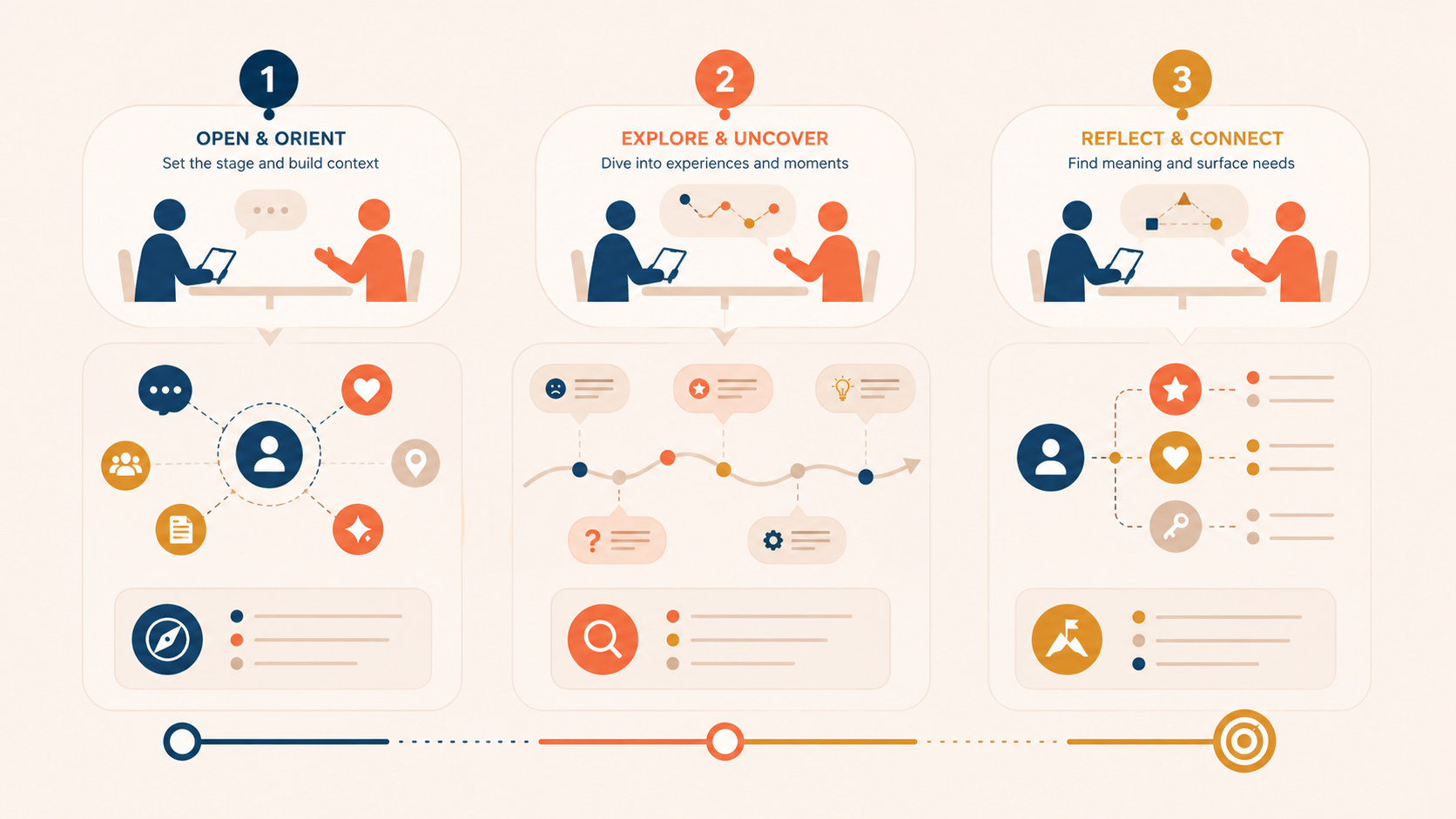
In the last post, we covered the three rules of good interview questions based on the Mom Test. Rules tell you what to avoid. They do not tell you what to ask next when the conversation stalls. This post fills that gap with two practical tools: a 3-step framework that works for any topic, and a question library you can copy into your next session.
The shared idea behind both tools is simple. Good customer interview questions never beg for validation. They pull stories out of real moments, follow what actually happened, and probe the gaps the customer skipped. Stories show behavior. Opinions hide it.
The 3-Step Framework for Better Customer Interview Questions
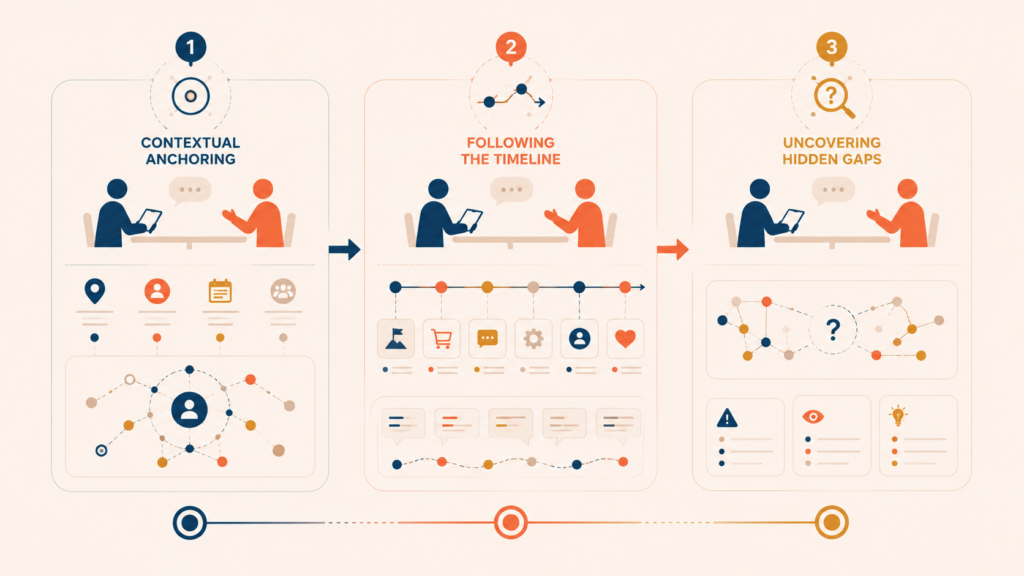
Good stories unfold along a timeline and reveal real behavior. This three-step approach lets you dig into any topic, whether it is a workflow, a purchase decision, or a feature request.
Step 1: Anchor the Context (Pin the Conversation to a Real Moment)
Start by fixing the conversation to a specific moment in time.
- “When was the last time you experienced [this problem]?”
- “Where were you when it happened?”
- “Who else was involved?”
- “What were you trying to do?”
These questions ground the conversation in reality. Hypotheticals fade out, and the customer starts talking about what actually happened rather than what they think they would do.
Anchoring works like asking someone to picture a movie scene. Ask, “What’s your favorite scene in a romance film?” and you get something vague — “Hmm… the snow scene?” Ask, “What was the last romance film you watched? Where did you see it?” and a specific memory lights up, pulling a much richer story with it. Pinning the conversation to a real moment is the first move.
Step 2: Follow the Timeline (Track What Actually Happened)
Once you have a starting point, walk through the sequence of events.
- “What happened next?”
- “What did you do then?”
- “How did it turn out?”
- “Why did you decide to do it that way?”
Wait for the customer to tell the full story in their own pace. People skip details that feel obvious or unimportant to them. Your job as the interviewer is to surface those hidden steps.
Following the timeline is detective work. “I saw the suspect” is not enough. A detective asks, “What time? Where? What were you doing before? What did you do after?” The full picture only appears when you walk through events in order. Customer workflows behave the same way. Step by step, the frictions and workarounds that nobody talks about start to show.
Step 3: Fill the Gaps (Uncover the Hidden Story)
When you notice a jump in logic or a missing step, dig into the gap.
- “Wait, what happened just before that?”
- “How did you find out about it?”
- “Why did you pick that one instead of the alternatives?”
The most valuable insights often hide in these gaps:
- The customer may have asked a coworker for help (a social workflow exists).
- They may have dropped the task for three days (the problem is not actually urgent).
- They may have used a competitor’s product (the real competitor reveals itself).
Quick Reference: The 3-Step Story-Based Interview Framework
| Stage | What you do | Example questions | What it reveals |
|---|---|---|---|
| Step 1: Anchor the context — pin the interview to a real moment | Fix the conversation to a specific time and situation | “When was the last time you experienced this?” / “Who was involved?” / “What were you trying to do?” | Real-world setting, trigger, stakeholders, initial intent |
| Step 2: Follow the timeline — track what actually happened, step by step | Walk through the story in chronological order | “What happened next?” / “How did it turn out?” / “Why did you decide that?” | Friction points, workarounds, delays, decision drivers |
| Step 3: Fill the gaps — probe jumps and missing steps | Surface hidden behavior and assumptions | “What happened just before that?” / “How did you find out?” / “Why that option?” | Social workflows, urgency (or lack of it), real competitors |
How to use the framework in practice:
- Start every topic at Step 1. Skip the context and you only get opinions.
- Push Step 2 a little further than feels comfortable. Friction shows up there.
- Use Step 3 selectively. The gaps are where the most valuable insights hide.
The Customer Interview Question Library: 4 Scenarios You’ll Need

The framework above tells you how to ask. The library below tells you what to ask in the four scenarios you’ll hit most often: evaluating problem importance, digging into feature requests, probing emotional signals, and asking the scary questions every interview needs.
1. Questions to Evaluate Problem Importance
Use these when you need to judge whether a problem is worth solving.
- “How seriously do you take [this activity]?”
- “Are you making money from [this]?”
- “Have you tried to increase revenue, efficiency, or output around [this]?”
- “How much time per week do you spend on [this]?”
- “Do you have any bigger goals or plans tied to [this]?”
- “What tools or services are you using for [this] right now?”
- “Are you already doing anything to improve this problem?”
- “What are the top three things you’re trying to solve or improve right now?”
- “Why does this matter?”
- “What happens when this problem hits?”
- “Tell me about the last time this problem came up.”
Signals to listen for: time spent, money spent, emotional intensity, and existing workarounds all point to importance. If the customer is not already trying to solve the problem, it probably is not painful enough to matter.
Problem-importance questions work like a patient’s self-diagnosis. “Where does it hurt?” is not enough. You also need “How often?”, “Is it disrupting your daily life?”, and “Have you bought medicine for it yet?” to gauge the real severity. If the customer is already spending time and money on it, the pain is real. If they have done nothing, they can live with it.
2. Questions to Dig Into Feature Requests
When a customer proposes a feature, peel back to the underlying need.
- “Why do you need that?”
- “What would it let you do?”
- “How are you getting by without that feature today?”
- “If this feature delayed the launch, would you wait? Or would you rather we ship first and add it later?”
- “How would that feature fit into your daily workflow?”
- “Tell me about the last time you needed this.”
Signals to listen for: focus on the job the customer is trying to get done, not the feature they describe. Customers are excellent at spotting their problems but often poor at designing the solution.
Feature requests are like a patient writing their own prescription. When a patient says, “Give me painkillers,” the doctor first asks, “Where does it hurt?”, “When did it start?”, and “What were you doing when it began?” What matters is the symptom, not the drug the patient asked for. The same applies to customer interviews: chase the underlying need, not the requested feature.
3. Questions to Probe Emotional Signals
When you spot a strong emotion, dig in.
- “Can you tell me more about that?”
- “That seems to really bother you — what’s the story behind it?”
- “What makes it so hard?”
- “Why haven’t you solved this yet?”
- “You sound excited about this part — is it really that important?”
- “What makes you happy about it?”
- “What would it mean for you if this problem went away?”
Signals to listen for: the higher the emotional temperature, the more important the issue. Pain, frustration, joy, and fear all point to how much the problem actually matters.
Emotional probing is like looking under the surface of an iceberg. A sigh, a sudden change in tone of voice, a raised volume — those are the tip. “Tell me more about that” pulls up the much larger story underneath: repeated frustrations, failed attempts, organizational blockers, the things people rarely volunteer up front.
4. The Scary Questions Every Interview Must Include
Every customer interview should include at least one question that could shake your current business plan.
- “What would make you stop using our product entirely?”
- “If we disappeared tomorrow, what would you use instead?”
- “Why didn’t you buy from us sooner?”
- “Have you ever come close to choosing a competitor? What pulled you that way?”
- “What’s the biggest risk you see in working with us?”
Signals to listen for: these questions are uncomfortable to ask, and that is exactly why they are valuable. Hearing an inconvenient truth now is far better than building the wrong thing for six months and discovering it later.
Scary questions are like asking for a cancer screening at a checkup. The test is uncomfortable, but catching the problem early gives you options. Skip the test and you stay comfortable — until it is too late to act. In interviews, the questions that might surface answers you don’t want to hear are the ones that let you change course before the business does.
Conclusion
The 3-step framework and the 4-scenario question library work best together. Use the framework as the spine of every conversation: anchor the moment, follow the timeline, fill the gaps. Pull questions from the library when the topic calls for it — problem importance to qualify, feature requests to translate into jobs, emotional signals to surface depth, and scary questions to stress-test the plan. The combination keeps you in stories instead of opinions, and stories are where customer interview questions earn their keep.
In the next post, we’ll look at where to find the right customers to interview and how to write an outreach message that gets a high response rate.
Customer Interview Series
(1) Customer Interviews: The Real Purpose and 4 Warning Signs You’re Doing It Wrong
(2) 4 Types of User Interviews and the One Principle That Makes Them Work
(3) The Mom Test: 3 Rules for Asking Better Customer Interview Questions
(4) Customer Interview Questions: A 3-Step Framework and Ready-to-Use Question Library