
The previous article in this series argued that DevOps is a cultural problem, not a tooling problem. Culture, however, does not change through agreement or persuasion. It changes when the daily work itself changes. This is where continuous delivery enters the picture.
Continuous delivery is the practice that turns DevOps principles into observable behavior. It defines how changes move from a developer’s laptop to production, how often, with what level of confidence, and at what cost when something goes wrong. The five principles of continuous delivery describe the behaviors that mature teams converge on, but those behaviors do not stand on their own. They rest on two technical foundations: comprehensive configuration management and continuous integration (CI). Without these, the principles remain slogans on a wiki page.
The sections that follow do two things. First, they unpack what continuous delivery actually means and the five operating principles behind it. Second, they walk through the two foundations — configuration management and CI — that make those principles real in day-to-day work, and how the two interact, since neither one alone is enough.
Behavior First, Mindset Second: How Deployment Habits Change Culture
Most teams approach culture change in the wrong order. They start by trying to convince people that something matters, expecting that new beliefs will produce new behaviors. In practice, the sequence runs the other way around.
John Shook, a long-time observer of lean transformations at Toyota and elsewhere, put it directly:
“What my NUMMI experience taught me that was so powerful was that the way to change culture is not to first change how people think, but instead to start by changing how people behave — what they do.”
— John Shook
Consider what happens when a team is told that “failure is okay.” On its own, the statement does almost nothing. But when the same team works inside a system where failures are small, visible, and easy to recover from, the message lands. People see that a mistake no longer triggers a postmortem with twelve stakeholders. The behavior shifts first; the belief about failure shifts later.
Culture does not live in documents. It lives in the processes that quietly reward some behaviors and discourage others. Continuous delivery matters because it changes those processes. When deployment becomes routine instead of ceremonial, the surrounding culture has no choice but to follow.
What Continuous Delivery Actually Means (and What It Doesn’t)
Continuous delivery is often confused with “deploying constantly.” That is not quite right. A more accurate definition is the capability to deliver any kind of change — features, configuration updates, bug fixes, experiments, infrastructure or security changes — into production quickly, safely, and repeatably, and to expose it to users when the team chooses.
The distinction between continuous delivery and continuous deployment matters here. Continuous deployment means every change that passes automated checks goes to users immediately. Continuous delivery means every change could go to users at any time, but the decision to release is separate from the act of deploying. Most product teams want the second, not the first.
The point is not speed for its own sake. It is reliable speed. When continuous delivery is working, the team operates differently in a few subtle ways. Deployments stop feeling like high-stakes events. Incidents become moments of learning instead of moments of blame. Plans become more flexible because the range of what can be safely undone is wider.
A team practicing continuous delivery is not a team that deploys ten times a day for its own sake. It is a team that could deploy ten times a day, and chooses when to do so based on product judgment rather than fear of the pipeline.
The Five Principles of Continuous Delivery
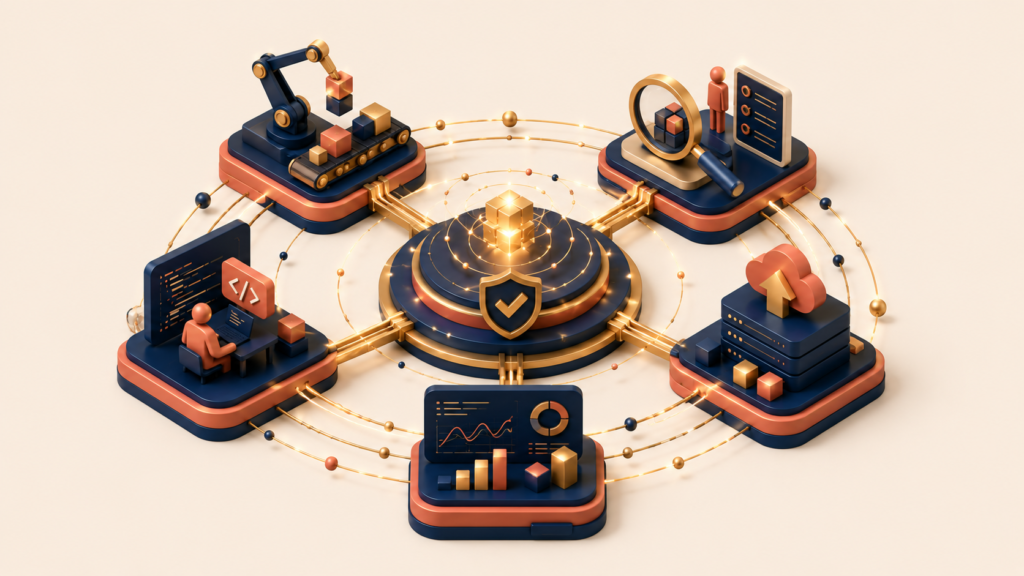
For continuous delivery, the tools matter less than the behaviors they support. Five principles describe how mature teams operate:
| Principle | Core Idea | How Behavior Changes |
|---|---|---|
| Build quality in | Check quality early, not at the end | Problems are caught while context is fresh and fix cost is low |
| Work in small batches | Reduce the size of each change | Failures are easier to understand, contain, and recover from |
| Automate repetitive work | Remove manual steps from delivery | Feedback gets faster and deployment becomes predictable |
| Improve continuously | Treat improvement as part of daily work | Teams adjust incrementally instead of waiting for big resets |
| Everyone is responsible | Share accountability across roles | Hand-offs shrink and defensive behavior drops during incidents |
Principle 1: Build quality in
Quality should surface problems as early as possible. When checks shift forward in the process, failure becomes a routine signal instead of an emotional event, and the chaos that often appears late in development is largely prevented.
Principle 2: Work in small batches
Small batches limit how much can go wrong at once. When a change is easy to understand and easy to revert, the team can validate assumptions continuously rather than betting on a single irreversible release — the classic “big bang.”
Principle 3: Automate the repetitive; leave judgment to people
As a system grows, manual steps create invisible delays and quiet anxiety. Automation removes the predictable friction so people can focus on the decisions that actually require human judgment.
Principle 4: Improve continuously, not occasionally
Continuous improvement treats learning as part of the work rather than a separate project. Small, steady adjustments prevent the slow accumulation of problems that eventually demands a large refactor or replatforming effort.
Principle 5: Everyone is responsible for the system.
Shared responsibility removes the dynamic where stability or speed is “another team’s problem.” When teams are jointly accountable for outcomes, coordination improves and defensive behavior fades during the moments that matter most.
Technical Capabilities That Enable Continuous Delivery
Principles become real through specific technical capabilities. These capabilities are not goals in themselves. They exist to make changes fast, safe, and repeatable.
| Capability | Why It Exists |
|---|---|
| Version control | Tracks every change and makes rollback possible |
| Automated testing | Catches regressions early and cheaply |
| Deployment automation | Removes fear and inconsistency from releases |
| Continuous integration | Surfaces integration issues while they are small |
| Shifting security left | Prevents late-stage, high-impact risk discoveries |
| Trunk-based development | Reduces painful merge conflicts |
| Test data management | Keeps tests reliable and meaningful |
| Loosely coupled architecture | Allows independent change without whole-system risk |
| Team autonomy | Speeds up decisions and ownership |
Two of these capabilities — version control extended into comprehensive configuration management, and continuous integration — carry more weight than the rest. They are the foundations the other capabilities rest on. The next two sections look at each in detail.
Foundation 1: Comprehensive Configuration Management — Where the Source of Truth Lives
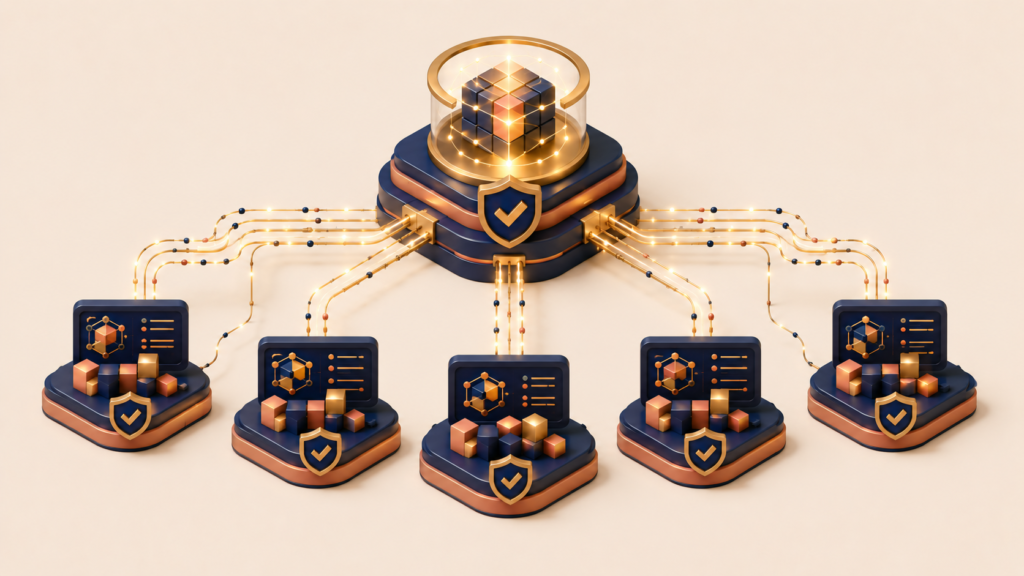
When people hear “configuration management,” they usually picture infrastructure or operations work. That framing is too narrow. The real question configuration management answers is broader: “Where does the truth about our system live?”
In high-performing teams, the answer is simple and consistent: every meaningful change starts in version control. This includes application code, environment settings, build and deployment scripts, feature flags, and runtime configuration. Nothing important lives only in someone’s memory, a Slack thread, or a manual checklist.
What “Comprehensive” Means
“Comprehensive” does not mean there is no human involvement. It means environments (development, staging, production) are defined explicitly, builds and tests and deployments follow automated paths, and any change can be traced from intent to execution. Manual approvals can still exist; what should not exist is manual execution as the default mode.
| Execution Model | How It Actually Operates | Long-Term Effect |
|---|---|---|
| Manual execution | Outcomes depend on individual memory, judgment, and situational decisions | Inconsistent results, hidden risk in undocumented steps, dependence on specific people |
| Automated execution | The same steps run the same way regardless of pressure or context | Repeatable results, system-wide visibility, confidence to act under pressure |
If a deployment requires a specific hero to be online, the system is teaching the organization the wrong behaviors.
What It Means to the Whole Product Team
From a product perspective, weak configuration management produces a recognizable set of problems:
- “It worked in staging, but it doesn’t work in production.”
- “I’m not sure which version is live right now.”
- “We can’t roll this back cleanly.”
Each of these slows learning and raises the emotional cost of every change. Strong configuration management does the opposite. It enables safer experiments, clearer accountability, and quick recovery when an assumption turns out to be wrong. It quietly raises the ceiling on what a product team can attempt.
Product managers and other non-engineers do not design configuration systems directly, but they shape how those systems are used in practice.
- They can clarify why differences between development, staging, and production environments matter.
- They can name rollout conditions before a deployment decision is made, not after.
- They can treat rollback paths as part of every launch plan, not as a recovery story written under pressure.
This work shapes the reversibility of product decisions. When configuration discipline is strong, a launch stops being a one-way door and becomes a managed decision with clear entry and exit conditions.
Foundation 2: Continuous Integration — Why Integration Problems Become Product Problems

Most product teams have several people working on the same codebase at the same time. To keep that workable, changes usually happen on separate branches — temporary copies of the main line of code that allow parallel work without unfinished changes leaking into the product too early.
The trouble starts when branches stay separated for too long. Assumptions diverge, dependencies shift, and context fades. When everything is finally merged back together, the team often discovers that the work was fine in isolation but does not fit cleanly when combined. The cost of resolving those collisions grows roughly with how long the branches were apart.
Continuous integration changes this by changing how long branches stay separated. Small changes are merged frequently, automated builds and tests run immediately, and problems are detected while the cost of fixing them is still low. The point is early contact with reality. Instead of finding a conflict three weeks later, the team finds it within hours or days.
This compounds. Surprises at deploy time become rarer. Development progress becomes more predictable. Trust in release schedules grows because “done” actually means done.
Without CI, teams tend to experience a familiar pattern: optimistic early plans, last-minute slippage, features that are “almost done” but never quite ship, and deployments that feel unpredictable. With CI, the team gets clearer signals about progress, earlier warnings when scope is at risk, and a more reliable shared understanding of what completed means.
This is also why CI tends to force clarity on the Definition of Done. If automated tests fail, the work is not done. If integration is broken, the work is not done. The rule can feel strict at first, but it is what protects both product quality and planning credibility over time.
How CI and Configuration Management Work Together
Configuration management defines what the system is. Continuous integration verifies that a change safely fits into that system. The two answer different questions, but neither one is useful in isolation.
When both are strong, three things follow. Changes are traceable, so the team always knows what went out and why. Feedback is fast, so problems surface while the context is still fresh. Recovery is realistic, so rollback is a normal option rather than a worst-case scenario.
When either one is weak, the gaps show up quickly. Deployments slow down. Risk accumulates quietly. Teams start compensating with heavier processes and more cautious planning — which looks responsible from the outside but is really a sign that the underlying system cannot be trusted.
This is why configuration management and CI are not optimizations to add once the team gets ahead of its roadmap. They are foundations. Everything else in continuous delivery — small batches, automation, shared responsibility — rests on top of them.
Conclusion
Continuous delivery is less a tool stack than a set of behaviors that compound over time. The five principles describe what those behaviors look like: quality built in, work in small batches, automation of the repetitive, continuous improvement, and shared responsibility for the system. But principles alone do not change how a team ships. They land only when two foundations are in place — comprehensive configuration management that defines what the system is, and continuous integration that verifies each change safely fits.
When both foundations hold, the rest of continuous delivery becomes practical rather than aspirational. Deployments stop being events. Failures stop being political. Plans stop being fragile.
The next article in this series turns to measurement. If continuous delivery is a capability, how do we know whether a team actually has it? That is what the DORA metrics — lead time for changes, deployment frequency, change failure rate, and time to restore service — are designed to answer, and they reveal something deeper about how DevOps maturity reshapes product execution.
DevOps Series
(1) DevOps Culture: How Organizational Culture Shapes Product Deployment
(2) Continuous Delivery and CI: The Five Principles and Two Foundations of DevOps Deployment
(3) DORA Metrics: How to Measure DevOps Performance and Why It Changes Product Execution
(4) DevOps for Product Managers: Practical Practices and a Final Checklist