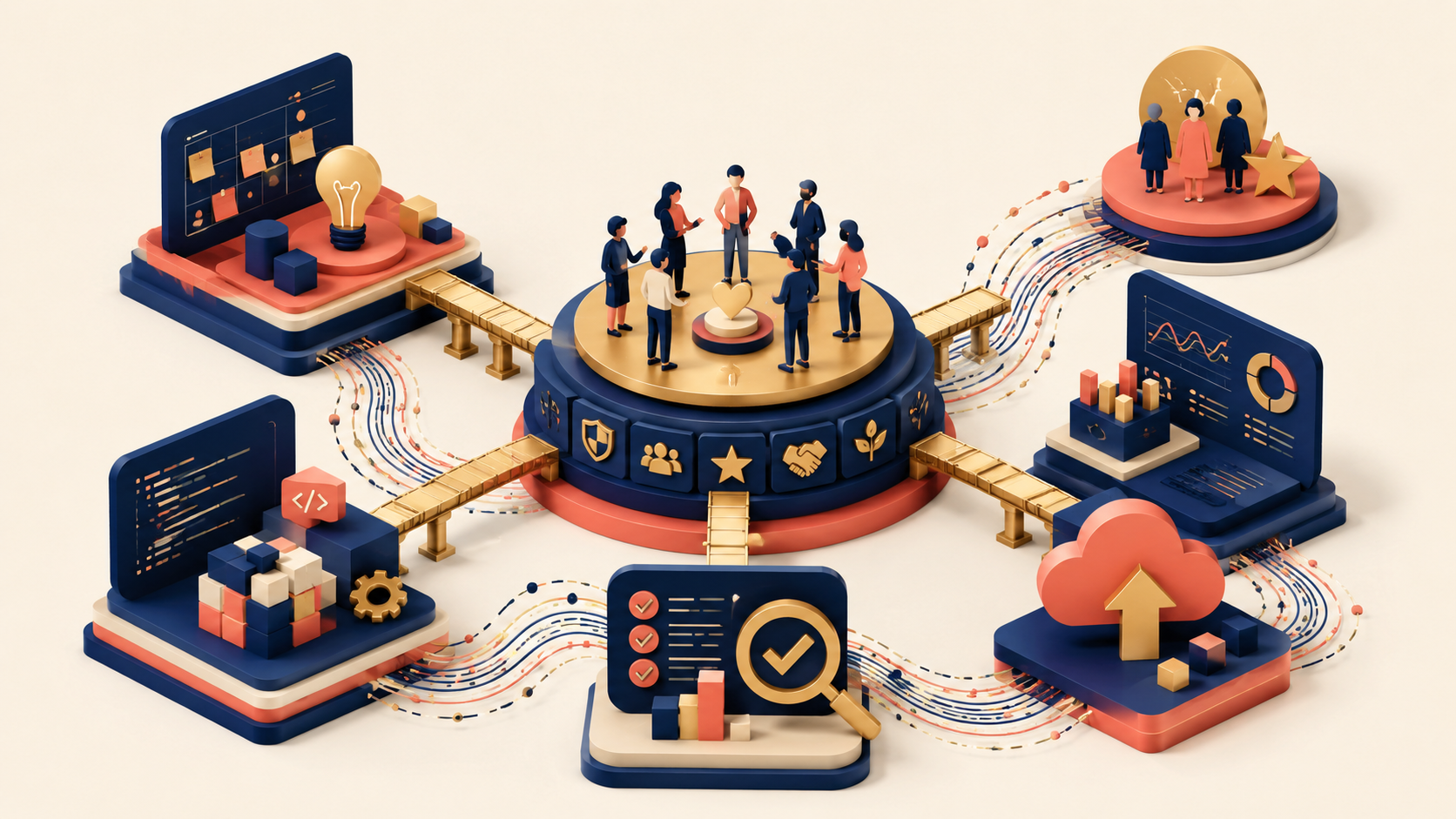
DevOps is not a developer-only topic. Product work sits on top of software, and even teams that never write code depend on deployment, incidents, and operations to keep their roadmap promises. DevOps is the system that decides whether a product can move quickly while remaining trustworthy.
DevOps culture is the part most teams underestimate. Tools and pipelines matter, but the real question is how a team handles risk, surfaces information, and responds to failure. Two foundations decide the outcome: what DevOps actually is, and why organizational culture determines whether the deployment system supports the product or blocks it.
Why Non-Engineers Should Understand DevOps
Software used to support the business. Today, in most industries, software is the business. It plays three roles at once:
- The product customers pay for
- The channel customers use
- The lever companies pull to respond to market change
Business success now depends on two capabilities. The first is sensing and responding to customer needs quickly. The second is anticipating and handling risk — security threats, regulatory shifts, economic shocks, and service outages. When either capability fails, customers feel a product that is slow or unstable.
Customers do not separate “product experience” from “system experience.” A delayed feature launch, a payment error, and a security incident all collapse into the same thing in the customer’s mind: trust. DevOps is what determines whether that trust holds.
What DevOps Actually Is: Culture and Systems for Safe, Fast Delivery
People often describe DevOps through tools — CI pipelines, Kubernetes, and monitoring stacks. A more useful definition sits one level deeper:
DevOps is the environment and culture that lets a team build and operate software quickly, safely, and sustainably.
DevOps lets a business learn and adapt at the pace of the market. It is the capability that allows a product to stay meaningful in its actual context of use, because success depends on how quickly the team can learn from real usage data.
Organizations with strong DevOps share a set of characteristics:
- Shorter time from idea to customer feedback
- Fewer high-stress “big bang” releases
- Clearer visibility into what is actually happening in production
- Faster recovery when something breaks
Weak DevOps produces the opposite pattern. Lead times stretch long enough to kill experimentation. Releases succeed only when a hero stays late. The “move fast” group and the “stay stable” group argue endlessly. Customer feedback loops slow down, so decisions become guesses.
Three Common Misconceptions About DevOps
Teams new to DevOps tend to repeat the same three misreadings. Each one quietly damages how the product gets built.
Misconception 1: DevOps is what you do when something breaks
Framed this way, DevOps stays invisible until a problem appears. The reactive definition guarantees that products stall, incidents pile up, and emergency meetings consume the calendar. A more useful framing is that DevOps is a delivery system that directly supports product strategy. When the delivery system is weak, strategy stays theoretical because the product never reaches the customer cleanly.
Misconception B: We use modern tools, so we are doing DevOps
Tools help, but tools are not capability. Two teams using the same CI tool can produce completely different outcomes. What separates them is how often they integrate new work into the product, how they treat failure, whether they can deploy without surprises, and whether the organization rewards learning or punishes mistakes.
Misconception C: Speed and stability cannot coexist
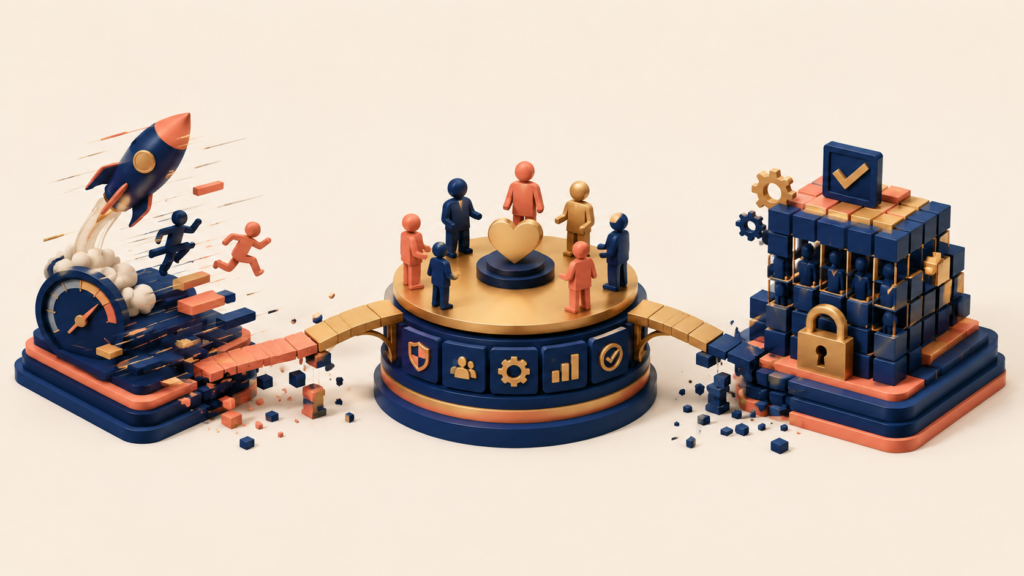
This belief forces teams into a false choice — release fast with frequent outages, or freeze change to stay stable. High-performing organizations refuse the trade-off. They aim for speed through quality: the same practices that prevent defects also remove the friction that slows delivery.
The Three Levels of Organizational Culture (Schein Model)
DevOps adoptions usually fail in the deeper layers of the organization. The visible problems — slow approvals, missed incidents, blame after outages — sit on top of three questions: how do people behave when something goes wrong, how does information flow, and what does the organization actually reward?
The answers come from culture. A useful way to read culture is in three levels, moving from invisible to visible.
| Level | Definition | How it shows up day-to-day | Why it matters to the team |
|---|---|---|---|
| Basic Assumptions | Unspoken beliefs formed inside the organization over time | Silence around risk; decisions go unchallenged; safety optimized over learning | Repeated product failures often trace back to assumptions, not missing process |
| Values | Stated principles the organization claims to hold | How success and failure are framed; how trade-offs get justified; who is praised or criticized | When values and incentives clash, the outcome shows which side actually wins |
| Artifacts | Visible expressions inside the organization | Documents, rituals, dashboards, workflows, approval steps | Easy to change on the surface, but ineffective without matching behavior and incentives |
Basic Assumptions: the invisible defaults.
When product plans keep failing the same way, the cause is rarely a missing process. It is a hidden assumption. Basic assumptions are the hardest layer to see and the hardest to shift, because they are absorbed silently from time spent inside the organization. Examples include:
- “When something feels risky, staying quiet is safer.”
- “A late launch is acceptable; a post-launch defect is not.”
- “Decisions get made by seniority, not data.”
No one writes these down. They still shape daily behavior more strongly than any explicit document.
Values: what the organization says it cares about.
Values sit one layer above assumptions. They can be discussed, and they are often documented. Values act like a lens — they shape how people interpret what happens. Is a failed experiment waste or useful learning? Is an outage an individual failure or a systemic signal? Values matter only when they show up in actual decisions. When values and incentives conflict, incentives usually win.
Artifacts: what you can actually see.
Artifacts are the visible layer — written principles, formal processes, rituals like sprint reviews and postmortems, dashboards, templates, and approval flows. Important as they are, artifacts are also the easiest layer to fake. A “blameless postmortem” template does not, by itself, create a safe culture. Artifacts reinforce culture only when they line up with the underlying assumptions and values.
How Information Flows: Westrum’s Organizational Typology
In a complex technical environment, information flow is everything. How quickly a problem surfaces, and how honestly it is discussed, decides whether a small issue stays small or quietly grows into a major incident.
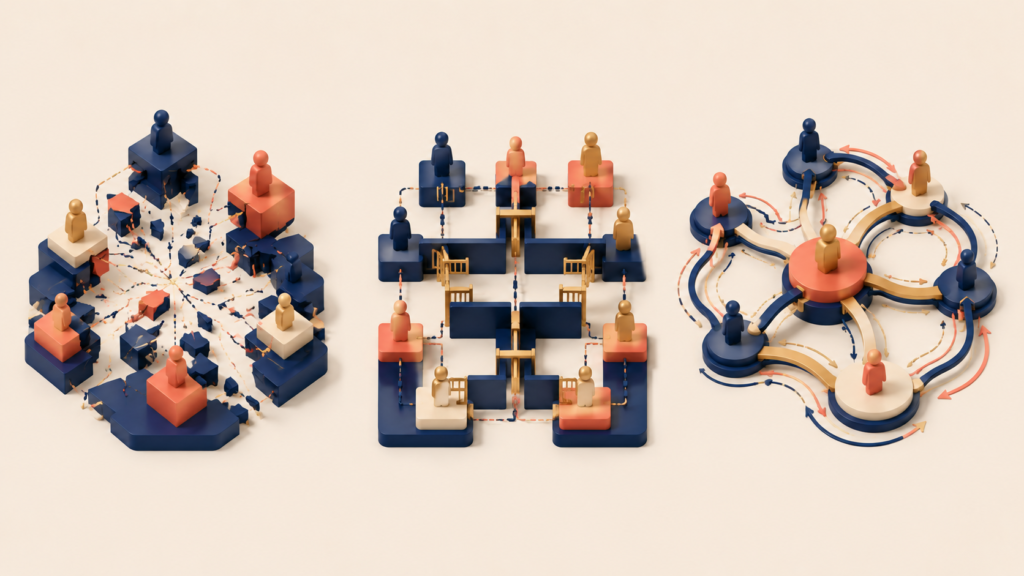
Sociologist Ron Westrum studied safety and failure in high-risk systems and proposed that organizations can be understood by how information moves through them. He identified three types.
| Organization Type | Core Orientation | How Information Flows | When Problems Occur | Impact on the Team |
|---|---|---|---|---|
| Pathological | Power and self-protection | Information is hoarded, distorted, or shared selectively | Blame and punishment dominate; the focus is on finding the culprit | Risk surfaces late; the roadmap looks stable until it suddenly collapses |
| Bureaucratic | Rules and boundary protection | Information flows through formal process and approvals | Process compliance outranks results | Decisions slow down; urgent items get stuck in approval queues |
| Generative | Performance and outcomes | Information moves freely to where it is needed | Failures are treated as system signals | Faster validation; fewer surprises from late information |
Pathological organizations are power-centered. Information is often hoarded, distorted, or used to support someone’s position. When something goes wrong, attention moves quickly toward who made the mistake rather than what allowed it. Bad news surfaces late, risks stay hidden, and issues tend to appear only right before launch.
Bureaucratic organizations are rule-centered. Information moves through formal processes and pre-defined boundaries. This structure reduces chaos, but it hits a limit when process compliance becomes more important than outcomes. Exceptions are hard to handle, cross-team coordination slows down, and urgent product decisions get stuck in approval queues.
Generative organizations are performance-centered. Information flows freely to wherever it is most useful, and failure is treated as system feedback rather than individual error. Because concerns surface early, the team can respond while the problem is still small and cheap to fix.
Why Information Flow Is the Real Bottleneck
Delivery delays usually get blamed on the obvious suspects:
- Slow development speed
- Unclear requirements
- Not enough time or people
The deeper cause is usually different. Most delays start when information arrives late or arrives distorted. High-quality information has three properties:
- It answers the real question someone is facing
- It arrives early enough to act on
- It is presented in a usable form
Improving information flow often creates more impact than adding another process step.
Psychological Safety and Failure: Google’s Project Aristotle
Project Aristotle, Google’s internal research initiative, set out to identify what makes a team perform well. The surprising finding was that the main driver was not the talent of individual members. The most important factor was how the team interacted, especially when things went wrong.
In unhealthy environments, failure triggers defensiveness. People look for someone to blame, and learning stops. In healthy teams, failure inside a complex system is treated as expected. Instead of hunting for a single cause, the team examines system design, handoffs, missing signals, and unclear ownership.
This mindset treats the organization as a complex adaptive system, not a collection of replaceable individuals. The shift matters because product work happens inside exactly this kind of system. Without psychological safety, the information needed to run that system never reaches the people who could act on it.
Conclusion
DevOps is fundamentally cultural. Tools shape the surface, but the deeper layers — basic assumptions, stated values, and the artifacts on the wall — decide whether a deployment system actually supports the product. Information flow turns out to be the real bottleneck in product execution, and psychological safety is what keeps that flow honest.
The next article in this series moves from culture to practice. It covers the five principles of continuous delivery, the role of comprehensive configuration management, and continuous integration — the technical foundations that make safe, fast deployment possible.
DevOps Series
(1) DevOps Culture: How Organizational Culture Shapes Product Deployment
(2) Continuous Delivery and CI: The Five Principles and Two Foundations of DevOps Deployment
(3) DORA Metrics: How to Measure DevOps Performance and Why It Changes Product Execution
(4) DevOps for Product Managers: Practical Practices and a Final Checklist