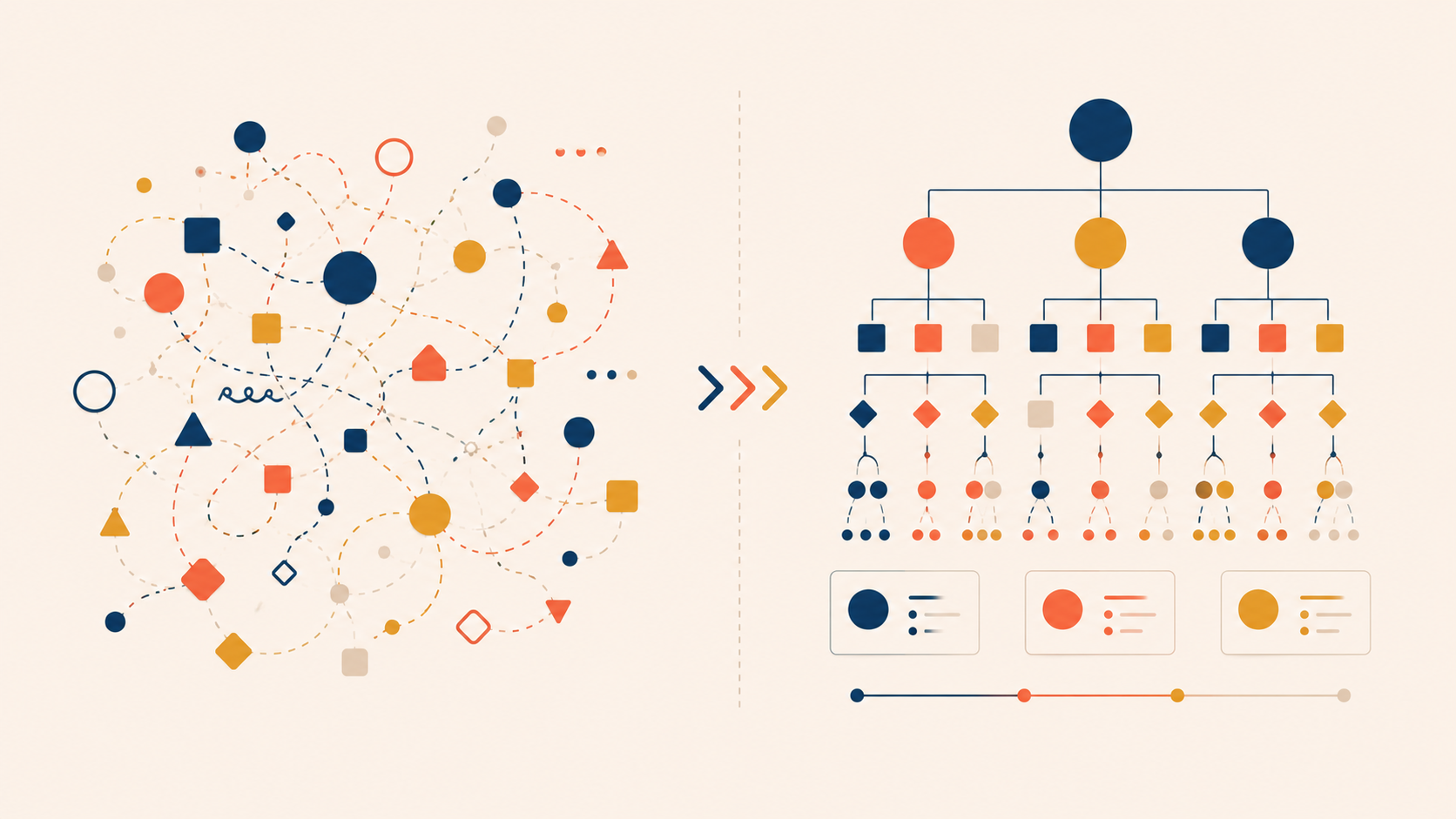
A customer interview wraps up, and the room feels warm. The customer nodded along, called the idea “useful,” and even suggested features. Then weeks go by and nothing happens.
This gap between positive feedback and actual behavior is where many product teams get lost. The problem is rarely execution speed or product quality. The frame of the conversation was wrong from the first question.
Consider what happens when you ask a customer:
- “Would you use a product like this?”
- “Does this seem valuable to you?”
- “Would you pay for something that does X?”
Questions like these turn the customer into a polite evaluator instead of an honest storyteller. Most people don’t want to disappoint you, so they encourage, express vague interest, or pretend to agree. They aren’t lying. The question simply doesn’t give them a better option, so what feels like validation is closer to social courtesy.
The cold truth is this:
Many customer interviews fail before they begin. They are designed to confirm an idea rather than uncover how the customer actually behaves.
This piece is the first in a series on customer interviews that reveal real behavior, from the first outreach message to the last note-taking template. The starting point is the real purpose of a customer interview and the four warning signs that you are running a bad one.
The Real Purpose of a Customer Interview: Facts, Not Praise
A customer interview is not a popularity contest. If a meeting ends with friendly feedback but no follow-up meeting, no commitment, and no purchase, that is a clear warning. The goal of customer development is not to collect compliments. It is to reduce business risk and discover real opportunities.
Ask yourself a few hard questions after every conversation:
- Why does the customer say they like the idea?
- How much does it actually save them in time or money?
- How does it fit into their daily workflow?
- What have they already tried to solve this problem?
If you cannot answer these with specific examples from the conversation, you collected praise, not data.
A customer interview has three core purposes:
- Risk mitigation: Surface the things that could kill the business before you commit serious resources.
- Opportunity discovery: Find problems the customer is willing to pay to solve.
- Reality validation: Test whether your assumptions match how the world actually works.
What you should walk away with is not a vague good feeling. It is specific facts about customer behavior and specific next steps: a follow-up meeting, a pilot program, a referral to a colleague. If the customer is enthusiastic but unwilling to take any of those steps, the enthusiasm is worth very little.
Think of it like a doctor’s visit. A patient saying “I feel fine” tells the doctor almost nothing about their health. The doctor needs blood pressure, lab results, and specific symptoms. “You look good” is not a diagnosis. In a customer interview, “Great idea” is not evidence. “I wasted four hours last week because of this problem” is.
4 Warning Signs You’re Running a Bad Customer Interview
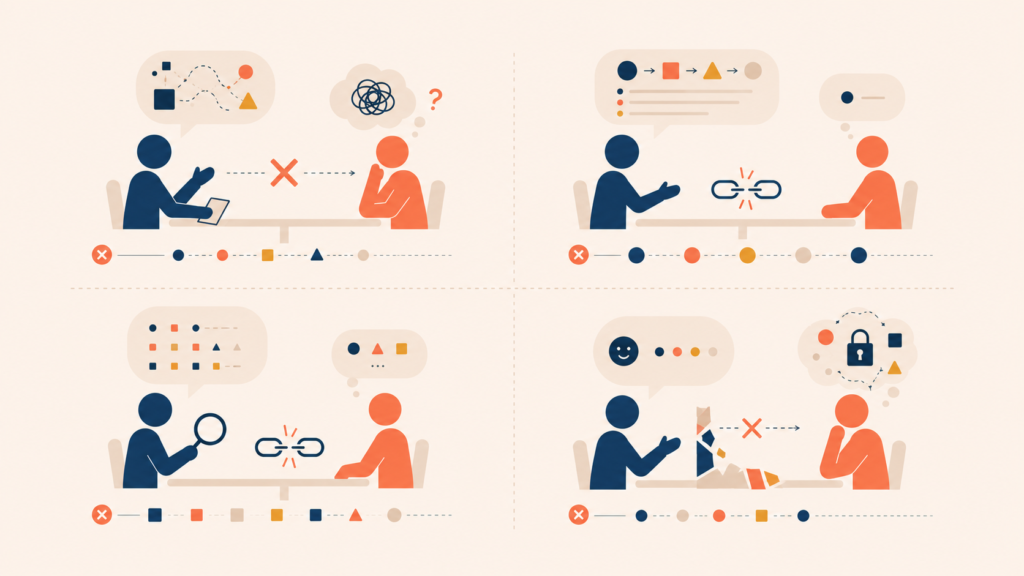
Most bad customer interviews share a small set of patterns. If any of these four signs show up in your team’s research, the conversations are probably producing comfortable noise rather than usable signal.
Sign 1: You’re Asking Leading Questions That Beg for Validation
Some customer interview questions are functionally requests for emotional support, not research. They sound like this:
- “I’m thinking of quitting my job to build this. What do you think?”
- “Doesn’t this sound like a great idea?”
- “I’ve already started building it. Be honest, do you like it?”
These questions create emotional pressure. When the person across the table is visibly invested in a particular answer, most people will give them that answer. The result is a polite lie.
A leading question in an interview works the same way as asking a defendant in court, “You’re innocent, aren’t you?” The answer is already inside the question, so no honest answer is possible. When you ask “Doesn’t this seem great?”, saying “No” becomes socially expensive, and the customer takes the easier path.
Sign 2: Your Team Has a Learning Bottleneck (Only a Few Talk to Customers)
In many product teams, engineers have never spoken to a customer, and designers haven’t either. Only the PM attends the interviews, and insights rarely make it back to the rest of the team. This is a serious learning bottleneck at the organizational level, and it is one of the patterns Teresa Torres flags in continuous discovery habits — research only sticks when the people building the product hear customers directly.
Different team members pick up different signals from the same conversation. An engineer hears the offhand technical constraint the customer mentions in passing. A designer notices a friction in the workflow that the customer treats as normal. When only one person is in the room, the team loses this multi-dimensional view.
A learning bottleneck is like a soccer match where only one person watches from the stands and then explains the game to the rest of the coaching staff. The person who saw it directly understands player condition, the opponent’s shifts in tactics, and the mood of the field. Everyone else gets a summary. Real understanding requires the full team in contact with customers.
Sign 3: You’re Counting Conversations, Not Insights
“We had 20 customer conversations this month” sounds impressive. But if none of those conversations changed the direction of the product, the team has wasted twenty hours of everyone’s time, including the customer’s.
The metrics that matter are different:
- Which assumptions did we discover were wrong?
- How many new opportunities did we find?
- How did the roadmap change because of what we learned?
Counting conversations without counting insights is like counting gym visits without checking whether you got stronger. You can go twenty times in a month and leave with the same muscles if all you did was stretch. The point is not attendance. It is whether the work produced a measurable change. The same applies to customer interviews: the real outcome metric is whether the conversation changed a product decision, not how many calls were on the calendar.
Sign 4: You’re Starting Interviews Without a Clear Goal
If you walk into a conversation without a specific hypothesis to test, you will touch many topics and learn nothing in particular. Before the conversation begins, you should know exactly what you are trying to learn.
An interview without a goal is like turning on the navigation system without a destination. You drive, but you do not arrive. An hour later you have circled the neighborhood. “Let’s learn something about our customers” is not a goal. “Let’s find out how this customer handles this task on Monday morning” is.
A clear goal also forces a clean question structure. When you know the one thing you need to understand, you can build user interview questions around concrete past behavior rather than hypothetical futures. The hypothesis becomes the spine of the conversation, and everything that does not serve it can be skipped.
Conclusion
A bad customer interview is rarely a problem of charm or rapport. It is a problem of purpose. If the conversation is designed to collect praise, the customer will give you praise. If it is designed to surface facts about real behavior, the customer will give you facts.
Before your next interview, run a quick self-check:
- Am I asking about the customer’s life, or pitching my idea?
- Will the rest of the team hear what this customer says, or only me?
- Will I leave with a specific next step, or just a good feeling?
- Do I know the one thing I am trying to learn today?
The next piece in the series looks at the four types of customer interviews — exploratory, validation, satisfaction, and efficiency — and the core principle that ties them together: pull stories, not opinions.
Customer Interview Series
(1) Customer Interviews: The Real Purpose and 4 Warning Signs You’re Doing It Wrong
(2) 4 Types of User Interviews and the One Principle That Makes Them Work
(3) The Mom Test: 3 Rules for Asking Better Customer Interview Questions
(4) Customer Interview Questions: A 3-Step Framework and Ready-to-Use Question Library