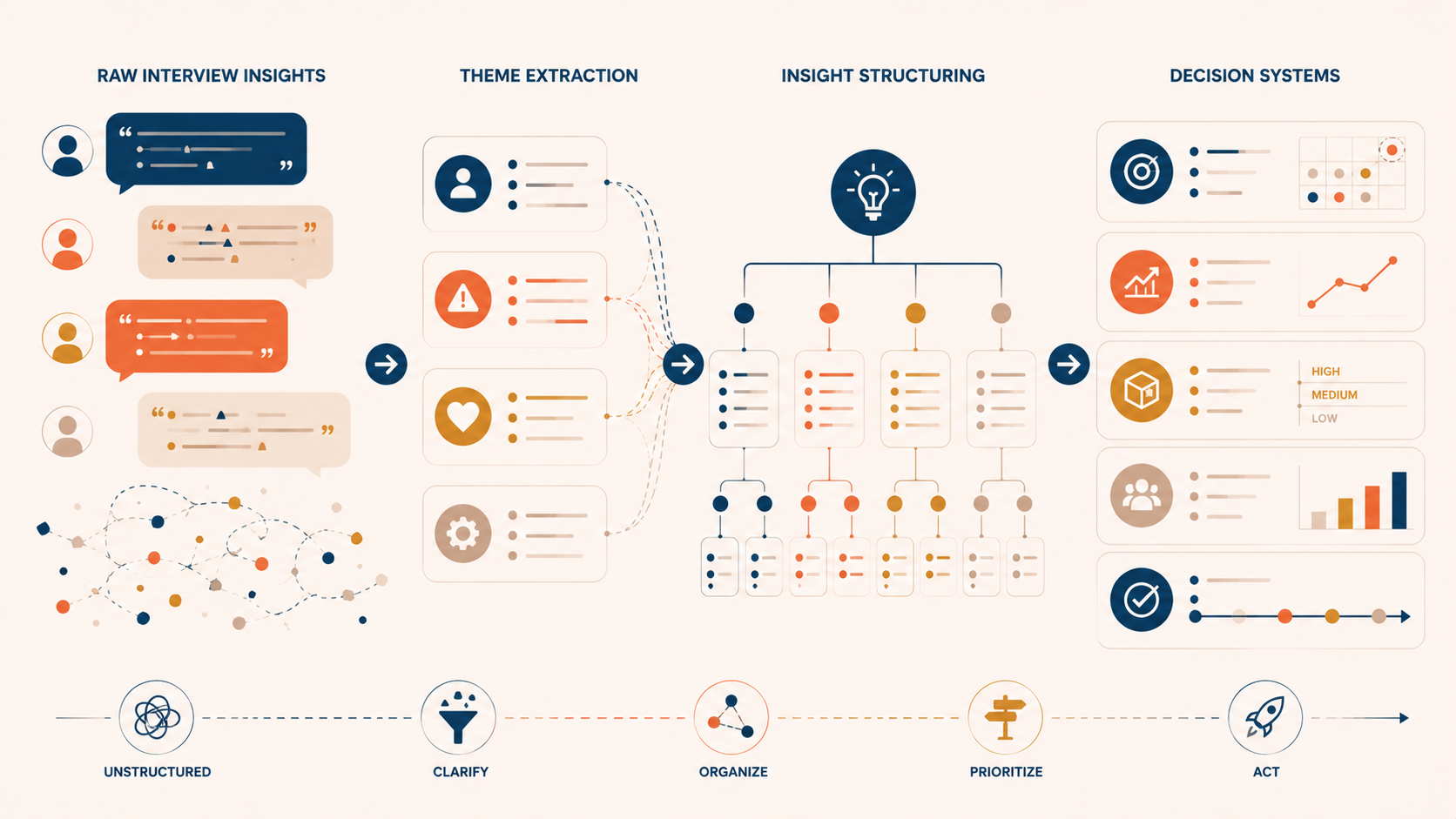
The previous post in this customer interview series covered how to find the right people to talk to and how to write an outreach message that gets a response. That work matters, but it is wasted if what happens next goes wrong. The best customer interview in the world means nothing if you cannot capture what was said, preserve it past the week, and turn it into a decision your team can act on.
Most product managers fail at this transition. The conversation ends, the energy fades, and within a month the only thing left is a vague feeling that “users want flexibility” — a sentence too soft to ship anything against. The fix is not better memory. The fix is a system that runs in three stages: capture during the conversation, preserve the insight in a format that survives months, and structure scattered opportunities so the team can prioritize them. This guide follows the Continuous Discovery Habits framework developed by Teresa Torres, and walks through each stage: note-taking, the interview snapshot, and the opportunity solution tree.
Customer Interview Note-Taking: What to Capture During the Conversation
The hardest part of a customer interview is not asking good questions. It is writing down the right things while the conversation is still moving. Most notes end up useless because the interviewer recorded their impressions instead of the raw material that impressions can be rebuilt from later. Good note-taking is closer to a reporter’s notebook than a meeting summary.
The 4 Categories You Must Capture in Every Interview

Four kinds of data carry almost all the value in an interview transcript. Miss them and the notes go flat within a week.
1. Exact quotes. When a customer says something that matters, write it down word for word.
- “I’ve tried three different tools, and they all failed because…”
- “Honestly, ‘confusing’ is probably the right word for it.”
- “The worst is when…”
Direct quotes are the single most persuasive material you will have when you present findings to stakeholders. A paraphrase argues; a quote shows.
2. Specific facts. Numbers, frequencies, concrete instances.
- “I spend about four hours on this every Friday.”
- “It runs us roughly $600 a month.”
- “Last Tuesday I had to restart the process three times.”
Facts are verifiable. They beat opinions because they survive scrutiny from a skeptical engineer or finance partner.
3. Emotion and energy. Mark the moments the customer’s tone or energy shifts.
- “Visibly frustrated when talking about _.”
- “Lit up when _ came up.”
- “Voice dropped when mentioning _.”
Emotion signals importance. Where the energy spikes, a real problem or a real opportunity is usually sitting.
4. Gaps and contradictions. Note where the customer’s words and behavior do not line up.
- “Said price isn’t important, but earlier mentioned switching services to save $40/month.”
- “Said they use that feature weekly, but couldn’t recall the last time they actually opened it.”
These contradictions often expose the truth hiding behind a polite answer.
A useful way to think about all four categories: a good reporter’s notebook never says “the mood was good.” It captures the exact words, the specific numbers, the change in facial expression, and the places where the story did not quite add up. Bring those four back and you can write a vivid article months later. Bring back only your impressions and you have nothing.
3 Common Note-Taking Mistakes and How to Avoid Them
Three failure patterns show up in almost every set of interview notes. Each one is fixable in the moment if you catch it.
Mistake 1: Writing down “usually” or “always” as fact. When a customer says “I usually do X” or “I always handle it this way,” do not log it as a fact. Probe immediately.
- “Tell me about the last time that happened.”
- “Can you walk me through a specific example?”
Convert the generalization into a concrete story, then record the story.
Mistake 2: Capturing vague praise. “I love it!” or “That sounds great!” is not an insight. Dig deeper.
- “What specifically do you like about it?”
- “Can you share an example of when that helped?”
Don’t write down the compliment. Write down what you learn after you push past it.
Mistake 3: Logging feature requests without context. Do not just write “wants X feature.” Capture the why.
- “Asked for calendar integration. Currently bouncing between three apps to schedule one meeting.”
- “Asked for bulk edit. Processing 50 items one at a time takes more than two hours.”
Why beats what. A list of requested features without their underlying pain is a wish list, not a research output.
A doctor who copies “I always get headaches” straight into the patient chart cannot diagnose anything. They need “Tuesday, 3 p.m., two-hour duration after a meeting, painkiller taken.” Customer interview notes work the same way. Generalizations cannot be acted on; specific facts can.
Your During- and Post-Interview Note-Taking System
Treat the live interview and the hour after as two different modes.
During the interview. Stay in capture mode. Use a plain text file or a simple notebook — nothing that pulls your attention into formatting. Get quotes down verbatim where you can. Drop a timestamp at any moment that feels important (“15:30 — describing the workaround”). Mark anything you want to follow up on with a star or highlight. Do not try to organize. Organizing kills listening.
Right after the interview. Inside one to two hours, while the memory is still warm, do the second pass. Fill in the gaps you couldn’t write fast enough to catch. Add the context you remember but didn’t note. Highlight the three to five insights that feel most important. Log any questions the interview opened up.
The same principle applies to organizing photos after a trip. During the trip you shoot whatever catches your eye; the moment you get home, you sort and label, because by next week you won’t remember which café that photo was taken in. Interview notes evaporate the same way. Without an immediate second pass, you keep the words and lose the context.
Interview Snapshots: How to Preserve Insights for Months and Years
Raw notes fade fast.
- After a week, you cannot reliably tell which customer said what.
- After a month, the whole conversation goes soft at the edges.
- After three months, the notes are essentially archaeological — present, but unreadable without effort.
The interview snapshot, a format introduced by Teresa Torres in Continuous Discovery Habits, solves this. A snapshot is a one-page summary that captures the heart of a single conversation. It has two jobs: keep the key details accessible to you months later, and put the actual customer’s voice in front of stakeholders when you need to make the case for a decision.
An Interview Snapshot Example: Anatomy of a One-Pager
A good snapshot fits on a single page and follows a consistent structure. Here is what one looks like for a customer named Seoyeon Kim, an operations manager at a small artisan bakery.
Name: Seoyeon Kim
Title: Operations Manager, artisan bakery
Photo: [profile photo]

Memorable Quote:
"I tried five different scheduling apps.
Every one of them assumes you have predictable staffing demand.
We don't."

Key Facts:
- Manages 18 part-time staff across 2 locations
- Spends 4–5 hours per week building the schedule
- Staff availability shifts daily based on school schedules and side jobs
- Current tools: Google Sheets + group text messages
- Loses roughly $600/month to over-staffing during slow hours

Core Insights:
- Needs same-day schedule adjustments, not weekly planning
- Willing to pay more for accuracy than for features
- Mobile-first is non-negotiable (rarely at a desk)
- POS integration would eliminate manual sales tracking

Opportunities:
- "When a staff member calls in sick, I want to message everyone who's available."
- "Before I finalize the schedule, I want to see what next week's labor cost will be."
- "I want a quick way to see who's close to their overtime cap."

Context Quote:
"Last Tuesday a baker called out sick at 5 a.m.
I spent 45 minutes texting people one by one to find a replacement.
By the time someone said yes, I'd already decided to come in myself.
A tool that pings everyone who's marked as available
would have saved that morning."
The structure is deliberately rigid. Same fields, same order, every time. That consistency is what lets you scan across ten snapshots three months later and still recognize patterns.
3 Reasons Why Snapshots Beat Raw Notes
A snapshot does three jobs that raw notes cannot.
For yourself. Three months after the interview, you can open the snapshot and immediately remember why a particular feature mattered to a particular person. Raw notes force you to re-read transcripts and rebuild context. Snapshots restore context in seconds.
For stakeholders. Instead of arguing in the abstract that “users want scheduling flexibility,” you put Seoyeon’s snapshot on the screen. The exact words, the actual numbers, the concrete morning that broke. The customer makes the argument; you just hold the microphone.
For the team. Designers can visualize who they are designing for. Engineers can ground their constraints in a real human need rather than an abstract persona. Everyone aligns around a real person, not a composite.
The medical chart is the closest analogy. A doctor does not start from scratch at every visit. They open the chart, scan the history, the chief complaints, and the allergies, and recover the full context in under a minute. A snapshot does the same for an interview — one page, one person, the whole conversation accessible at a glance months later.
The Opportunity Solution Tree: How to Structure Scattered Insights
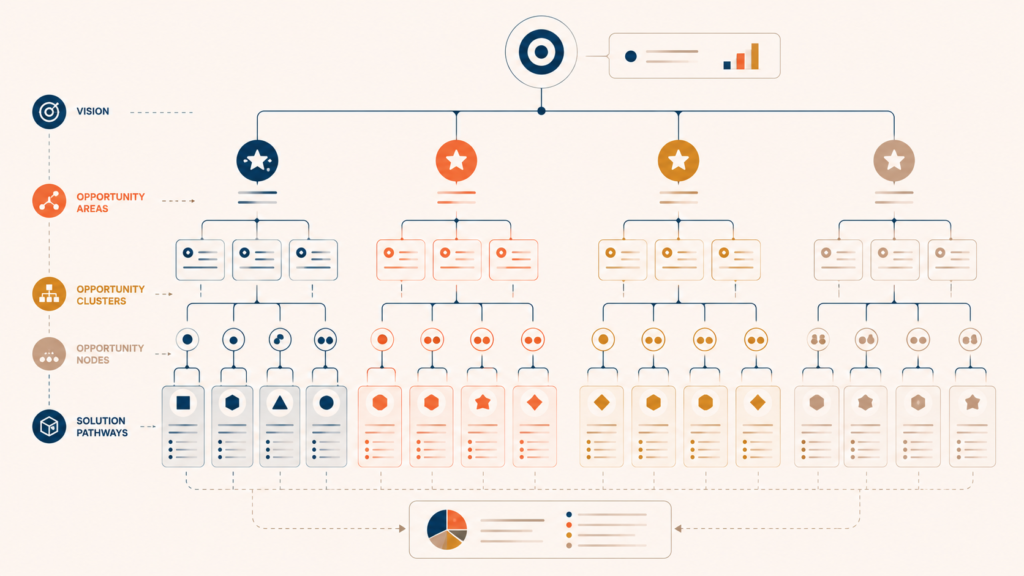
After a handful of interviews, the snapshots pile up. Each one surfaces opportunities — some large and vague (“scheduling is hard”), some small and specific (“I can’t see who’s close to overtime”). Without structure, the pile is unworkable. You cannot prioritize what you cannot see in relation to other things.
The opportunity solution tree, another tool from Teresa Torres’s Continuous Discovery Habits, converts that pile into a visual hierarchy. The tree makes it possible to see which opportunities are parents of others, which ones are leverage points, and which ones are too narrow to spend a sprint on.
Understanding the Opportunity Solution Tree
The tree starts with a desired outcome at the top and branches downward into progressively more specific opportunities. Each parent opportunity contains one or more sub-opportunities. The hierarchy tells you which problems sit underneath which other problems, so you can find the leverage points: a parent opportunity that, if solved, knocks out several child opportunities at the same time.
Example:
Desired Outcome: Increase weekly platform engagement by 30%
    |
    ├─ Opportunity: Users can't find relevant content
    |   ├─ Sub-opportunity: Search doesn't understand intent
    |   ├─ Sub-opportunity: Recommendations feel random
    |   └─ Sub-opportunity: The navigation menu is overwhelming
    |
    ├─ Opportunity: Users forget to come back to the platform
    |   ├─ Sub-opportunity: No daily reason to return
    |   └─ Sub-opportunity: Notifications feel too generic
    |
    └─ Opportunity: The early experience doesn't build a habit
        ├─ Sub-opportunity: Onboarding doesn't lead to the "aha moment"
        └─ Sub-opportunity: First-time users don't complete the core action
The shape itself does the work. Looking at the tree, you can see that “users can’t find relevant content” is a parent worth attacking, because three downstream problems collapse into it. A narrow fix to the navigation menu, by contrast, only moves one node.
Using the Opportunity Solution Tree to Prioritize Features
Once the tree is built, four decisions become easier.
Prioritize ruthlessly. Focus on parent opportunities. Solving one parent often closes out multiple children at once, which is the definition of leverage.
Test efficiently. Start with the most specific opportunities — the leaves of the tree. They are narrow enough to test quickly, and a quick test informs the parent above them.
Pivot quickly. When a chosen opportunity doesn’t pan out, the alternatives are already mapped. There is no scramble for “what’s next” because the tree shows it.
Communicate clearly. When you present to stakeholders, you don’t push a single idea and hope it lands. You show the full opportunity landscape and explain why you chose this branch over the others. Stakeholders argue better when they can see what was not chosen.
Wrap-Up: Why Great Customer Interviews Change Products (Full Series Checklist)
The difference between a product that ships and a product that succeeds usually comes down to whether the team actually understood the customer’s problem. Good interviews force that understanding. Bad interviews protect the team from it.
Good vs. Bad Customer Interviews: The Outcomes
A good customer interview tends to produce four outcomes:
- It surfaces uncomfortable truths early, when changing direction is still cheap.
- It identifies specific, solvable problems instead of broad themes.
- It generates concrete evidence — quotes, numbers, contradictions — that can persuade stakeholders.
- It ends with commitments (a follow-up meeting, a pilot, a willingness to pay) rather than compliments.
A bad customer interview tends to produce the opposite:
- It uses leading questions to validate assumptions the team already wanted to validate.
- It collects opinions about hypothetical behavior instead of evidence of past behavior.
- It creates false confidence that costs the team months of development time.
- It ends with thank-yous and no defined next step.
The Complete Customer Interview Checklist
Before the next interview, run through this checklist. It rolls up the whole series.
Preparation
- Do you know exactly which assumption this interview is testing?
- Have you prepared at least one “scary question” that could invalidate the current plan?
- Are your questions about past behavior, not hypothetical behavior?
- Are you prepared to listen for at least 70% of the conversation?
- Have you blocked time immediately after the interview to organize notes?
During the interview
- Are you asking about the customer’s life and context, not pitching your ideas?
- Are you converting generalizations (“usually,” “always”) into specific stories?
- Are you probing emotional cues and the root causes behind feature requests?
- Are you capturing direct quotes and concrete facts, not just impressions?
- Are you noting contradictions between what the customer says and what they do?
After the interview
- Have you created an interview snapshot within 24 hours?
- Have you identified at least two or three specific opportunities?
- Have you shared the insights with the team — not just filed the notes away?
- Have you updated the opportunity solution tree?
- Have you adjusted the roadmap or your assumptions based on what you learned?
Process health
- Are you running at least one interview per week?
- Are multiple team members attending or reviewing interviews?
- Has the roadmap actually shifted because of a customer conversation?
- Are you tracking which assumptions have been validated and which have been invalidated?
- Can every major feature on the roadmap be traced back to a specific customer problem?
The best product teams don’t just talk to customers. They run a system that extracts truth from those conversations through structured questions, careful note-taking, organized synthesis, and ruthless prioritization.
Stop asking your mom. Start asking questions that could overturn your current plan. Your business depends on it.
Conclusion
Three stages turn a conversation into a product decision: capture (notes that hold the four categories), preserve (a snapshot that survives months), and structure (an opportunity solution tree that makes prioritization visible). Skip any one of them and the interview’s value leaks out before the team can act on it. Continuous Discovery Habits is not a one-time exercise; it is a weekly rhythm that compounds over time as snapshots stack up and the tree fills out.
This is the final post in the customer interview series. Across the six posts, the series covered the full lifecycle — purpose, types, question rules, frameworks, recruiting, and now synthesis. Each piece is designed to be useful on its own, but the system is strongest when run end to end.
Customer Interview Series
(1) Customer Interviews: The Real Purpose and 4 Warning Signs You’re Doing It Wrong
(2) 4 Types of User Interviews and the One Principle That Makes Them Work
(3) The Mom Test: 3 Rules for Asking Better Customer Interview Questions
(4) Customer Interview Questions: A 3-Step Framework and Ready-to-Use Question Library