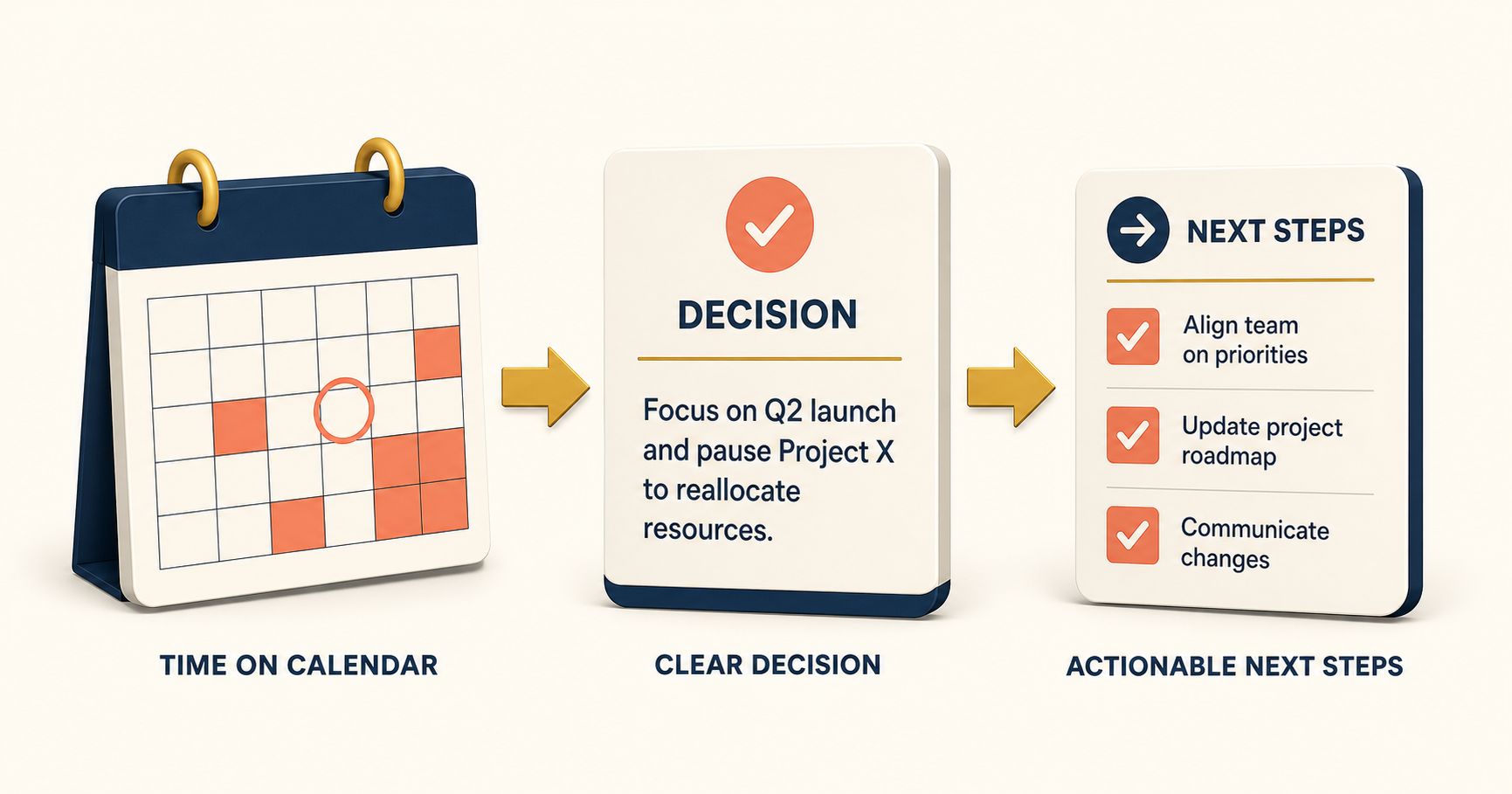
Meetings quietly drain product teams more than almost any other activity, and most teams underestimate the cost. A one-hour meeting with ten people does not cost one hour. It costs ten hours of focused attention, plus the time each person spends rebuilding their concentration afterward. That is a serious organizational investment, and yet meetings get scheduled with less scrutiny than a small line item in a budget.
The difference between a useful meeting and a draining one rarely comes down to the people in the room. It comes down to the structure around the conversation. The previous article in this decision-driven productivity series covered the three questions to ask before starting any work and a framework for faster, better decisions. This article focuses on the environment where most of those decisions actually happen: meetings. The sections ahead cover the true cost of meetings, the five pillars that separate effective meetings from wasteful ones, and the anti-patterns that quietly kill productivity even on well-intentioned teams.
If you want to know how to run effective meetings without simply running fewer of them, the answer is not discipline. It is structure.
Understanding the True Cost of Meetings
Meetings are not inherently bad. They are inherently expensive. The cost just does not show up on a balance sheet, so teams underestimate it. It shows up as lost focus, delayed work, and fragmented attention spread across the week.
To make meetings productive, the first step is understanding what they actually consume.
The synchronous constraint
Every meeting has one unavoidable property: everyone has to be present at the same time. The moment a meeting is scheduled, three things happen:
- Attendees stop whatever else they were doing
- Focused work before and after the meeting gets interrupted
- Each context switch adds recovery time on top of the meeting itself
A one-hour meeting with ten people does not cost one hour. It costs ten hours of focused time, plus the additional time each person needs to rebuild momentum. That is a substantial organizational investment.
This is why “Can I borrow an hour of your time?” is a misleading question. What it actually asks is:
“Can the organization afford to pause meaningful work for several people right now, because this meeting matters more than what they were doing?”
If a meeting does not produce a decision or unblock work, it is not creating value. It is consuming a significant resource.
The opportunity cost of fragmented attention
The most harmful meetings are not the long ones. They are the unnecessary ones.
Every meeting displaces something else:
- Writing
- Thinking
- Building
- Talking with users
The cost is not only the time spent in the meeting room. The cost is the work that did not happen because attention was somewhere else.
This hits hardest for roles that depend on long stretches of focus — engineers, designers, writers. Fragmented calendars make it hard to reach the deep work state where real progress happens.
Signals that a meeting should not exist
Some meetings look reasonable on the surface but do not survive a closer look. Common warning signs:
- “Let’s think through this together” without any pre-reading
- A discussion among people who do not own the decision
- A topic that could be resolved in a document
- A status update with no interaction needed
These meetings often end with more meetings. They do not reduce uncertainty. They spread it.
If a meeting cannot clearly answer “What will be different because of this?”, it is better not held.
Meetings are decisions about how a team spends its most expensive shared resource. Effective leaders treat meeting time not as a default communication channel, but as a scarce, shared resource.
This shift alone changes behavior:
- Attendee lists shrink
- Agendas get sharper
- Preparation improves
Meetings stop being where thinking starts and become where thinking gets resolved.
A physical conference room is limited, so people book it only when they really need it. Other people’s focused time is just as limited. The same discipline that protects physical space should protect attention.
Understanding the cost sets the standard. The next step is making sure the meetings that do happen are worth that cost.
Pillar 1: A Clear Purpose
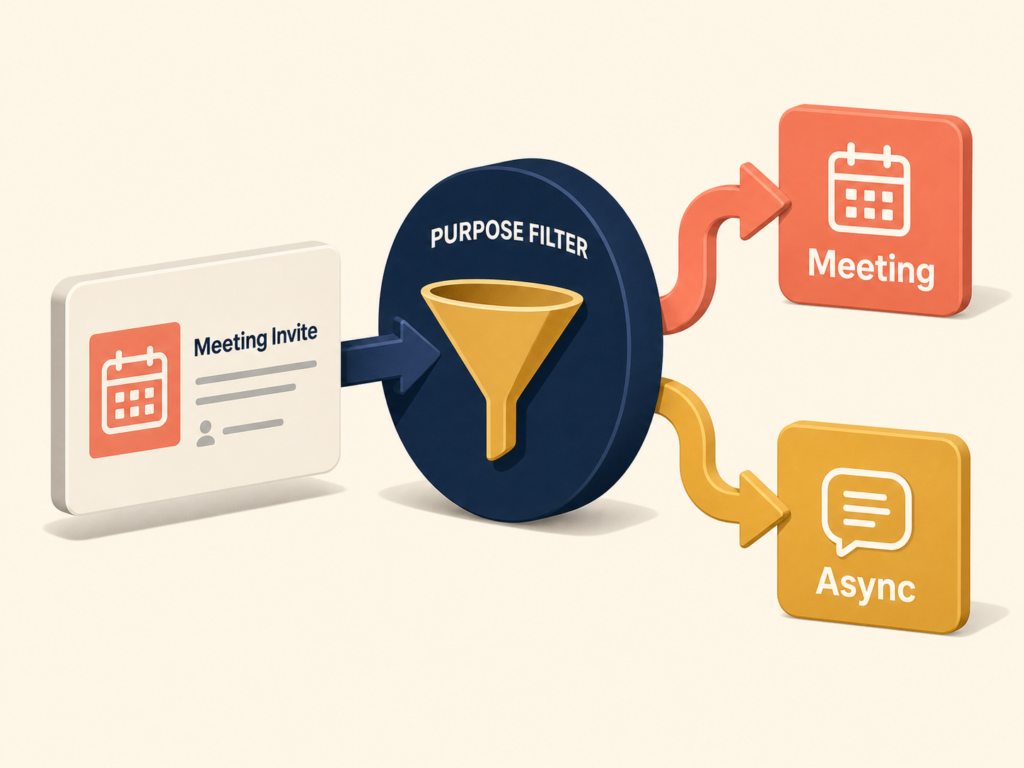
Every meeting should exist for one primary purpose. Before sending an invite, it helps to complete this sentence:
“This meeting exists so we can _.”
That purpose almost always falls into one of three categories:
- Share context or direction (inform)
- Make an approval decision (approve)
- Solve a complex problem together (collaborate)
Naming the purpose ahead of time sets expectations. People prepare differently depending on whether they are being informed, asked to approve, or asked to contribute.
Ambiguous purpose leads to ambiguous outcomes. If the purpose cannot be stated in a sentence, the meeting is doing exploratory work that should happen somewhere else first.
Cooking without a target — “let’s make something” — leads to wasted ingredients and confusion. “Let’s make beef stew” instantly clarifies what to buy and in what order to do things. A meeting works the same way: a title like “Decide which onboarding flow to ship” tells attendees how to prepare.
Pillar 2: The Right Attendees
More people in a meeting do not produce better decisions. Each additional attendee increases:
- Coordination cost
- Social pressure
- Time spent on context setting
Two questions help shape an invite list:
- Who is required for this decision to actually happen?
- Who does not need to attend but should be informed afterward?
Separating required from optional attendees reduces bloat and gives people permission to skip without guilt.
It also clarifies ownership. When it is obvious who is responsible for the decision, the decision moves faster.
Putting thirty players on a soccer field does not improve the game. Eleven players in the right positions do. The rest follow along from the bench. Meetings work the same way — only the people essential to the decision attend, and everyone else gets the result.
Pillar 3: Preparation Before the Meeting
A meeting should not be where thinking starts. Preparation shifts cognitive load to asynchronous time, where people can think more carefully and on their own schedule. This is the most important place to draw the line between synchronous and asynchronous communication.
The shape of the preparation depends on the purpose:
- Inform: a clear narrative that minimizes ambiguity
- Approve: background, options considered, and risks
- Collaborate: the problem framing, constraints, and relevant data
Sharing this material at least a day in advance gives people time to absorb and reflect.
When preparation is skipped, meetings fill up with clarifying questions and context resetting. Preparation is, more than anything else, a way to respect other people’s time.
Pillar 4: Facilitation
Even a well-prepared meeting can drift without facilitation. The facilitator’s job is not to dominate the conversation but to protect it.
Effective facilitation involves:
- Anchoring discussion to the purpose
- Managing time intentionally
- Inviting quieter voices without forcing consensus
This role usually falls to the person who called the meeting, but it does not have to. What matters is that someone is deliberately guiding the flow.
Good facilitation makes a meeting a space for decisions, not speeches.
Pillar 5: Clear Next Steps
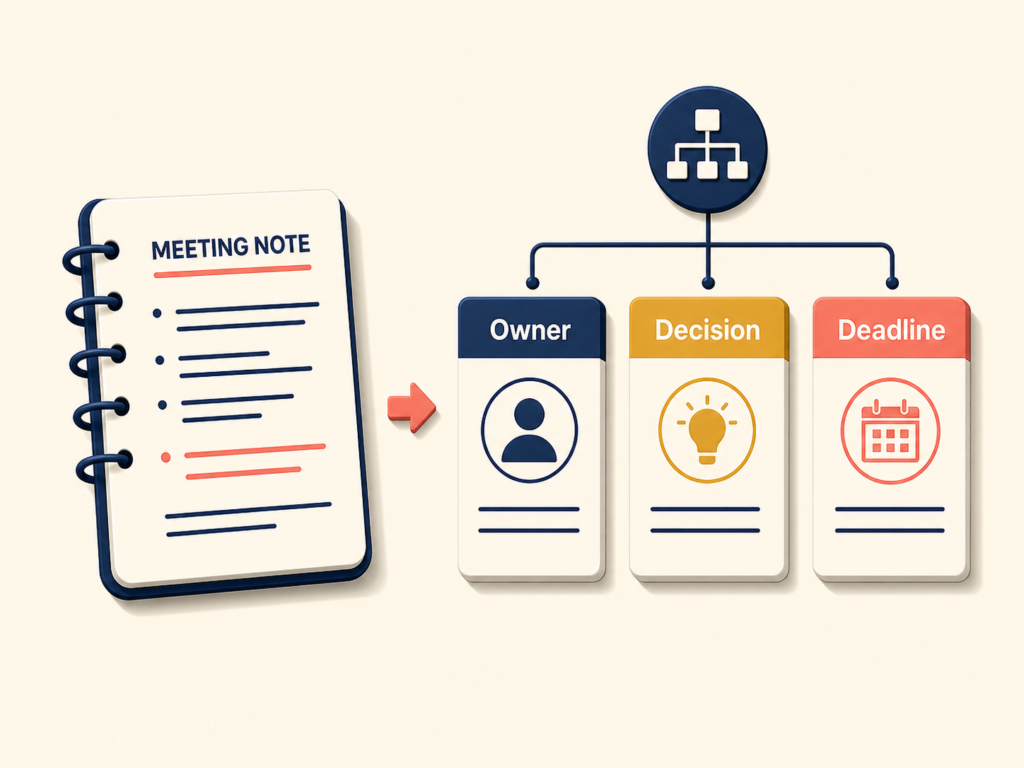
A meeting without follow-through is unfinished work. Before adjourning, four things should be explicit:
- What was decided
- What is still open
- Who owns the next action
- When the team will check in
Writing this down and sharing it right after the meeting prevents quiet re-litigation later.
Many meetings fail not because the conversation was bad, but because nothing changed after. The discussion felt productive, but no one could point to what shifted.
Even a great doctor’s visit changes nothing without a prescription. “What, who, and by when” is the prescription a meeting gives the team.
Meeting Anti-Patterns That Kill Productivity
Even well-intentioned teams fall into meeting traps. These patterns persist not because anyone wants bad meetings, but because the underlying decision-making problem has not been solved.
Recognizing the anti-pattern is often enough to break it.
The abstract meeting
This meeting starts with a vague purpose:
- “Let’s align.”
- “Let’s think through this together.”
- “Let’s talk about it.”
No concrete problem is named. No decision scope is set.
What follows is predictable:
- Conversation drifts toward concepts instead of specifics
- Attendees end up talking past each other
- Time runs out before anything actionable surfaces
The problem is not the discussion. The problem is the abstraction.
Productive meetings are anchored to something concrete — a specific user pain, a specific decision to be made, a specific constraint to explore. Without that anchor, meetings become philosophical rather than operational.
The “let’s just sync” habit
This is the most common meeting addiction. The question shifts from “What do we need to decide?” to “When can we meet?”
Symptoms include:
- Recurring meetings with unchanged agendas
- Meetings that demand synchronous time for things a short written update would resolve
- Status updates where no interaction is needed
The habit feels efficient because it centralizes communication. In reality, it shifts the cost. When people rely on meetings to process information, they stop doing the harder, more valuable work of organizing their thinking in advance.
Endless re-litigation
People keep returning to the same topic — not because they disagree, but because no one is sure what was decided last time.
This creates:
- Frustration from people who thought the issue was settled
- Hesitation to commit, since decisions seem reopenable
- Erosion of trust in the team’s process
Clear records, even short summaries, prevent this loop. Memory is unreliable. Writing is cheap. Use it generously.
Conclusion
Meetings are decisions about how a team spends its most expensive shared resource — collective attention. Treating them that way is what separates productive meeting cultures from busy ones.
The five pillars — a clear purpose, the right attendees, preparation, facilitation, and clear next steps — turn meetings from default to deliberate. Awareness of the common anti-patterns (the abstract meeting, the reflexive sync, endless re-litigation) keeps a team from drifting back into wasteful patterns.
Meeting productivity is not about running fewer meetings for the sake of it. It is about making sure each meeting clears a higher bar than the alternative use of that time. The next article in this series moves from team-level practices to personal productivity habits and a decision-culture checklist that ties the whole framework together.
Decision-Driven Productivity Series
(1) 7 Core Principles of Decision-Driven Team Productivity
(2) Decision-Making Framework: Three Questions and Tools for Better Decisions
(3) How to Run Effective Meetings: 5 Pillars and Anti-Patterns to Avoid
(4) Decision-Driven Productivity in Practice: Personal Habits, Templates, and Culture Checklists