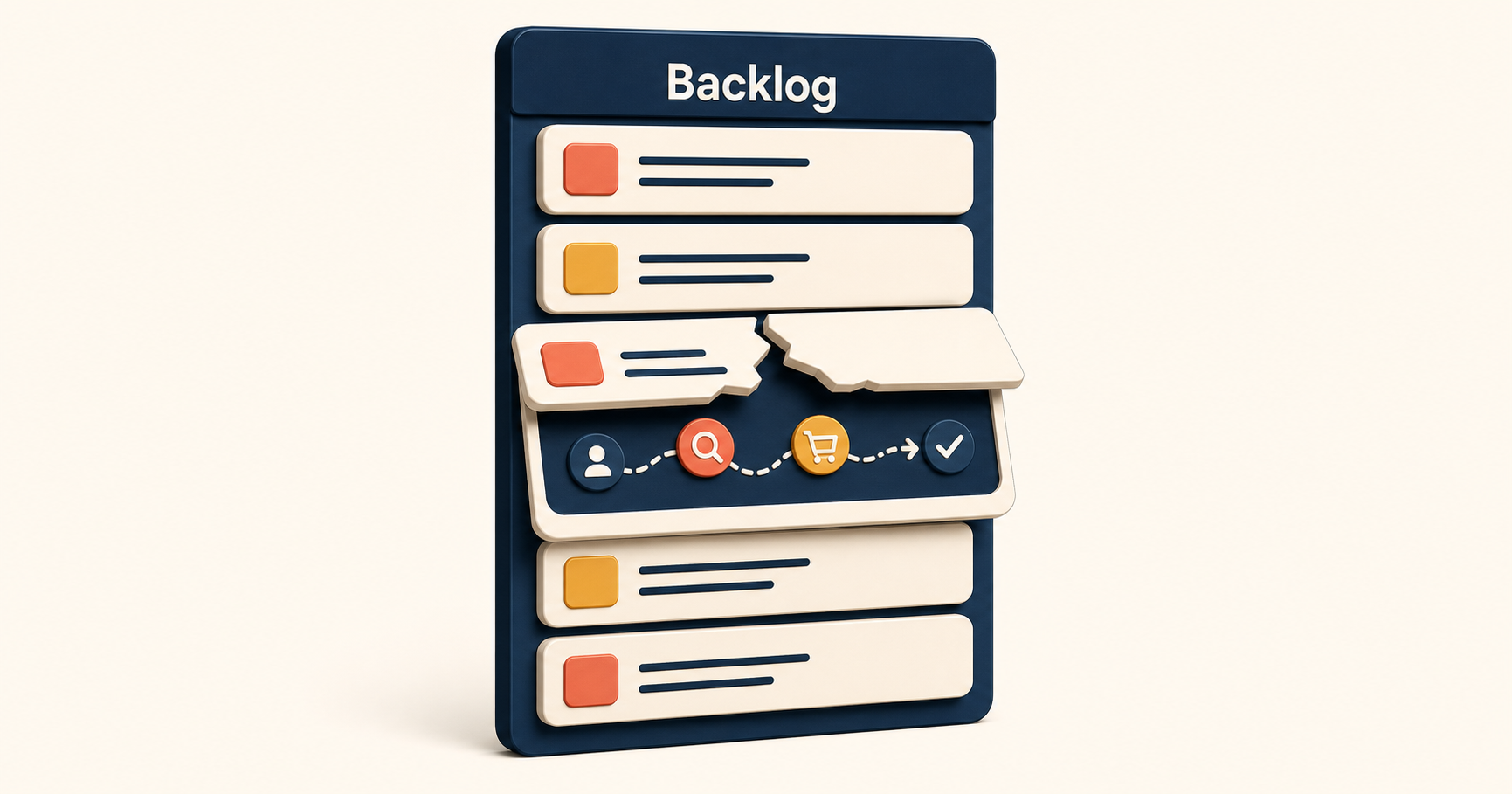
If you have worked on an agile team, you have probably watched user stories drift away from their original purpose. Stories become tickets that fill a sprint, checklists for marking work “done,” or a substitute for actually thinking through a problem. Across this series, we look at user story mapping not as a deliverable, but as a tool for building shared understanding inside a team and driving better product conversations.
The series follows the perspective set out in Jeff Patton’s user story mapping work — stories are tools for shared understanding, not fixed requirements. This first post is a diagnostic: where agile user stories quietly go wrong, and why even teams that “agree on everything” still ship features that miss the point.
Why Features Fail Even When Everyone Agrees
A stakeholder says:
“Customers need to export their analytics report as a CSV.”
The team turns it into a story:
“As a user, I can export a report as a CSV.”
Engineering builds it. QA signs off. It looks done. Then support starts hearing about it:
“The CSV is missing the time zone.”
“The totals don’t match what I see in the dashboard.”
“The file is too big to open in Excel.”
“I actually needed it emailed on a schedule, not a button.”
These failures are not engineering failures. The story passed every check it was supposed to pass. What it didn’t do was trigger the right conversation.
What the story left out was any real picture of the user. A useful story would have surfaced:
- Who exports the report, and why do they need it?
- What happens after the CSV is downloaded?
- What accuracy and format count as “usable”?
- What constraints exist (Excel row limits, localization, permissions)?
- What is the actual Job-to-be-Done — exporting, sharing, or auditing?
A “story as ticket” hides these questions. A “story as conversation” forces them into the open.
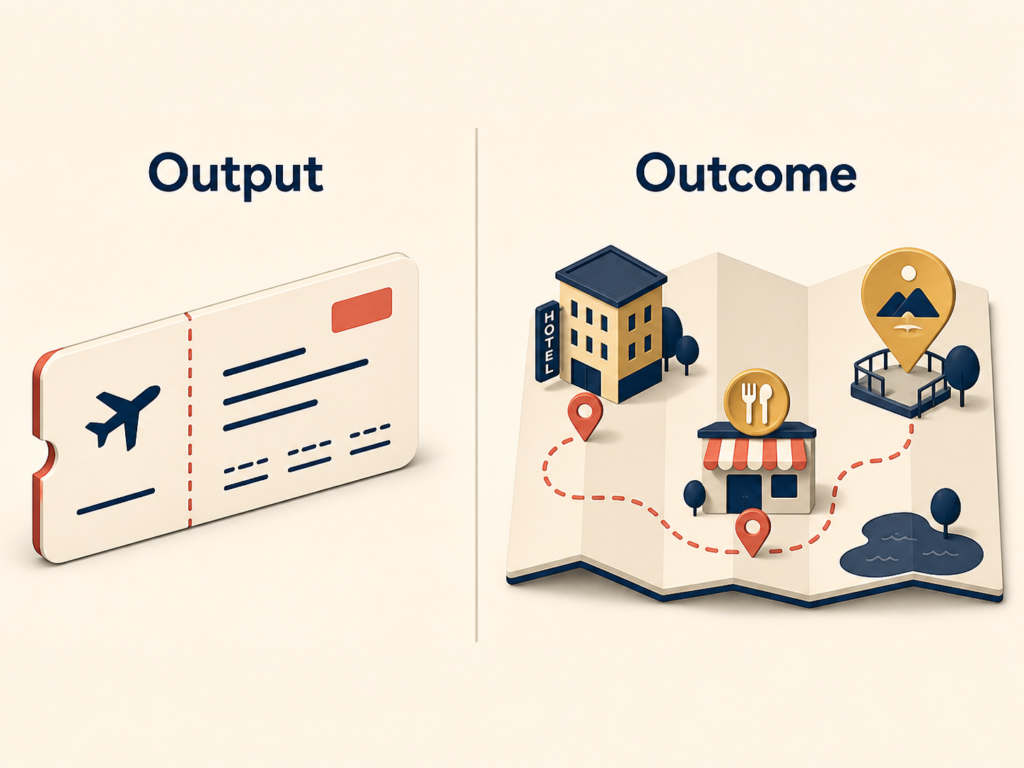
Think of it like asking a travel agent for “a plane ticket to Paris.” The agent will happily book the ticket. But what the traveler actually wanted was “three nights in a hotel with an Eiffel Tower view for our honeymoon, plus local restaurants we’d love.” The ticket (output) gets delivered, but the trip (outcome) is missed. Stories work the same way: the surface request always sits on top of a deeper context, and the conversation is how you get to it.
Stories Are Conversations, Not Acceptance Criteria
Most teams use user stories in a way that quietly contradicts what stories were designed for. In a typical lean or agile setup, stories get treated as a unit of work — a way to slice a feature small enough for a sprint. On the surface, that looks reasonable. In practice, something else happens.
The actual user’s story disappears into a sea of finely-sliced requirements that all carry the label “story.” What ships at the end is a “Frankenstein product” — technically correct features that nobody asked for in that shape.
The core problem is this: a story is not an acceptance criterion. It exists to trigger a conversation.
Stories do get used as acceptance criteria during development, and that’s fine. But that is the smallest part of what a story is for. If you reduce a story to its acceptance criteria, you end up reproducing the old waterfall pattern, just with smaller batches — requirements come down from above, and engineers are told to “just build what’s listed.” So what is a user story actually for? Its real job is to lead the team to shared understanding, not to a shared document.
A story should drive a conversation that surfaces:
- What is the user trying to accomplish?
- What is the context around them?
- What can go wrong?
- What does success look like — for both the user and the business?
When those questions get skipped, teams ship features that are “technically correct but weirdly unused.”
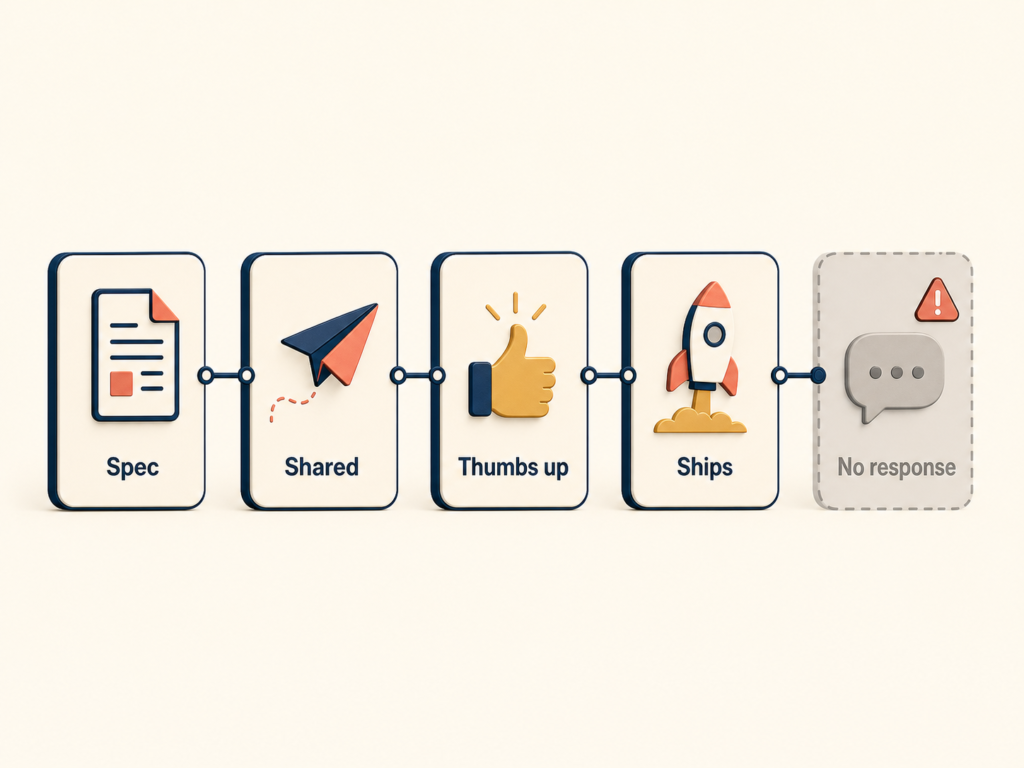
Most teams fall into the same five-step trap:
- The PM writes a detailed spec.
- The spec gets shared in Slack or Notion.
- Everyone reacts with a thumbs up.
- The feature ships.
- Users don’t respond, and the team is surprised.
This happens because a shared document is not the same thing as shared understanding.
Shared understanding looks more like this:
- You understand the user’s context and goals.
- You understand the constraints and edge cases that matter.
- You understand what “success” looks like for both the user and the product.
- You understand what you are deliberately choosing not to do yet.
Documents alone rarely produce that. The gap widens when a product spans multiple layers — UX, backend, analytics, ops, policy, marketing. Each layer reads the same spec through a different lens, and a thumbs up doesn’t reveal which lens.
Shared understanding is knowing what other people on the team believe about the user, why they believe it, and arriving at a single point of agreement. Getting there takes context, two-way conversation, and an environment where someone can keep asking “why?” without it feeling like an interrogation.
The “We’re Agile, We Don’t Write Docs” Myth
One line shows up more often than it should:
“We’re agile now, so we don’t write docs.”
Most people who actually know what agile means treat it as a joke. But when someone says it seriously, it is usually a warning sign. The real problem is not documentation itself. The problem is documentation used as a substitute for shared understanding.
Agile does not mean “no docs.” It means:
- Don’t write docs nobody reads.
- Don’t confuse writing something down with understanding it.
- Don’t let documentation become one-way broadcast.
Healthy product teams still write things down. They just write the kind of things that help with decisions and learning — a photo of a whiteboard after a workshop, a short note that captures “why we decided this.” Those are not info dumps. They are memory aids for decisions.
Think of agile docs the way a working chef thinks about kitchen notes. Nobody rewrites the entire recipe book from scratch every time they cook. But a one-line note — “less salt this time worked better” — pays off the next time the dish comes around. Team documentation should work the same way: not exhaustive specs, but the key decisions and the reasoning behind them, kept short enough to actually use.
Self-Diagnosis: Signs Your Team Is Misusing User Stories
If any of the patterns below sound familiar, story mapping is likely to help:
- Stories get written and assigned with minimal discussion.
- Sprint planning feels like aggressive negotiation rather than discovery about the user.
- Stakeholders treat the backlog as a list of obligations to deliver.
- Engineers feel like “order-takers.”
- “Completed” features ship, but the metrics don’t move.
These are different symptoms of the same underlying issue: stories are being used as tickets, not as conversations.
Conclusion
Most agile teams don’t fail at user stories because they wrote bad sentences. They fail because the story became the work product instead of the conversation that produces the work. The diagnosis here is simple: when stories are tickets, you ship outputs; when stories are conversations, you ship outcomes.
The cure is story mapping — a way of arranging stories that keeps the user’s full journey visible, so the team keeps talking about what actually matters. In the next post, we look at how the word “requirements” quietly shuts down those conversations, and how story mapping shifts a team from outputs to outcomes.
User Story Mapping Series
(1)
(2)
(3)
(4)
(5)
(6)
(7)
(8)