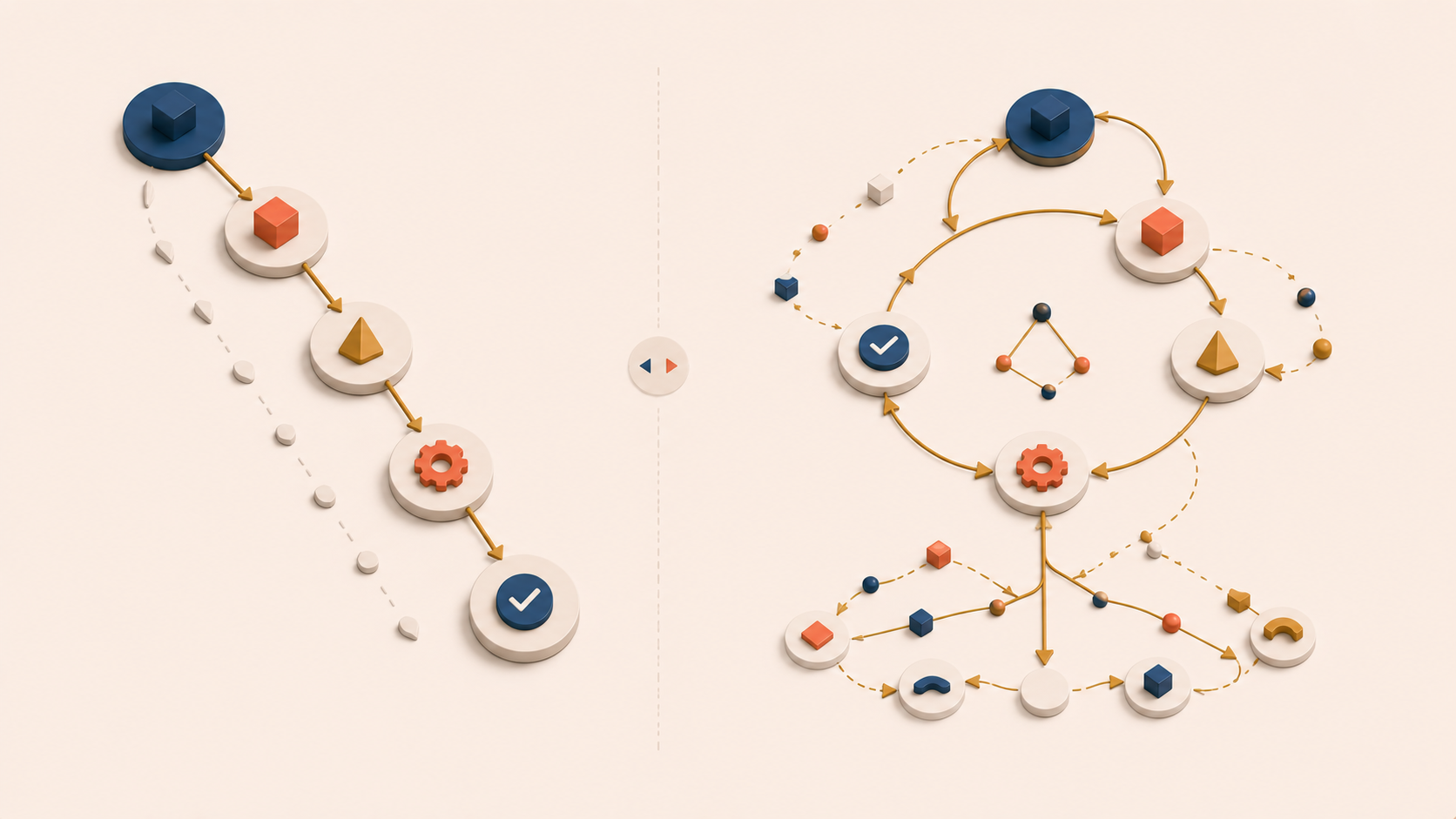
“So… are we doing Waterfall or Agile?”
If you have worked as a product manager, you have heard this question more times than you can count. It sounds simple, but in practice it is easy to misread and often political. Most teams say they are Agile. Look closely at how they actually plan, decide, and validate, and you often find Waterfall thinking underneath.
This guide compares Waterfall and Agile from a PM perspective: what each one is, where Scrum and Kanban fit, why most companies fail at Agile, and how to choose the right framework for your situation. The real question is not “agile vs waterfall” in the abstract — it is which framework reduces the most risk in front of you right now.
What Is Waterfall? The Linear, Sequential Approach
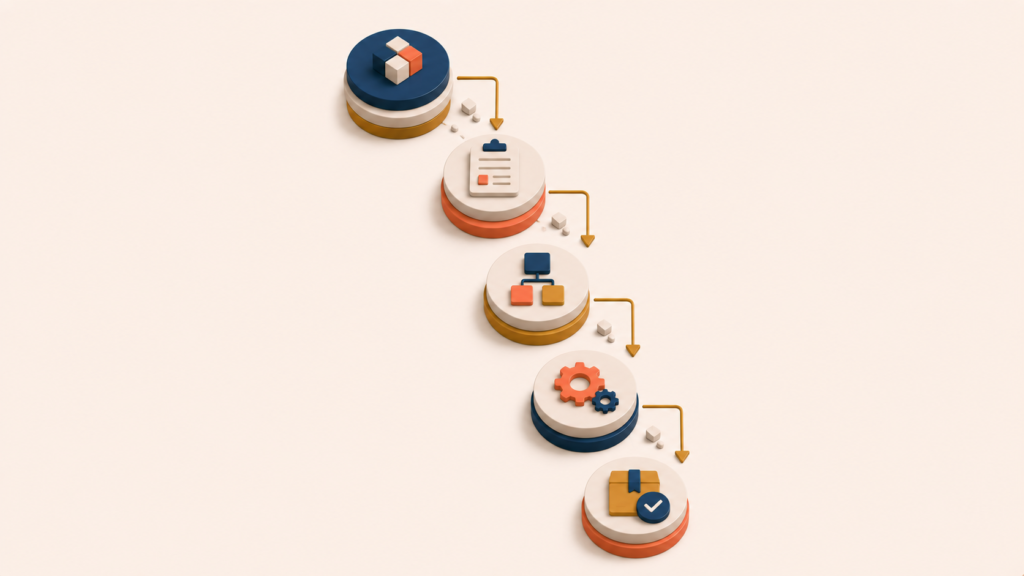
Waterfall is a linear, sequential project management framework in which each phase must finish before the next one begins. Once a stage completes, going back is expensive and rare. Water falls down; it does not run back up.
A Waterfall project follows a fixed lifecycle:
Initiation → Planning → Execution → ClosingRequirements are locked early. From there, the project moves forward with minimal flexibility. Any change has to go through a formal change request, which usually means more cost, more time, and more approvals. Changing a Waterfall plan mid-project is like moving a structural column in a building that is already built — possible, but nothing like deciding it during design.
In Waterfall, the PM is an active leader and manager. The PM:
- Owns the full project plan and timeline
- Defines scope up front
- Allocates resources
- Tracks milestones, cost, and quality
- Reports progress to stakeholders
What Success Looks Like in Waterfall
Success is measured by three classic questions: Was it delivered on time? Was it inside budget? Did it meet the original requirements? The PM here is closer to a train conductor than an explorer. The route is fixed before departure, and the main KPI is arriving on schedule on the rails that were laid down.
This shows up in how Waterfall treats the three constraints:
- Scope: defined early, hard to change
- Cost: planned in advance, tightly managed
- Quality: evaluated at the end against predefined criteria
Change is not impossible in Waterfall, but it is expensive. A change typically requires formal documentation, stakeholder approval, and a re-estimate of cost and timeline. The whole structure favors certainty over learning.
That trade-off is the point. Waterfall fits when requirements are stable, risk is low, and predictability matters more than learning speed. Infrastructure build-outs, compliance-driven projects, and vendor integrations are common examples. The situation looks less like exploring a new market and more like building a standardized apartment block for the fiftieth time: the design is proven, variables are few, and the goal is to finish on time and on budget.
What Is Agile? The Iterative, Adaptive Approach
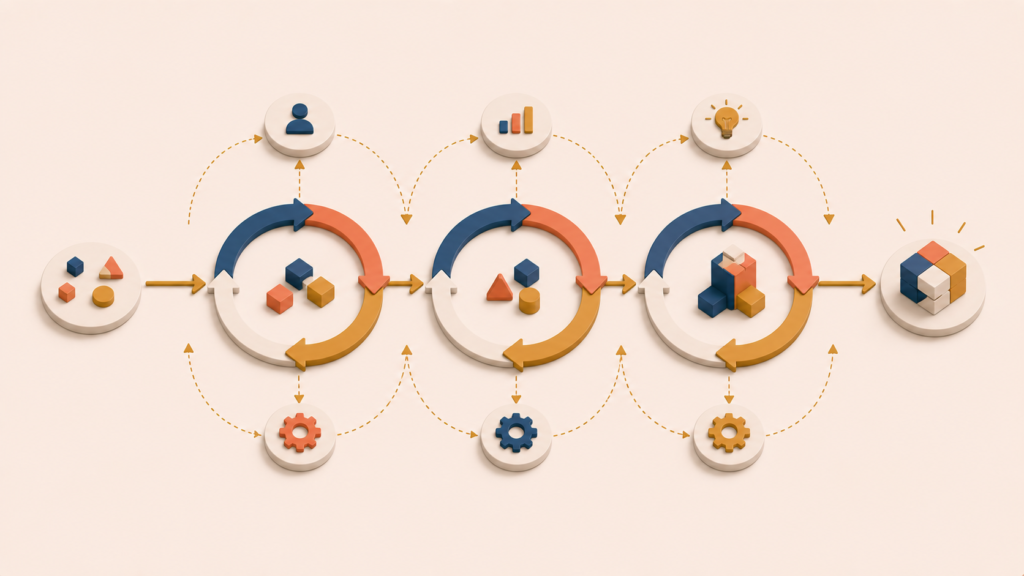
Agile is an iterative, collaborative framework focused on continuous learning, feedback, and value delivery. At its core is the Agile Manifesto, which prioritizes responding to change over following a fixed plan. In practice, Agile is also shaped by Lean principles, especially around learning, flow, and removing waste.
Instead of betting everything on a perfect upfront plan, Agile assumes:
- We do not know everything yet
- Requirements will change
- Learning fast is more valuable than guessing right early
Agile is closer to a navigation app than a printed map. You set a destination, but you re-check traffic at every intersection and adjust the route based on real conditions.
Agile work is broken into short cycles — iterations or sprints. Each cycle, the team:
- Plans a small slice of work
- Builds and ships something usable
- Collects feedback
- Adjusts the plan
Planning is not a one-time event. It is a continuous activity that runs alongside the work.
In Agile, the PM is not a command-and-control manager. The PM:
- Owns product vision and priorities
- Works closely with designers and engineers
- Validates value with users continuously
- Balances business goals with user needs
What an Agile PM optimizes for looks different too: learning speed, customer outcomes, and value delivered per iteration. Agile fits when uncertainty is high and learning matters more than predictability — new products, user-facing features, and innovation-driven work. The Agile PM is closer to an expedition leader than a train conductor: the destination is set, but the path through the jungle is decided as the team walks it, with daily plans rewritten based on what was learned that day.
Agile Is Not Scrum: Scrum vs Kanban
Before comparing Scrum and Kanban, one thing has to be clear: Scrum and Kanban are not Agile. They are ways to practice Agile.
Agile itself is a mindset and a set of principles:
- Deliver value quickly and continuously
- Learn through feedback
- Adapt to change instead of locking in a plan
Scrum and Kanban are frameworks for putting those principles into daily work. If Agile is “living healthy,” Scrum is “exercising at the same time every day” and Kanban is “moving throughout the day whenever you can.” Both serve the same goal; they just structure the behavior differently.
Scrum offers a time-boxed, ritual-driven structure for practicing Agile:
- Fixed-length sprints (usually one to two weeks)
- Defined ceremonies: planning, daily standup, review, retrospective
- Clear roles and a steady cadence
Scrum works well when the problem space is still evolving, when the team needs focus, alignment, and a shared rhythm, and when learning happens through cycles of build, ship, and reflect.
Kanban emphasizes continuous flow over fixed cycles:
- No fixed sprints
- Work is pulled continuously
- Workflow is visualized (To Do → In Progress → Done)
- Work-in-progress (WIP) limits reduce bottlenecks
Kanban fits when work is predictable or repetitive, when interruptions are frequent, and when the goal is throughput optimization and shorter lead time. The choice between Scrum and Kanban is not ideological. Scrum optimizes for focus and learning cycles; Kanban optimizes for flow and efficiency. PMs should pick based on the nature of the work, not team preference, industry trend, or what the last company happened to use.
Why Most Companies Fail at Agile
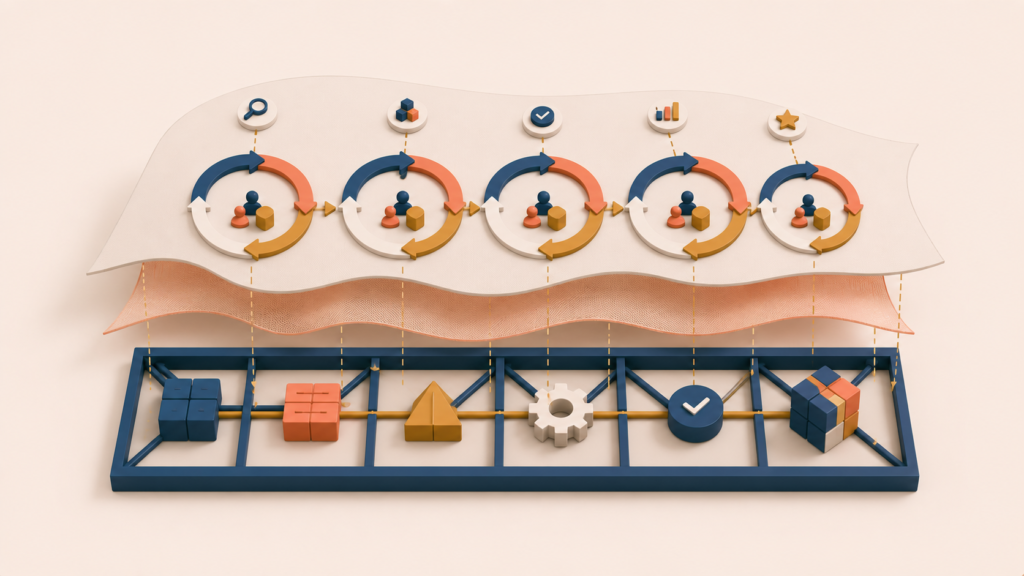
Almost every company today calls itself Agile. They run sprints, hold standups, and use Jira. Many of these teams still struggle to ship meaningful product outcomes. Most companies fail at Agile not because Agile does not work, but because they never adopted real Agile in the first place. On the surface, development looks Agile. Underneath, all the important decisions are already locked. This is Waterfall in a sprint costume.
Agile Starts Too Late
In many organizations, Agile begins at the development phase. Everything before that follows a familiar Waterfall script:
- Leadership decides on the idea
- The roadmap is locked months in advance
- The PM writes detailed requirements
- Designers design to spec
By the time engineers start their first sprint, every major decision is already set. Agile stops being a product strategy and becomes a delivery tactic. It is like an architect finishing the entire design and then telling the construction crew, “Feel free to be creative.” They can rearrange the order of laying bricks, but they cannot change the structure of the building. That is not real freedom.
The Illusion of Certainty
Traditional planning assumes you can answer questions like:
- How much revenue will this feature drive?
- How long will it take?
- What exactly do we need to build?
In most product work, the honest answers are:
- We do not know user behavior yet
- We do not know whether the solution will work
- We do not know what the real constraints are
When the organization demands certainty too early, the PM has to pretend to know things they do not know. That leads to overconfident roadmaps, brittle plans, and resistance to any change. It is like predicting tomorrow’s weather precisely and then planning a six-month-out trip down to the minute — the moment you treat the uncertain as certain, the plan starts drifting away from reality.
PMs Get Reduced to “Requirement Couriers”
In fake-Agile environments, the PM gets treated as a document writer, a backlog groomer, and a stakeholder messenger. The real responsibility — defining the right problem — quietly disappears. When PMs deliver decisions instead of shaping them, the team loses ownership, the discovery work behind great products vanishes, and outcomes get worse. The motions of Agile continue. Product thinking stops. A doctor who writes the prescription the patient asks for, without doing the diagnosis, is still writing prescriptions. They have stopped doing medicine.
Output-Based Success Metrics
Agile also fails when success gets measured the wrong way. Many teams still celebrate:
- Number of features shipped
- Hitting deadlines
- Velocity improvements
Shipping faster is not the same as creating value faster. Without clear outcome metrics, teams optimize for delivery speed only. Customer impact and business results fall out of the picture. Agile turns into a factory instead of a learning system. A restaurant that only measures plates served, not whether customers actually enjoyed the food, has no signal for whether it is doing well. Repeat visits and satisfaction are the real indicators.
How to Choose Between Waterfall and Agile: A PM’s Reality Check
The choice between Waterfall and Agile is not a philosophical debate. For a PM, it is a risk management decision. Strong PMs do not ask, “Which framework is better?” They ask, “Which framework reduces the most risk right now?” Four questions help answer that.
How Well Do You Understand the Problem?
This is the first and most important question. How clearly do you understand the customer problem and the solution space?
Waterfall fits when:
- Requirements are well-defined and stable
- You have solved a similar problem before
- The problem space is already validated
Agile fits when:
- Customer needs are unclear or shifting
- Multiple solution options need to be explored
- Learning itself is the goal
The difference is the difference between a daily commute you have driven a hundred times and a first trip into unmapped terrain. The familiar route rewards precise planning. The unknown rewards adaptability.
What Is the Cost of Change?
Every framework choice is, at the bottom, a judgment about the cost of change.
Waterfall fits when:
- Changes ripple through the whole system
- Rework is expensive
- There are legal, contractual, or compliance constraints
Agile fits when:
- Work can be split into small, testable units
- Iteration and rollback are possible
- Recovery from mistakes is fast
When Can You Validate?
PMs are paid to surface risk early.
Waterfall assumes:
- Meaningful validation happens at the end
- Mid-project feedback has limited value
Agile assumes:
- A partial solution can produce real feedback
- Early validation improves the final result
The difference is tasting a dish only when it is finished versus tasting it while cooking. Tasting mid-way reveals if the salt is off in time to fix it. Tasting only at the end can mean starting the dish over.
What Does the Organization Actually Optimize For?
Frameworks do not work in a vacuum. They sit inside organizations that have their own incentives.
Waterfall fits organizations that:
- Require fixed budgets and timelines
- Value predictability over adaptability
- Centralize decision-making
Agile fits organizations that:
- Treat uncertainty as part of innovation
- Reward learning and experimentation
- Give teams real decision authority
The contrast is closer to a military unit versus a jazz band. A military unit relies on clear command and fixed procedures. A jazz band relies on improvisation and listening to one another. Neither is “better.” Which one fits depends on what music has to be played.
The Real Question to Ask Before Picking a Framework
Before picking a framework, ask one question:
Are we executing a known solution, or are we searching for the right one?
- Executing a known solution → Waterfall
- Searching for the right solution → Agile
Agile reduces uncertainty. Waterfall executes certainty. The question is not which framework is better in general. The question is which framework fits the situation in front of you.
Conclusion
“Waterfall vs Agile” is the wrong frame. The useful question is, “Which framework reduces the most risk for this work right now?” Waterfall is built for known problems where the cost of change is high. Agile is built for unknown problems where the cost of learning late is high. Scrum and Kanban are ways to practice Agile, not Agile itself. Most teams that say they are Agile are actually running Waterfall decisions through Agile delivery. PMs who treat the framework choice as a risk management decision — not a cultural badge — make better calls for their teams and their products.