Knowing what AEIOU stands for is the easy part. Putting it to work in a real research session — and getting insight out the other end — is something else entirely. Most teams that adopt the framework do not fail because they forgot one of the five letters. They fail because they use AEIOU the wrong way, at the wrong moment, for the wrong purpose.
Part 1 of this series covered what the AEIOU framework is and what each of its five elements — Activities, Environments, Interactions, Objects, and Users — captures. This article picks up from there: how to get real value out of AEIOU as one of your core UX research methods, when it shines, and the five most common ways teams quietly misuse it.
Cross-Element Analysis: Where the Real Insights Live

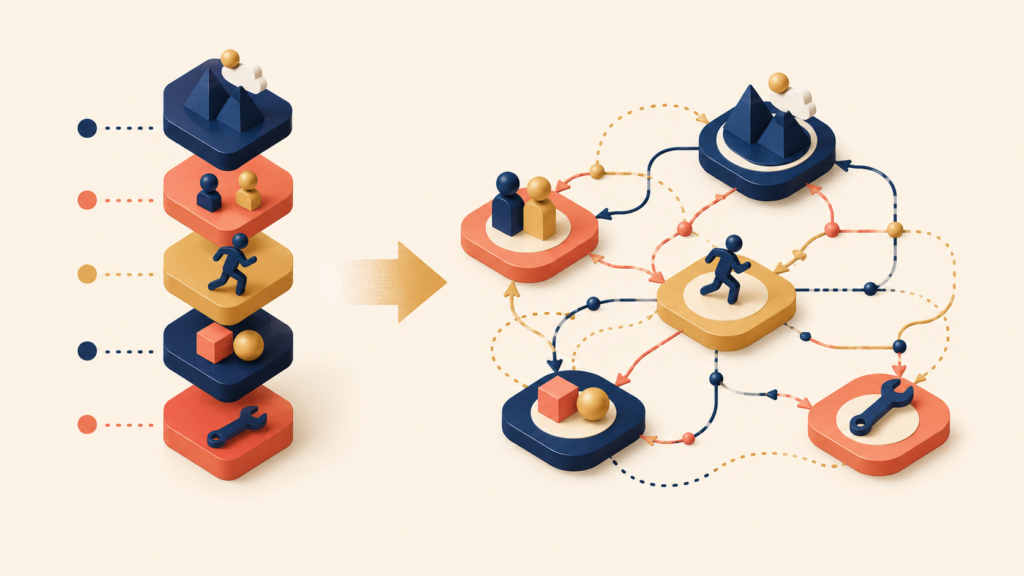
The most useful insights in AEIOU rarely come from any single element. They come from how the five elements interact.
Looking at one column at a time — a list of activities, a list of objects, a list of users — produces tidy notes and very little understanding. The richer signal is in the relationships between columns: how the environment shapes the activity, how a specific object reshapes an interaction, how a user’s role changes the meaning of a tool.
Why each element alone tells half the story
Each AEIOU element is a slice of context. A slice is useful, but it is not the whole picture. A list of activities without the environments those activities adapt to is incomplete. So is a list of objects without the interactions they shape, or a list of users without the roles those users carry.
A list under each letter is a starting point, not an output. The insight starts when you draw lines between letters.
The monthly performance report, revisited
Consider the monthly performance report scenario from Part 1. Seen one behavior at a time, each action looks inefficient or even careless. Seen together, a clear pattern emerges.
The user’s personal spreadsheet, kept open beside the official system, isn’t a quirk of preference. It is a response to a specific combination of forces:
- High accountability for the final numbers (Activities, Users)
- Limited control once a request has been submitted (Interactions)
- Constrained focus time in the environment they work in (Environments)
Looked at this way, AEIOU helps you reframe the question. Instead of asking “Why is this user working in such a convoluted way?”, you start to ask:
“What changed in the system, and how did the behavior adapt?”
That single shift prevents a lot of shallow conclusions about “user error” or “tool misuse.”
Reframing “user error” as a system response
A good analogy for cross-element analysis is investigating a traffic accident. You can’t determine the cause from the condition of the car (an object) alone. You have to cross-reference the road conditions (environment), the driver’s state (user), the relationship with other vehicles (interactions), and the purpose of the trip (activity). Only by reading these together do you understand why the accident happened.
The same logic applies to behavior in a product. Cross-element qualitative research data analysis is what turns AEIOU from a categorization tool into a diagnostic one.
When AEIOU Is at Its Best
Like most frameworks, AEIOU is not equally useful all the time. It shines in specific moments — typically when ambiguity is high and shared understanding is low. Three situations stand out.
Early exploration and product discovery
AEIOU is at its strongest when a team is still figuring out what is actually going on. In early discovery, teams often face questions like:
- What problems are people actually running into?
- Are we solving the right thing?
- Why does the current solution feel unsatisfying?
Jumping straight to hypotheses or metrics in that situation narrows the field of view too quickly. AEIOU keeps exploration broad without letting it drift into vagueness. It gives early observation a structure without forcing premature conclusions.
Field research and contextual observation
AEIOU was designed with real-world observation in mind. It works best when you can watch behavior unfold in its natural setting, rather than in a controlled test. Typical formats include:
- Shadowing at someone’s place of work
- Site visits
- Ride-alongs
- Service walkthroughs
- Contextual interviews and contextual inquiry sessions
In these environments, the unexpected details are the valuable ones. AEIOU provides a mental model for noticing things that interviews alone rarely surface:
- Interruptions no one anticipated
- Tools people rely on but never mention
- Social dynamics that quietly shape decisions
A useful comparison: an ecologist observing animals in their natural habitat learns very different things than one watching the same species in a lab. The lab (a usability test) reveals controlled behavior. The habitat (the field) reveals real survival strategies.
When you need to reframe the problem
AEIOU is also useful after initial research, when a team has data, interviews, and even a proposed solution — but progress has stalled. Often, the issue isn’t a lack of research. It is that the problem has been framed too narrowly.
Re-mapping what you already know through AEIOU can expose blind spots:
- Is this really a usability problem, or an environment problem?
- Is user frustration driven by the tool, or by the interaction model around it?
- Are we optimizing an object while ignoring the activity it is meant to support?
Used this way, AEIOU becomes a way to audit your own framing before committing to a direction.
5 Common Ways Teams Misuse AEIOU
AEIOU feels simple enough to use intuitively. That is exactly why it is easy to misuse. The five mistakes below show up across teams of all sizes and seniority.
Mistake 1: Treating AEIOU as a sorting task
The most common misuse is applying AEIOU only after observation, as a way to tidy up notes. The output usually looks something like this:
- Activities: a few notes about tasks
- Environments: a few notes about location
- Interactions: a few notes about clicks or conversations
- Objects: a list of tools
- Users: a persona summary
It looks neat. The insights underneath are shallow. This usually happens because the framework was applied too late, the observation itself wasn’t guided by the categories, or the relationships between elements were ignored.
AEIOU works best during observation, where it shapes what you pay attention to in real time. Used afterwards, it can confirm what you already noticed, but it rarely surfaces anything new.
Mistake 2: Overfocusing on “users” and ignoring the rest
Another common pattern is treating the U in AEIOU as the only column that matters. Teams spend most of their time refining personas, motivations, and demographics, while treating activities, environments, interactions, and objects as background noise.
This is the bias that produces explanations like:
“The user is careless.” “The user doesn’t understand the feature.” “The user isn’t motivated enough.”
Each of these puts the responsibility on the person, not on the system around them. AEIOU exists specifically to prevent that move. Used properly, it pushes the team to ask:
- What in the environment makes this behavior reasonable?
- Which interactions encourage or discourage specific actions?
- Which objects are silently shaping decisions?
Most behavior that looks like “user error” turns out to be a predictable response to context.
Mistake 3: Analyzing elements in isolation
AEIOU breaks experience into parts, but it doesn’t treat those parts as independent. If you analyze each element on its own, you’ll miss the dynamics between elements — which is where most insight lives.
- Activities without environments miss the constraints.
- Objects without interactions miss how the object is actually used.
- Users without roles miss the social pressures involved.
Insight appears when you ask how one element shapes another. If your analysis has no lines drawn between categories, it isn’t deep enough yet.
Mistake 4: Using AEIOU to justify ideas you already have
AEIOU can also become a post-hoc storytelling device. The team starts with a solution in mind and then collects only the observations that support it. The framework stops being a discovery tool and becomes a way to dress up a pre-existing answer.
A simple check helps:
- Did anything during the observation surprise you?
- Which elements challenged an existing assumption?
- Did AEIOU change the question you were asking?
If every answer is “no,” the framework isn’t doing any real work. It’s decoration.
Mistake 5: Forgetting that AEIOU is descriptive, not prescriptive
AEIOU doesn’t tell you what to build. It helps you describe what is happening. Jumping straight from AEIOU notes to features skips the most important step in the middle: interpretation.
A healthy workflow separates three layers:
- Observation (AEIOU)
- Interpretation (patterns, tensions, trade-offs)
- Decision (designs, policies, processes)
Collapse those layers into one and you’ll get fast, confident, and often wrong answers.
A useful comparison: weather observation and umbrella decisions. “It’s cloudy and humid” (observation) is not the same as “it might rain” (interpretation), which is not the same as “bring an umbrella” (decision). Skip straight from cloud cover to the umbrella, and you’ll miss the times when the clouds simply pass. The same is true when teams skip from AEIOU notes to feature decisions.
Conclusion: From Technique to Mental Model
There is a temptation to treat AEIOU as a technique you reach for occasionally — a workshop activity, a research deliverable, something you “run” before a kickoff. That framing limits what the framework can actually do.
In practice, AEIOU produces more value when it becomes part of how you think, rather than a step in a process. It is closer to a mental model than a procedure. Used consistently, it helps you notice patterns, tensions, and gaps in understanding across many different situations.
Its real effect shows up over time. With repeated practice, you start to notice subtle shifts:
- You stop jumping straight to interface fixes.
- You ask more follow-up questions about context.
- You become more comfortable sitting in ambiguity.
- You catch yourself asking, “What else is shaping this behavior?”
When people say a framework “builds intuition,” this is usually what they mean. The intuition isn’t magical. It is structured attention, applied consistently.
Anyone involved in shaping experiences can benefit from this: people who define problems, people who build systems, people who run services, and people who make trade-offs under real constraints. Users don’t experience products, services, or systems in isolation. They experience them while doing something, somewhere, with someone or something, under real constraints.
Once you learn to observe beyond the screen, you start designing and building for reality rather than for an idealized user. That shift alone is often enough to change the quality of the decisions a team makes.
AEIOU series
Leave a Reply