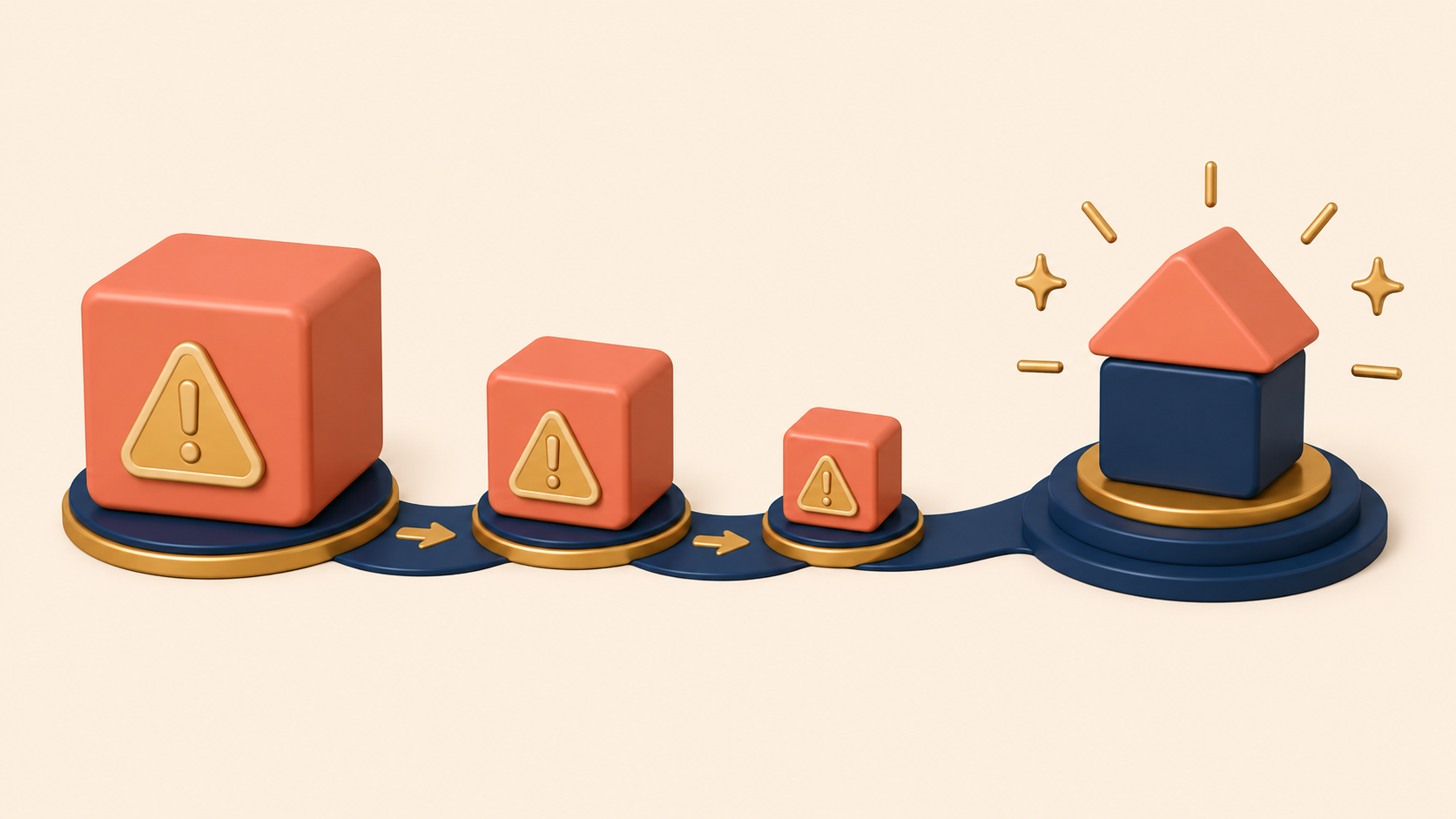
Product strategy is often confused with product vision, but the two answer different questions. Vision describes where a team wants to go. Product strategy describes how to get there while managing the chance of failure along the way.
Every product decision carries risk. Will customers actually want this? Can we build it inside our constraints? Will it generate enough revenue to sustain the investment? A useful product strategy does not pretend these risks can be eliminated. It reduces them step by step through evidence, collaboration, and a deliberate sequence of decisions.
Product strategy works through four lenses: strategy as risk management, the two halves of value, the discovery loop that moves teams from assumptions to evidence, and the two foundations that let strategy survive execution. Together, they form a working answer to the question of what product strategy is in practice — not as a slide deck, but as the daily work of a product manager.
Strategy Is Risk Management, Not a Roadmap
A roadmap lists what a team plans to ship. A strategy explains why those bets are worth taking and how the team will know when a bet is wrong. The two are easy to mix up because both live in the same documents, but they do different jobs.
Three categories of risk show up in almost every product decision. Customer risk asks whether anyone outside the building cares about the problem. Feasibility risk asks whether the team can build a workable solution given its technology, time, and skills. Business risk asks whether the resulting product can sustain itself, either through revenue or through a strategic position the company values.
Strong product strategy treats these risks as the unit of work. Each major decision lowers one or more of them. A user interview lowers customer risk. A technical spike lowers feasibility risk. A pricing test lowers business risk. The strategy is the order in which a team chooses to retire its biggest unknowns — and that order matters far more than the shape of the final roadmap.
This framing changes how a PM evaluates a quarter. The question is not “did we ship what we planned?” but “did we learn enough to make the next set of decisions with less uncertainty?” When strategy is risk management, progress and shipping are not the same thing.
The Value Equation: Customer Utility Meets Business Sustainability
The word value gets diluted quickly. In product work, it pays to define it precisely, because almost every strategic argument inside a team is really an argument about which half of value matters more.
Real value has two inseparable parts:
Value = Customer Utility + Business Sustainability
Customer utility means solving a real problem the customer cares about, or meeting a need that already exists in their day. Without it, the team builds something no one wants. Business sustainability means generating enough revenue, or enough strategic advantage, to justify continued investment. Without it, the team builds something it cannot keep alive.
Both halves have to hold. A product customers love but the business cannot support eventually disappears. A product that earns money but fails its customers eventually loses to a competitor that does the job better. The interesting product strategy work happens in the overlap, where a real customer problem also funds the company that solves it.
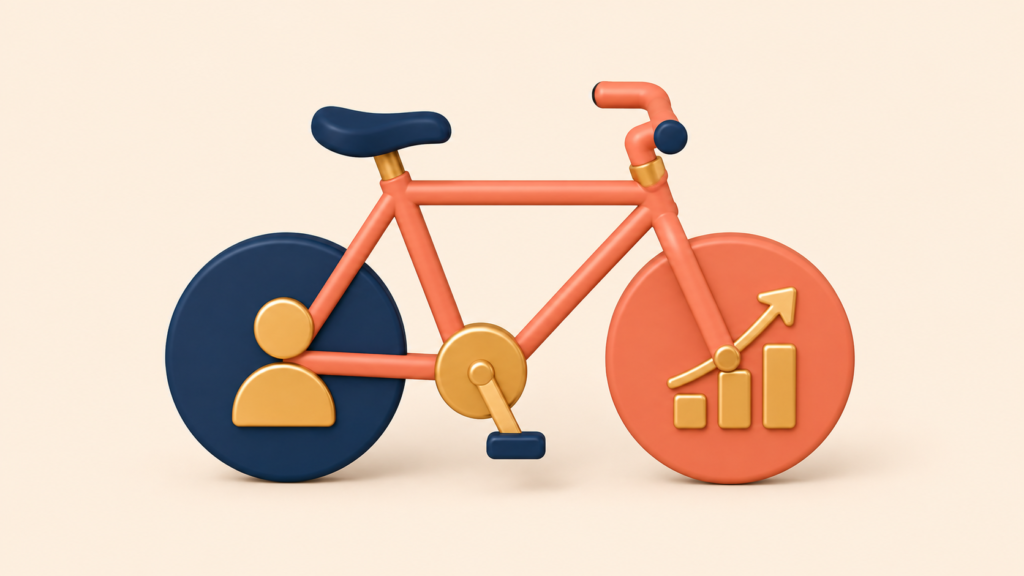
A useful way to picture this: customer utility is the front wheel of a bicycle, and business sustainability is the back wheel. The front wheel steers but cannot move on its own. The back wheel powers the ride but does not know where it is going. The bike only reaches the destination when both wheels turn together. Product strategies that ignore one wheel always wobble.
For PMs, the equation becomes a checklist for every major bet. If we cannot explain the customer utility in one sentence, we are not ready to build. If we cannot explain how the work supports the business over time, we are not ready either. Skipping either question is how teams produce features that demo well and die quietly.
Escaping the Internal Echo Chamber
One of the most common failure modes in product development is building from internal opinion instead of external evidence. A team spends weeks in conference rooms debating features, convinced it knows what customers want, without ever talking to a customer during that period. The conversation feels productive because everyone is engaged. It is not productive, because the answers cannot come from inside the room.
The uncomfortable truth is that value cannot be settled by internal discussion alone. The people in the room are not the people who will use the product, and their intuition about the customer is shaped by the same assumptions that produced the current debate. Talking longer does not break that loop.
Customer research feels uncomfortable for understandable reasons. It takes time. Feedback can contradict something the team has already decided. A user might describe a problem the roadmap does not address. But the discomfort of customer research is small compared with the discomfort of launching something no one wants.
The only way out is to leave the building and meet real customers. That means actively seeking out customers and prospects, taking their context seriously, learning from what they do rather than what they say, and exploring opportunities based on their reality instead of the team’s assumptions. The goal is to bring outside evidence into a process that, left alone, will keep recycling its own opinions.
A working analogy: discussing a product entirely inside the office is like rehearsing a song in a soundproof booth. Inside the booth, your voice sounds perfect. On stage, the audience reacts to something quite different. Internal debate is the booth. Market response is the stage. Only one of them tells you whether the song works.
From Assumptions to Evidence: The Three-Stage Discovery Loop
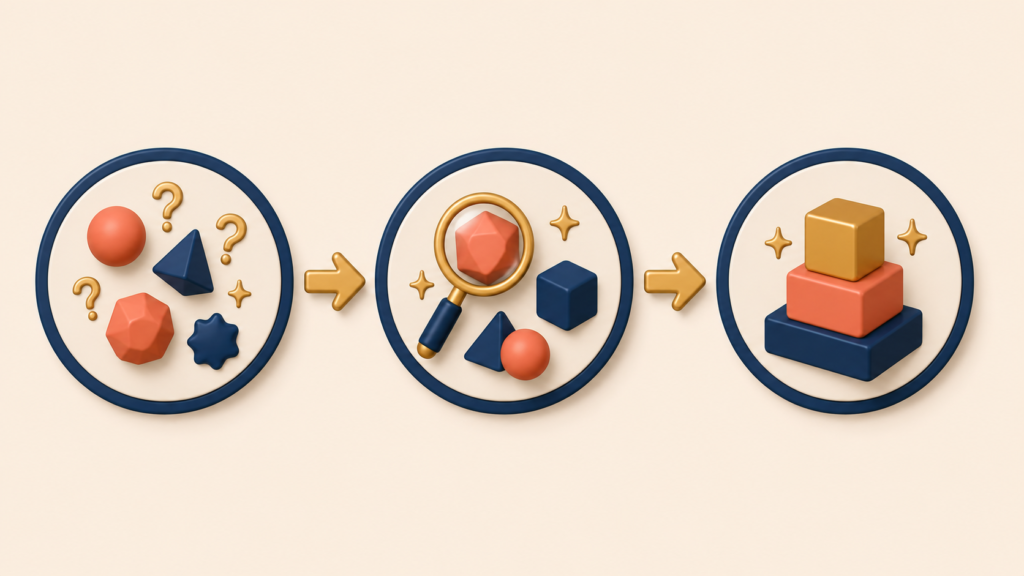
How does a team move from internal assumptions to validated evidence? Not through a single research sprint, but through a continuous loop where each round of learning produces new questions for the next. This is what continuous discovery looks like as a habit, not as a project.
The loop has three stages:
┌───────────────────────────────────────┐
│  Stage 1: Continuous Product Discovery│
│  (Gathering evidence)                 │
│  • Customer interviews, observation,  │
│    ethnographic research              │
└──────────────┬────────────────────────┘
               ▼
┌───────────────────────────────────────┐
│  Stage 2: Opportunity-Solution        │
│  Analysis (Structuring evidence)      │
│  • Pattern recognition, opportunity   │
│    identification, prioritization     │
└──────────────┬────────────────────────┘
               ▼
┌───────────────────────────────────────┐
│  Stage 3: Solution and Concept Design │
│  (Shaping the opportunity)            │
│  • Concept decisions, PRDs,           │
│    story mapping                      │
└───────────────────────────────────────┘| Stage | Core activities | Main outputs |
|---|---|---|
| Stage 1: Discovery | Customer interviews, ethnographic research, behavioral observation | Interview snapshots, customer understanding, new hypotheses |
| Stage 2: Analysis | Pattern recognition, opportunity prioritization, strategic decisions | Opportunity maps, customer story maps, selected opportunities |
| Stage 3: Design | Solution planning, concept validation, business case | Solution concepts, PRDs, feature story maps |
Each stage builds on the one before it. Raw customer contact becomes structured understanding, and structured understanding becomes a concrete product plan. The opportunity solution tree is one common way to make the link between evidence and decisions visible, but the underlying loop is the more important pattern.
A simple analogy: the loop works like a farming cycle. Before planting, you look at the soil (discovery). Then you decide which crops the soil can support (analysis). Only after that do you plant the seeds (design). After harvest, you check the soil again to prepare for the next season. Product strategy works the same way — a cycle that keeps turning, not a line that finishes.
What Happens at Each Discovery Stage
Stage 1: Continuous product discovery
Evidence collection starts here. The main method is customer interviews, supported by direct observation and ethnographic research. The goal is not to validate an idea the team already holds. It is to build a genuine understanding of the customer’s life, context, and difficulties. That understanding becomes the raw material for everything else.
A useful discipline at this stage is to interview without an agenda for the product. PMs who walk in trying to confirm a roadmap item rarely hear anything new. PMs who walk in trying to learn how the customer’s day actually works often discover the problem they should have been solving instead.
Stage 2: Opportunity-solution analysis
Collected evidence is valuable, but on its own it is not actionable. Patterns have to emerge across many customer conversations: an individual complaint turns out to be a widespread problem, and issues that looked separate share a common root cause. This is where scattered observations become a structured set of opportunities the team can prioritize.
The work here is honest categorization. Two interviews that mention “the export is slow” might point to the same opportunity, or to two different ones depending on what the users were trying to do. Treating them as the same problem too early leads to a solution that fixes neither.
Stage 3: Solution and concept design.
Only after an opportunity is clearly understood does solution design begin. This is the stage where a validated opportunity turns into a concrete product plan.
One constraint matters here. The solution should address an opportunity drawn from the evidence, not justify an idea the team had before research started. This discipline prevents a common failure mode: running research to confirm a conclusion the team already reached. Each stage of the loop should generate new questions and new hypotheses, which means product strategy never finishes — it improves with each pass.
A courtroom analogy is useful: if a prosecutor decides the verdict first and then collects only the evidence that supports it, the trial is not fair. Research has the same risk. The starting point should be “let us find out what is actually happening for the customer,” not “let us confirm that our idea is right.”
A product strategy is only worth the effort if it survives contact with execution. That handoff works when two conditions hold: the people building the product share a real understanding of the customer, and every decision can be traced back to its reasons.
Everyone involved in building the product needs enough understanding of the customer to make good local decisions. This does not mean every engineer has to attend every interview. It means:
- The team shares a common mental model of who the customer is.
- Key customer insights are accessible and referenced in discussion.
- Decisions are connected to customer evidence, not to opinion.
- Disagreements can be resolved by returning to shared understanding.
When customer understanding lives in one person’s head, that person becomes both a bottleneck and a single point of failure. A new engineer cannot judge a tradeoff. A designer cannot evaluate a flow. The team waits for the PM to answer, and the PM becomes the slowest part of the system.
A useful analogy: shared customer understanding is like an orchestra’s sheet music. If only the conductor knows the piece, the music stops the moment the conductor steps away. But when every musician understands the score, each one creates harmony from their own part. Sharing customer understanding across the team is the same as handing every musician the score.
Traceable reasoning
Every product decision should be traceable to its origin. When someone asks “why are we building this feature?”, the answer should not be “because the PM decided” or “because it seemed like a good idea.” It should connect to specific evidence and an explicit line of reasoning. This is what evidence-based decision making looks like in daily practice.
Traceable reasoning makes several things possible:
- Better decisions, because the logic is explicit and reviewable.
- Easier course correction, because when the evidence changes, the conclusions can change with it.
- Faster onboarding, because new team members can follow the reasoning instead of memorizing the outcomes.
- More productive debate, because arguments are about evidence rather than about opinion.
A math analogy makes this concrete: if you write only the final answer, there is no way to find the mistake when the answer is wrong. If you show the working, you can locate the error and fix it. Product decisions need the same kind of working. The “why” behind a choice is what lets a team change direction quickly when the situation shifts.
These two foundations — shared customer understanding and traceable reasoning — are what turn a written strategy into actual behavior. Without them, even a well-argued strategy collapses into individual judgment calls under pressure.
Conclusion
Product strategy is not a separate artifact that lives next to the roadmap. It is the sequence of decisions a team makes to retire its biggest risks before committing to a direction. Risk first, then evidence through the discovery loop, then execution grounded in shared understanding and traceable reasoning. That sequence is the working answer to what product strategy is.
Strategy described this way is also strategy that can survive a real team. When the next quarter starts with a surprising customer signal, a strategy built on evidence and reasoning can absorb the change. A strategy built on opinion cannot.
The next part of this series looks at how product strategy actually distributes across roles — how PMs, designers, and engineers divide the work, where their responsibilities overlap, and what makes the PM’s position unusual inside that group.
Leave a Reply