
For the past several years, OKR has been everywhere in the tech industry. Blog posts, conference talks, internal playbooks — the framework has shown up in all of them. And then came the backlash.
“OKRs don’t work.”
“We tried OKRs and went back to KPIs.”
“OKRs just gave us more meetings and more stress.”
In most of these cases, OKR itself was not the core problem. The trouble came from how teams interpreted, applied, and adapted OKR inside their organizations. Teams used OKRs as performance-review tools. They turned them into glorified to-do lists. They mixed ambitious goals meant to stretch the team with committed work that demanded delivery — and then penalized teams that fell short.
This guide is not a defense of OKR. It explains what OKR actually is, where it came from, and how the framework works when you use it the way it was designed. If you have ever felt that OKRs added pressure instead of clarity, or process instead of focus, the next few sections should help.
What is OKR? A quick definition
OKR stands for Objectives and Key Results. It is a goal-setting framework that pairs a qualitative goal — the Objective — with a small set of measurable outcomes — the Key Results — that prove whether the goal is being reached.
A single OKR looks like this: one Objective that describes the destination, and three to five Key Results that describe the evidence of progress. Teams set OKRs at the company, team, and sometimes individual level, usually each quarter. The Objective answers “what do we want to achieve?” The Key Results answer “how will we know we are getting there?”
That is the whole definition. The rest of this guide is about why each part matters and how to write Objectives and Key Results that hold up in practice.
The origin of OKR: from Intel to Google
OKR is not a new idea. The framework was developed by Andy Grove at Intel in the 1970s, drawing on Peter Drucker’s earlier “Management by Objectives” but tightening it into something faster and more measurable.
John Doerr, then a young salesperson at Intel, learned the system directly from Grove. Years later, as a venture capitalist, Doerr introduced OKR to Google in 1999, when Google was still a small team. He describes the meeting in his book Measure What Matters. Google kept the framework as it scaled, and the practice spread from there. LinkedIn, Twitter, Uber, and many other companies adopted OKR as they grew.
What these companies shared was not size or industry. They shared one thing: speed, uncertainty, and the need for alignment without micromanagement. They needed a way to keep hundreds or thousands of people pointed in the same direction without scheduling endless coordination meetings.
OKR gave them a simple way to answer two questions:
“What matters most right now, and how will we know we are making progress?”
Different from traditional goal setting: three key shifts
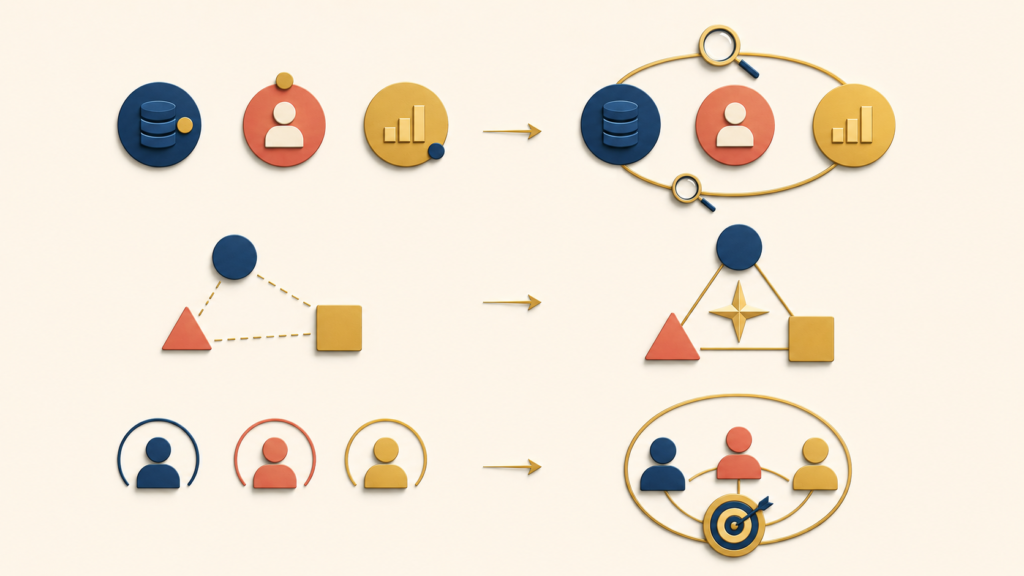
OKR is often treated as just another goal-setting framework. In practice, it changes how an organization thinks about progress. Three differences do most of the work.
| Dimension | Traditional goal setting | OKR |
|---|---|---|
| Time orientation | Reviews last year’s performance | Plans the next quarter’s outcomes |
| Core question | “What did we achieve?” | “What outcomes will we create next?” |
| Visibility | Goals are private to manager and individual | Goals are shared and open to the team |
| Alignment | Requires constant coordination meetings | Emerges naturally through transparency |
| Stance on risk | Encourages safe, achievable targets | Encourages ambitious bets without penalty |
| Team behavior | Optimizes for explanation and justification | Optimizes for learning, impact, and outcomes |
| Product impact | Output-driven delivery plans | Outcome-driven product plans |
From past-focused to future-focused
Traditional performance systems ask: “What did you achieve last year?” OKR asks: “What outcomes will you create next?”
That small shift changes team behavior. Teams stop optimizing for explanation and start optimizing for results. For product teams, this means planning around learning and impact instead of around output delivery.
In many organizations, goals live in a document that only a manager and an individual can see. OKR makes goals public by default. When goals are shared:
- Designers understand product priorities without extra meetings.
- Engineers anticipate trade-offs earlier.
- Sales and marketing align with what is actually shipping.
Shared goals work like the full score of an orchestra. If each musician only sees their own part, the result is dissonance. When everyone can read the full score — the public OKRs — the parts come into harmony even without a conductor constantly waving them in.
From safe targets to meaningful stretch
When goals are tightly tied to rewards, people naturally pick the safe option. Used correctly, OKR creates space for stretch without penalty. In product organizations, innovation usually comes from the uncomfortable bets, not from the targets that were obviously going to be met.
How OKR improves daily decisions and priorities
OKR shows its real effect in everyday decisions:
- What to build now.
- What to defer.
- What to say no to.
Three simple mechanisms make this possible.
- Transparency. Teams can see what other teams are optimizing for. There are fewer surprises and fewer last-minute collisions.
- Alignment. Product, design, and engineering use the same definition of success when they make trade-offs. Coordination cost drops.
- Focus. Work that does not clearly advance an Objective or a Key Result is easier to deprioritize.
The cumulative effect is that prioritization moves from opinion-based to outcome-based. Most importantly, OKR creates a shared language for saying no without it feeling political. Pointing at a Key Result is much easier than arguing about preferences.
Objectives: defining your desired destination

Most of the confusion around OKR comes from how Objectives and Key Results are written. Get the definitions wrong and Objectives turn into vague slogans while Key Results turn into task lists.
An Objective describes what you want to achieve. Not how — what. It describes the destination, not the map. A strong Objective inspires action and points in a direction without prescribing the solution.
Three properties separate strong Objectives from weak ones.
Ambitious but grounded
An Objective should push the team toward something it would not reach by default, but it still has to be evaluable within the time box. A useful test:
At the end of the quarter, can we reasonably tell whether the team made meaningful progress?
If the answer is no, the Objective is not grounded.
- ❌ “Become the market leader” → no clear scope, no time frame, no way to evaluate progress.
- ✅ “Become the preferred solution for mid-market B2B teams” → a clear target segment and a direction that progress can be measured against.
Grounded ambition lets teams debate how ambitious to be instead of debating what the goal even means.
Clear value to the organization
Objectives exist to surface organizational priorities and trade-offs. A good test:
Compared to other possible objectives, can someone tell why this one should come first?
If the answer depends on insider knowledge or personal conviction, the Objective is not specific enough. Objectives with clear value make it obvious how success helps the business or the customer, so teams can resolve trade-offs without escalating every decision to a manager.
Customer- and outcome-focused
An Objective should describe the change you want to see, not the work you plan to do. The distinction is simple:
- Output: something the team ships.
❌ “Launch a mobile app” → an output. Delivery can succeed while customer value stays at zero. - Outcome: something that changes because of the work.
✅ “Make our product accessible to customers on mobile devices” → an outcome. Success depends on actual customer use.
Outcome-focused Objectives keep the team aligned on impact while leaving the freedom to pick the best solution.
Key Results: defining the evidence of progress
If an Objective describes the destination, Key Results define the evidence that you are moving in the right direction.
Each Key Result answers one question:
“What measurable change would convince us that this Objective is being reached?”
That is why strong Key Results are specific, quantitative, and outcome-based. Three properties separate strong Key Results from weak ones.
Directly connected to the Objective
Every Key Result should clearly support its Objective. A simple test:
If this Key Result improves, does the Objective get meaningfully closer?
If the answer is unclear, the Key Result is probably measuring the wrong thing. This is the reason teams sometimes feel they “hit every Key Result but missed the Objective.” The numbers moved, but not in the way that actually mattered.
Outcome-based, not activity-based
Key Results should measure impact, not effort. Activities describe what the team does. Outcomes describe what changes because of it.
- ❌ “Launch a new onboarding flow” → activity. The team can complete it without improving anything.
- ✅ “Increase activation rate from 45% to 60%” → outcome. Success depends on user behavior.
- ❌ “Conduct customer research” → activity.
- ✅ “Validate product-market fit with 30 qualified prospects, with 70% expressing high purchase intent” → outcome.
Outcome-based Key Results remove ambiguity. Either the metric moved or it did not.
Think of activity versus outcome like cooking versus taste. “I cooked for three hours” shows effort. Whether the guest enjoyed the meal is a separate question. No matter how hard the team works in the kitchen, the result on the table is what counts. A Key Result should measure what changed, not what was done.
Specific enough to leave no room for interpretation
A good Key Result does not leave room for interpretation.
- ❌ “Grow sign-ups.”
- ✅ “Grow daily sign-ups from 200 to 300.”
The number forces clarity:
- Which metric matters.
- How much change is meaningful.
- Whether the progress is real or just felt.
If a Key Result needs explanation during a review, it is probably not specific enough.
Key Results work like the numbers on a health checkup. “Get healthier” is too vague to act on. “Lower blood pressure from 140 to 120” or “reduce body fat from 25% to 20%” makes progress visible. And the right number is the outcome, not the activity. The point is not “did you exercise this week,” it is “did blood pressure actually come down.”
OKR scoring: how to score and what it means
Many teams use a 0.0 to 1.0 scoring system to grade Key Results at the end of a cycle.
- 0.0–0.3: Missed. Little to no progress.
- 0.4–0.6: Partial progress. Movement, but below expectations.
- 0.7–1.0: Success.
The point of the scoring system is to reinforce a specific mindset. For an aspirational OKR, success is not perfect execution. Success is meaningful progress toward an ambitious outcome.
That is why Google and many other organizations treat around 0.7 as success for a stretch OKR. A team that set an ambitious goal and reached roughly 70% of it has usually done three things:
- Taken a real risk.
- Learned what works and what does not.
- Created tangible impact.
A team that consistently scores 1.0, on the other hand, is often optimizing for certainty instead of progress. The number itself is not the point. The point is the conversation the number makes possible: what changed, what surprised us, and what to focus on next.
Conclusion
OKR is not a performance-review tool, and it is not a list of tasks dressed up as goals. It is a framework for setting an ambitious direction, defining the evidence that you are moving toward it, and creating the transparency that lets a team align without endless coordination. When teams write strong Objectives, pair them with outcome-based Key Results, and score with the right mindset, OKR turns into a shared language for focus and trade-offs rather than another layer of process.
The next post in this OKR series looks at one of the most common sources of confusion in practice: the difference between Committed OKRs and Aspirational OKRs, and how mixing them up is what usually causes the “OKRs don’t work” experience described at the start.
OKR series:
Leave a Reply