
Understanding OKRs is the easy part. Making them work, quarter after quarter, is where most teams stumble. The five steps below describe the operating habits that separate an OKR framework that drives focus from one that just adds another meeting to the calendar.
Set the right cadence. Keep the number of Objectives small. Track weekly. Cascade and align across levels. Agree on measurement before execution starts. Each step looks simple on its own, but the value comes from running them together as a connected system.
Each step that follows includes a concrete example, a rule of thumb, and the failure mode it prevents.
Step 1: Set the Right Cadence for Each Organizational Level
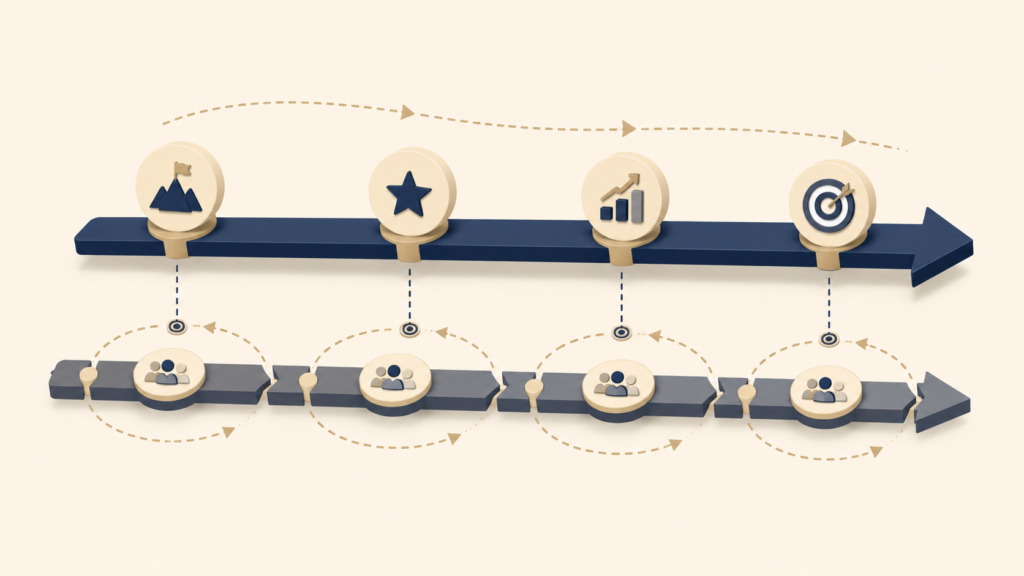
OKR cadence should match the level of the organization it serves. Company-level goals and team-level goals do not move at the same speed, so they should not run on the same clock.
Company-level OKRs
- Cycle: annual
- Purpose: strategic direction and long-horizon bets
- Review quarterly, but only adjust when something fundamental has changed
Team-level OKRs
- Cycle: quarterly
- Purpose: execution and learning
- Long enough to create impact, short enough to adapt
The two failure modes are predictable. Monthly OKRs at the team level create noise and surface-level work; the cycle ends before any meaningful learning lands. Annual OKRs at the team level go stale in fast-moving markets, because the world the team planned for in January no longer exists in May. Annual strategy paired with quarterly execution gives you the right balance: stability on direction, flexibility on delivery.
A useful rule: if you cannot articulate why a given OKR sits at a given level on a given cycle, the framework is already drifting. Cadence is not just scheduling — it encodes how often you allow yourself to change your mind.
Step 2: Keep the Number of Objectives Intentionally Small
Focus needs constraints. In an OKR framework, the constraint is the count.
- 1 to 3 Objectives per team. If a team has more than three Objectives, none of them is really a priority.
- 1 to 3 Key Results per Objective. If you need more than three Key Results, the Objective is usually too vague, or the team is tracking activity instead of outcomes.
The rule of thumb most experienced practitioners settle on:
- Hard ceiling: 9 Key Results per quarter for a team
- High-performing teams often run with 4 to 6 Key Results total
The point of the cap is not minimalism for its own sake. It forces a conversation. When a team has to choose between two candidate Objectives, leaders have to make the priority trade-off explicit instead of hiding it in a long list. The same goes for Key Results: a team forced to pick three KRs has to argue about which outcomes actually matter, and the argument itself is where alignment happens.
If every OKR review feels like a status update across twenty metrics, the framework is no longer doing its job. The number is the first signal something is off.
Step 3: Track Weekly, Not Quarterly
OKRs should not reappear only at the end of the quarter. By then, it is too late to change direction.
A weekly check-in answers three questions:
- Current score. Where does each Key Result stand right now?
- Change since last week. Did it move? In which direction?
- Blockers or help needed. What is in the way, and who can unblock it?
Ten to fifteen minutes is enough. A shared document, a dashboard, or a dedicated tool — the medium matters less than the visibility. If other people on the team cannot see where each Key Result stands, alignment quietly breaks down between reviews.
Weekly tracking surfaces problems while there is still time to act. A Key Result that has not moved in three weeks is a flag, not a verdict. By contrast, teams that only check OKRs at the quarterly review tend to learn about the same blocker on the last day of the quarter, when nothing can be done about it.
The check-in is also where the framework stops feeling like paperwork. Once the weekly cadence is in place, OKRs become the spine of the team’s planning conversation rather than a separate ritual.
Step 4: Cascade and Align Across the Organization

OKRs only deliver value when they connect strategy to execution. That is the job of cascading: translating company outcomes into product outcomes, team outcomes, and finally the work that engineers and designers actually ship.
A clean cascade has two flows at once:
- Alignment moves top-down. Leadership sets company OKRs based on strategy and market bets. The CPO and CTO translate those into Objectives for the organizations they own. Product teams then define team-level OKRs that contribute to those upstream Objectives.
- Ownership and feasibility move bottom-up. The teams closest to the work draft the Key Results, because they understand what is realistic, what is risky, and what trade-offs are hidden in a target number.
A good operating pattern: have cross-functional teams (PM, design, engineering) draft their OKRs together first, then check alignment with leadership. Drafting before alignment review keeps ownership in the team. Alignment review after drafting keeps the work connected to strategy.
Example: How a B2B SaaS Retention OKR Flows Through the Organization
Here is what a single company outcome looks like as it cascades through four levels in a B2B SaaS company.
[Company Objective]
Increase retention of our B2B SaaS product
└─ KR: Improve 90-day retention from 42% to 55%
      ↓
[Product-Level Objective]
Help new teams reach value faster
└─ KR: Lift activation rate from 38% to 60%
└─ KR: Cut time-to-first-value from 7 days to 2 days
      ↓
[Team-Level Objective: Onboarding]
Remove friction from the onboarding experience
└─ KR: Reduce onboarding drop-off from 45% to 20%
└─ KR: Lift onboarding completion from 55% to 80%
      ↓
[Execution-Level Objective: Engineering]
Improve onboarding performance and reliability
└─ KR: Reduce onboarding page load time from 4s to under 1.5s
└─ KR: Cut onboarding-related errors by 80%
How to read this:
- Company level defines the business outcome that matters most.
- Product level translates that outcome into user-centered success conditions.
- Team level focuses on a specific segment of the user journey.
- Execution level describes what has to change in the system to make it possible.
The same underlying question — “how do we keep more customers?” — gets rephrased at each level into something the people at that level can actually act on. That is what makes a cascade more than an org chart.
A useful way to picture cascading: think of a river system. Meltwater from the glacier at the summit (the company objective) feeds streams (product objectives). The streams gather into rivers (team objectives), and the rivers flow to the sea (execution). If any segment is disconnected, the water — the effort — ends up in the wrong place.
If you want a longer treatment of how Objectives turn into Key Results in practice, see our earlier post on the two types of OKRs: committed vs. aspirational.
Step 5: Agree on How to Measure Before Execution Starts
Disagreement about how a metric is calculated will erode trust inside an organization faster than missing the target itself. The fix is to resolve the disagreement before the quarter starts, not after.
Define measurement up front. Specify the data source, the calculation logic, and the edge cases explicitly. “Where does this number come from? Who owns the query? What happens to refunds, churn within the trial window, or accounts flagged as test?” These details should live with the OKR, not in someone’s head.
Standardize definitions across teams. “Active user” should mean the same thing in the product team’s dashboard, the marketing team’s report, and the finance team’s board slides. If three teams have three different definitions, the company has zero shared definitions.
A simple test of whether a Key Result is precise enough:
- ❌ “Improve customer satisfaction.”
- ✅ “Lift NPS from 42 to 55, measured monthly via survey to customers with 30+ days post-onboarding, minimum 200 responses.”
The second version answers what, by how much, how it is measured, who is in scope, and what counts as a valid sample. The first version invites a fight at the end of the quarter about whether the number “really” went up.
Precise definitions change what OKR reviews feel like. Instead of arguing about whether the metric is fair, the team can spend the review on the actual question: what is moving the number, what is not, and what should we try next? That is the difference between a status meeting and a problem-solving session.
Putting It Together: A 5-Step Checklist for Your First OKR Cycle
If your team is starting an OKR framework from scratch — or restarting one that has drifted — run through this checklist before the cycle begins.
- Cadence. Company OKRs annual with quarterly review; team OKRs quarterly. No monthly team OKRs.
- Count. 1–3 Objectives per team, 1–3 Key Results per Objective, hard ceiling of 9 Key Results per quarter.
- Tracking. A 10–15 minute weekly check-in covering current score, change since last week, and blockers. Visibility shared across the team.
- Cascade. Cross-functional draft first, then alignment review with leadership. Each level rephrases the question for its scope.
- Measurement. Data source, calculation, and edge cases written down before the quarter starts. Shared definitions for terms like “active user.”
If a team can answer yes to each of these before the cycle begins, the framework is set up to deliver focus rather than ceremony.
Conclusion
The five steps in this OKR framework are not innovative on their own — every team that has run OKRs for more than a year has learned them, usually the hard way. What makes them work is running them as a system. Cadence sets the rhythm. Constraints on count force priority. Weekly tracking turns the framework into a planning tool. Cascading connects strategy to execution. Measurement agreement keeps reviews productive.
OKRs fail far more often from operational drift than from a flawed Objective. Most teams know what they want to achieve. The five steps describe the discipline that lets them actually get there.
In the next post in this series, we will look at the 12 most common OKR mistakes — the specific patterns that quietly break the framework even when the five steps are nominally in place.
OKR series:
Leave a Reply