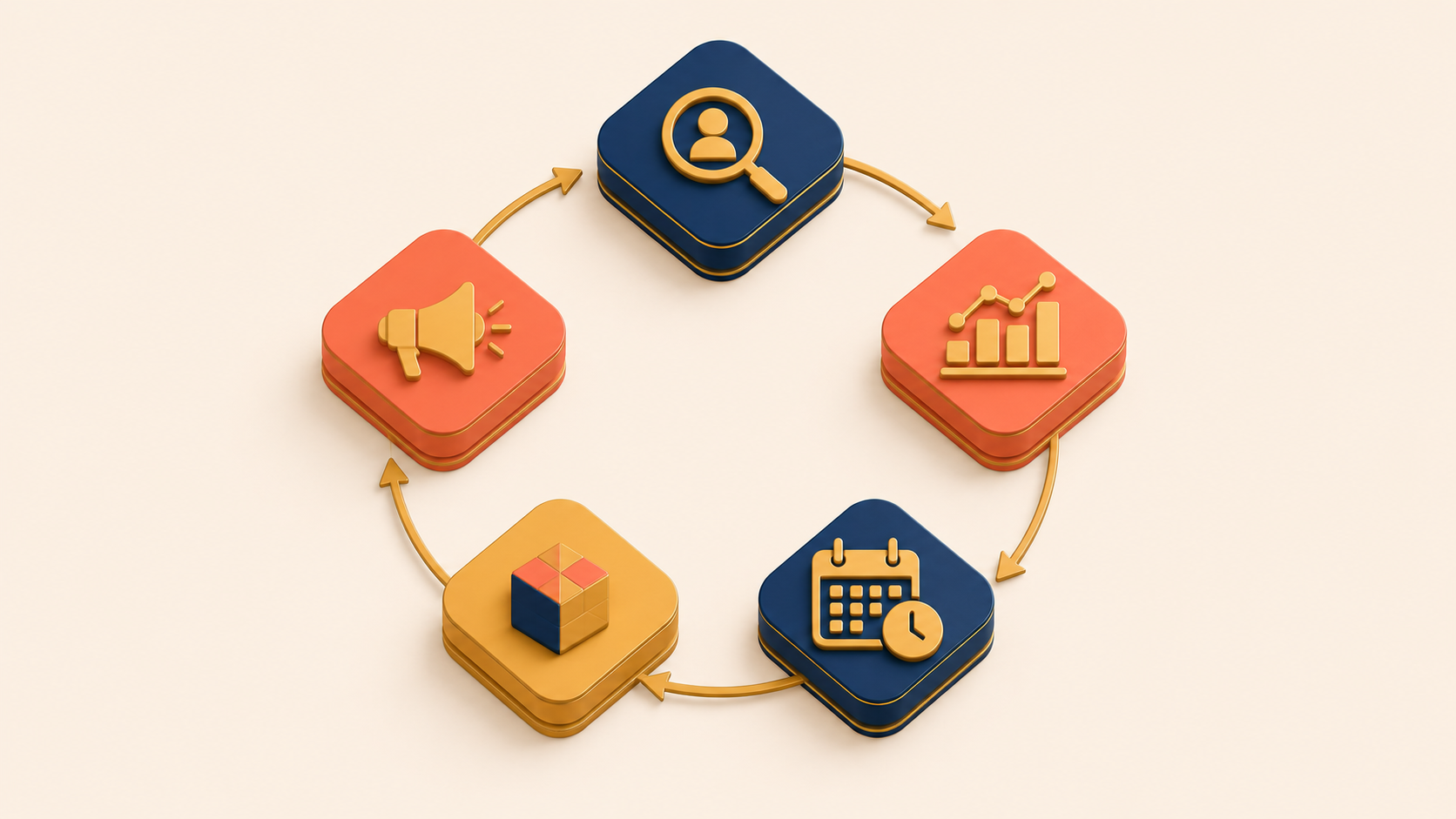
The planning phase sets the trajectory for everything that follows. Early decisions shape what teams build, how they build it, and how effectively the product reaches the right audience. For product managers, this is where the most leveraged work happens, often invisibly.
Most product manager responsibilities at this stage fall into five distinct activities: user and customer research, product data analysis, project schedule planning, product and business planning, and marketing planning. Each one closes a specific gap between assumption and evidence. Skip any of them and the team enters design carrying risks it could have already retired.
Each of the five activities below has a clear purpose, a set of participants, and concrete deliverables product managers are responsible for.
User and Customer Research

Why It Matters: Grounding Decisions in Evidence
Understanding the customer is not optional. Products built on assumptions about customer needs fail at predictably high rates because those assumptions almost always turn out to be partial, biased, or simply wrong. Research reduces this risk by grounding decisions in evidence rather than intuition.
Research is also not a one-time activity that happens at kickoff and then disappears. It is a continuous practice of refining understanding as the product evolves. That said, the planning phase calls for a concentrated round of research — enough to establish the foundational understanding that will guide every subsequent decision.
Roles and Participants: PM, Marketer, Designer
Research is a team activity, not a solo task. Each role contributes a different lens.
| Role | Responsibility |
|---|---|
| Product Manager | Designs the research strategy and synthesizes findings into product implications |
| Marketer | Analyzes market dynamics and gathers competitive intelligence |
| Designer | Contributes a user experience perspective and may participate in user interviews |
Engineers should also see customer feedback directly even if they do not run research themselves. This exposure builds empathy and context, which raises the quality of their later contributions. Operations and customer support teams often hold valuable insights as well, simply because they talk to customers every day.
Deliverables: Personas, Journey Maps, Competitive Matrices
The output of research is not raw notes. It provides a structured set of actionable insights for the team.
| Category | Focus Area | Key Deliverables |
|---|---|---|
| Market Context | Industry and competitive landscape | Industry trends shaping customer behavior, competitive landscape and alternative solutions, market size and growth trajectory |
| Customer Understanding | Segments and behavior | Target customer segment definitions, how customers currently solve the problem, jobs customers are trying to get done |
| Pain points and usage context | Core pain points and unmet needs, usage context (when, where, under what conditions) | |
| Strategic Implications | Direction and positioning | Core value needed to acquire customers, risks and uncertainties requiring validation, differentiation opportunities |
These insights typically take the form of research reports, customer personas, journey maps, competitive matrices, and opportunity assessments. The exact format matters less than whether the team shares a common understanding of who the customer is and what they need.
User research is like checking the charts before setting sail. Before leaving for a destination, an experienced sailor studies the currents, reefs, and weather patterns. Without that information, the chances of hitting a reef rise sharply. Research is the process of mapping the waters your product will navigate.
Product Data Analysis
Why Data Reveals What Users Actually Do
If a product already exists, usage data offers a kind of insight no interview can match: what customers actually do, as opposed to what they say they do or what we expect them to do. The gap between stated behavior and actual behavior is usually larger than teams assume.
Data analysis reveals patterns that other research methods cannot see. Where users struggle or drop off. Which features get heavy use and which sit idle. How behavior differs across segments. Whether a recent change moved core metrics up, down, or not at all.
Data does not replace qualitative research. It complements it. Qualitative work tells us why people behave a certain way; quantitative data shows what they actually do, at scale. Both are necessary, and either one alone gives a distorted picture.
Deliverables: Metrics, Behavioral Patterns, Hypotheses
| Category | Focus Area | Key Deliverables |
|---|---|---|
| Metric Foundation | Measurement clarity and baselines | Definitions and calculation methods for core metrics, baseline measurements for future comparison, meaningful segments or cohorts for analysis |
| Behavioral Insights | Usage and performance patterns | Usage patterns by feature and flow, conversion rates and drop-off points, engagement trends over time, differences across segments |
| Actionable Findings | Decisions and next steps | Data-driven opportunity areas, hypotheses that explain observed patterns, areas needing further investigation or experimentation |
Product analytics is like reviewing security camera footage in a retail store. Ask a store employee “how do customers shop here?” and they will give you a few impressions that stuck with them. Analyze the footage and you will see traffic patterns, dwell times, and exit points that no employee consciously noticed. Data is the product’s security camera.
Project Schedule Planning
Why Explicit Timelines Force Better Decisions
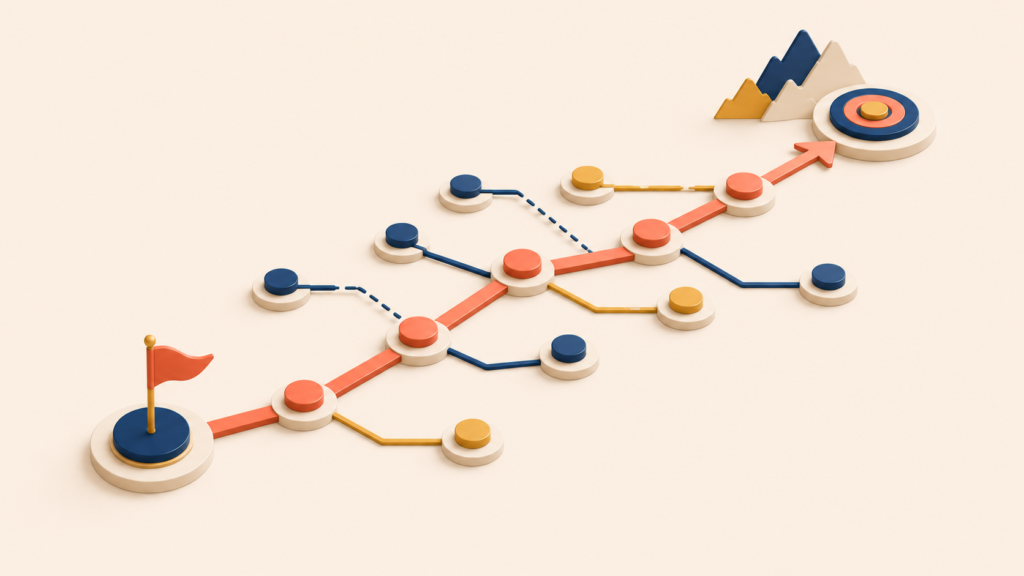
A project without a clear timeline tends to drift. Deadlines create focus and force teams to make tradeoff decisions instead of postponing them indefinitely. This is not about creating pressure for its own sake.
Schedule planning serves several specific purposes: coordinating dependencies between people and teams, setting expectations for stakeholders, creating checkpoints to assess progress, and forcing explicit decisions about scope and resources. Each of these gets harder, not easier, the longer a team avoids committing to dates.
A schedule is, fundamentally, a hypothesis about how work will unfold. Like any hypothesis, it can turn out to be wrong. But having an explicit hypothesis is far better than having none. Teams can update an explicit plan, but they cannot revise an implicit one.
Deliverables: Charters, Gantt Charts, RACI, Risk Registers
| Category | Focus Area | Key Deliverables |
|---|---|---|
| Project Definition | Direction and alignment | Clear goals defining what success looks like, principles for making tradeoff decisions, stakeholder identification, scope boundaries (in/out) |
| Timeline Structure | Planning and sequencing | Key milestones with target dates, dependencies between activities, the critical path of sequential events |
| Risk Assessment | Uncertainty and contingency | Major risks that could block progress, mitigation strategies for high-impact risks, contingency plans for likely issues |
In practice, teams typically capture these decisions in project charters, Gantt charts, timelines, risk registers, and RACI matrices.
Schedule planning is like a travel itinerary. Leaving without one feels free, but you end up missing flights and arriving at hotels with no room. Even if you do not follow a perfect itinerary, having key dates locked lets you flex the rest with confidence.
Product and Business Planning
Translating Customer Understanding into Product Direction
This is the stage where customer understanding turns into product direction. What features will we build? What problems are they solving? How will they behave? Teams answer these questions during the planning phase, not later in the process.
Product planning is the bridge between abstract strategy and concrete implementation. It translates “we should help customers do X” into specific features, flows, and behaviors that designers and engineers can actually work with. The translation is the work.
Without this translation, the team has no clear direction. And if the translation is wrong, the team builds the wrong thing — confidently, efficiently, and at full speed. Few outcomes waste more resources.
Deliverables: PRDs, User Stories, Wireframes, Acceptance Criteria
| Category | Focus Area | Key Deliverables |
|---|---|---|
| Feature Definition | Scope and success criteria | Clearly described features, the purpose and goal of each feature, success metrics for measuring outcomes |
| Rationale and Evidence | Strategic justification | Background context explaining importance, hypotheses being validated, evidence supporting the decisions |
| Specification | Functionality and interaction detail | User scenarios depicting real usage, flow diagrams showing interaction sequences, low-fidelity wireframes for structural alignment, detailed functional specs, edge cases and error handling |
| Constraints and Risks | Boundaries and uncertainty | Technical constraints affecting implementation, business constraints affecting scope or timing, regulatory and legal considerations, risks and mitigation strategies |
In practice, these typically take the form of Product Requirements Documents (PRDs), user stories, wireframes, flow diagrams, and acceptance criteria.
Product planning is like an architectural blueprint. A vision of “a cafe with a bright, welcoming feeling” eventually has to become specific window sizes, lighting positions, seating layouts, and electrical wiring. Without the blueprint, the construction team builds from individual interpretations, and the result rarely matches what anyone imagined.
Marketing Planning

Why Marketing Planning Cannot Wait Until Launch
Marketing planning ensures that what teams build actually reaches the people who need it. A great product fails just as surely as a bad one when no one knows it exists. The market does not reward invisible products.
Planning marketing during the planning phase — rather than after teams finish the product — creates several specific benefits. Product decisions reflect go-to-market implications from the beginning. Teams prepare launch activities before the product is ready. Positioning and messaging align with actual product capabilities rather than aspirational ones. Teams also allocate the resources required for launch on time.
When teams postpone marketing until after development ends, they guarantee a rushed and ineffective launch. The cost of late marketing planning rarely appears in a single decision; instead, it surfaces as a launch that simply does not land.
Deliverables: Positioning Statements, Messaging Frameworks, Campaign Briefs
| Category | Focus Area | Key Deliverables |
|---|---|---|
| Strategic Foundation | Direction and positioning | Marketing objectives aligned with business goals, target market and segmentation, positioning against alternatives, unique value proposition and core messages |
| Audience Understanding | Targeting and message fit | Audience profiles based on demographic and behavioral traits, channels for effective reach, messaging aligned with needs and motivations |
| Tactical Planning | Execution and measurement | Campaign concepts and creative direction, channel strategy with budget allocation, timeline aligned with product launch, success metrics and measurement framework |
In practice, these get captured in marketing strategy documents, positioning statements, messaging frameworks, campaign briefs, and launch checklists.
Marketing planning is like the run-up to a film release. No matter how good the film is, if the trailers, posters, premieres, and press coverage are not ready before opening night, audiences do not show up. Products work the same way. What you build and how you announce it have to be planned together.
Conclusion
The five activities of the planning phase — user research, product data analysis, schedule planning, product and business planning, and marketing planning — are not a checklist of independent tasks. They feed each other. Research and data analysis shape what gets built. Schedule planning forces tradeoff decisions that influence scope. Product planning translates understanding into specifications. Marketing planning ensures the result reaches the people it was built for.
The product manager’s job in this phase is less about producing any single deliverable and more about ensuring the connections between them hold. When they do, the team enters design with shared understanding, clear priorities, and most of the avoidable risk already retired.
The next phase — design — converts these plans into the actual user experience. The next post covers the four core activities of the design phase: design schedule planning, design execution, usability research, and timeline management.
Leave a Reply