Product teams meet every day, but decisions remain slow, unclear, and political — especially when discussion runs on instinct instead of structure. The KJ technique is a simple but powerful way to turn scattered opinions, qualitative data, and gut feelings into shared understanding and concrete action. As a formalized version of affinity diagramming, the KJ method puts heavier weight on decision-making and alignment, not just documentation.
The sections below cover why most meetings fail to produce decisions, what the KJ technique is, where it came from, how to run a KJ workshop, when product managers should reach for it, how it compares to brainstorming, design sprints, and Amazon 6-pagers, and the common mistakes that quietly sabotage a workshop.
Why Most Meetings Generate Opinions but Not Decisions
Most product meetings do not fail because attendees are careless or unprepared. They fail because of how information flows through the room. If you are a PM, you probably see the same symptoms every week:
- Plenty of opinions, no synthesis
- The loudest voice dominates the conversation
- Quieter teammates gradually disengage
- The meeting ends on “let’s think about this more”
- Decisions get postponed or quietly reversed later
In practice, most meetings are optimized for talking, not for thinking. Someone presents information, people react one at a time, the conversation drifts toward whoever is loudest or most senior, and the group either converges too early or never converges at all. Under that structure, real alignment is almost impossible.
What Is the KJ Technique?
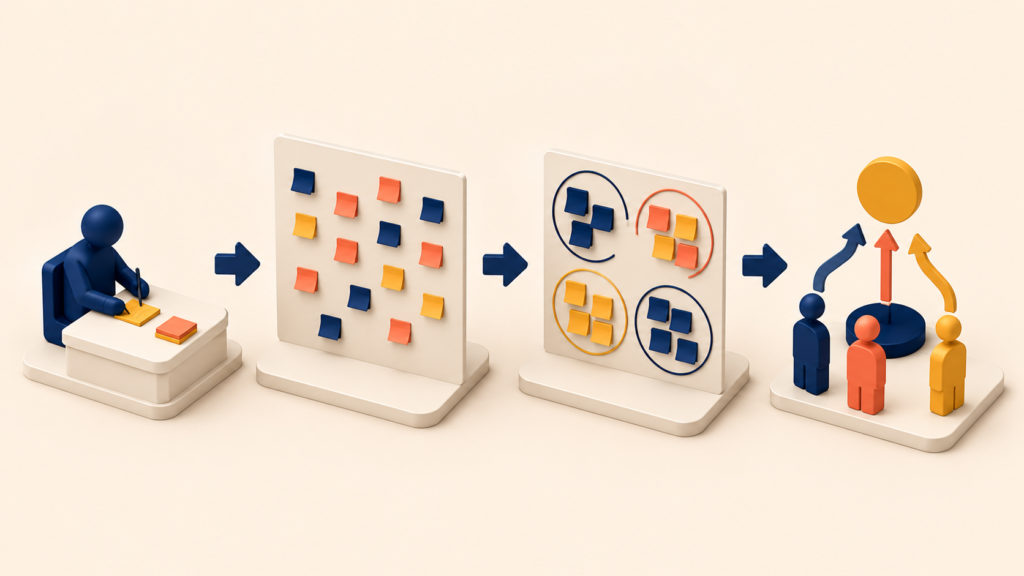
The KJ technique is a structured method for turning many fragmented ideas into shared understanding and concrete decisions. The flow is simple:
- People record their individual thinking in silence.
- All input becomes visible at the same time.
- Notes are grouped by meaning, not by category.
- The patterns drive decisions and action.
In one sentence: the KJ method helps a team think together without talking too early.
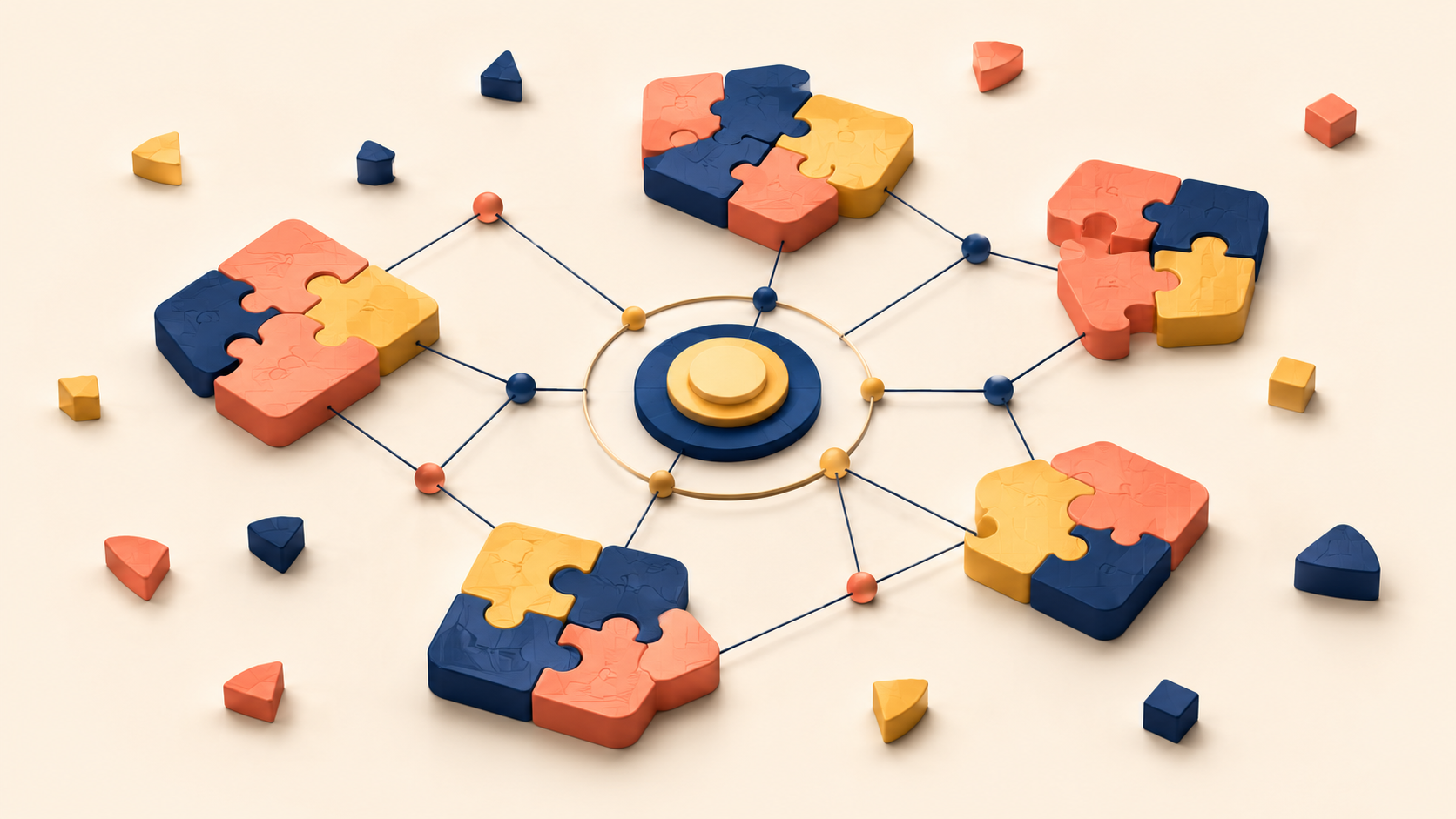
Think of the KJ technique as solving a puzzle as a group. Everyone first puts their pieces on the table (silent capture), the group looks at the whole picture and clusters similar pieces (grouping), and finally the team says together, “So this is the picture we were building” (decision). Instead of one person insisting their piece is the answer, everyone ends up seeing the same image.
The Problem It Solves
In UX and research contexts, the KJ technique is often treated as a formalized form of affinity diagramming, but with stronger emphasis on decision-making and collective alignment rather than pure documentation. Most group discussions fail for three structural reasons:
- Ideas arrive one at a time, sequentially.
- Early opinions anchor the rest of the conversation.
- Hierarchy steers the outcome.
The KJ technique inverts this structure. Instead of starting with discussion, it forces the group to:
- Think before speaking.
- Lay down evidence before forming opinions.
- Find patterns before drawing conclusions.
Because of this, the KJ method works especially well when the problem is ambiguous, the inputs are qualitative and tangled, and no single person holds the full picture.
How It Works at a Glance
The core flow stays simple:
- Individuals think alone. Everyone silently writes down observations, insights, and data points.
- Ideas get externalized. Thinking moves out of heads and onto notes or a board.
- Patterns emerge through grouping. Notes are clustered by meaning, not by predefined categories.
- Decisions follow shared understanding. The team discusses the patterns and agrees on what matters and what to do next.
Instead of debating who is right, the group explores which patterns and shared meanings show up.
The Origin of KJ: Jiro Kawakita and Japanese Quality Thinking
Japanese anthropologist Jiro Kawakita developed the KJ technique to answer a specific question: how can a group analyze complex qualitative information, avoid hierarchy-driven decisions, and reach agreement without forcing compromise?
Over time, the method spread through Japanese quality management, product development, and design and research synthesis. Unlike brainstorming, the KJ technique does not start with discussion. It starts with thinking in silence, and that is a deliberate design choice, not an accident.
How to Run a KJ Workshop: A Step-by-Step Process
A good KJ workshop feels calm, focused, and productive. A bad one feels like “another post-it activity.” The difference is not the tool. It is how each step is structured.
Step 1: Individuals Generate Ideas in Silence
This is the most important step. Before anyone speaks, every participant writes down their thoughts quietly and independently.
How to run it:
- Give each person a stack of blank sticky notes (or a digital equivalent).
- One idea per note.
- Short, specific sentences.
- No discussion, no questions, no explanation.
- Five to ten minutes is usually enough.
People can capture things like research observations, risks and concerns, data points, hypotheses, and user quotes or anecdotes. The rule is simple: before thinking together, think alone. Silent capture matters because introverted teammates contribute equally, early framings do not bias the group, and raw individual insights surface before they get smoothed away.
Step 2: Reveal All Notes Simultaneously
When writing is done, everyone’s notes go up at the same time. Not one by one. Not with individual explanations. Everything lands on the wall or board at once. That moment does something important:
- “My idea vs. your idea” disappears.
- A collective problem space takes its place.
In a traditional meeting, information arrives sequentially. In a KJ session, it arrives simultaneously. Simultaneous reveal turns opinions into a shared artifact, and that dramatically reduces the gravitational pull of hierarchy on the conversation.
Step 3: Affinity Grouping (Sensemaking, Not Sorting)
Now the team groups notes by natural relatedness. This step is closely related to affinity diagramming, which is why the KJ technique is often referenced in UX synthesis and research workflows.
What you do not do at this step:
- Drop notes into predefined categories.
- Build a logical taxonomy.
- Sort by team or function.
This step is about sensemaking, not tidiness. The right approach is:
- Move notes silently at first.
- Group things that “feel related.”
- Let patterns emerge organically.
- Name the groups only after clustering settles.
This phase often feels uncomfortable, and that is normal. The good signs are hesitation, group shapes that keep changing, and notes that move several times. That is what it looks like when a team is actually thinking.
Step 4: Discussion, Decisions, and Action Items
Only now does discussion begin — and it happens on top of visible patterns. A skilled facilitator walks the conversation through three phases:
Interpretation. What are these clusters telling us? What was surprising? Which clusters carry the most risk or impact?
Decision. What is the most important problem right now? What will we explicitly not focus on?
Action items. What changes because of this? Which elements feed into the PRD, the roadmap, or the next experiment?
If a KJ session ends without action, it has failed at its job as a decision-making tool. The discussion may still have value, but the KJ method itself did not deliver what it is designed to deliver.
When PMs Should Use the KJ Technique
The KJ technique is not the right tool for every meeting. It works best when:
- The problem space is tangled.
- The data is mostly qualitative.
- Shared understanding and alignment matter more than speed.
Three product scenarios where the impact is especially strong:
Synthesizing Product Discovery Findings
After user research, teams usually end up with a pile of interview notes, survey responses, metrics, and anecdotes from sales and support. Trying to summarize all of this alone is slow and risky. Running a KJ session with designers and researchers lets the team:
- Surface shared patterns.
- Avoid cherry-picking favorite quotes.
- Build a collective understanding of the user problem.
Prioritization downstream becomes much smoother. Discovery insights are stronger when they are built together, not summarized by one person.
Cross-Functional Alignment
Roadmaps fail more often because of misalignment than because of bad ideas. The KJ technique helps when:
- Engineering, design, and product see things differently.
- Each function sees different risks.
- No one is fully wrong, but nothing is resolved either.
By externalizing concerns and grouping them, hidden tensions surface safely, trade-offs become explicit, and alignment happens concretely instead of through debate alone. Real alignment is discovered, not negotiated.
Roadmap and Prioritization Workshops
When everything feels important, discussion alone does not help. The KJ technique helps the team lay out all assumptions and constraints, see clusters of effort, risk, and impact, and prioritize on top of shared context. It is especially useful before quarterly planning, during strategic resets, or ahead of any major decision. Good prioritization does not start with a ranking framework. It starts with a shared picture of reality.
KJ Technique in Practice: A Product Discovery Case Study
To make this concrete, consider a realistic product discovery scenario. A B2B SaaS product is used by mid-sized operations teams, and the symptoms are:
- Activation is lower than expected.
- Sales says onboarding is “too complex.”
- Customer support keeps logging setup confusion.
- Drop-off after the first session is high.
Every function has an opinion, and none of them are wrong.
Collecting the Raw Data
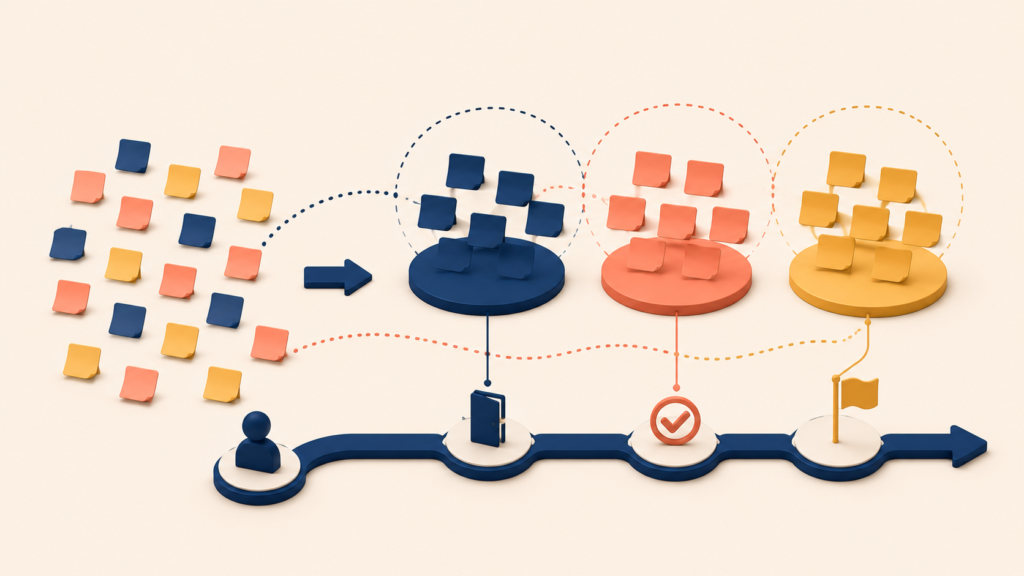
Instead of jumping into solutions, the team runs a KJ-based session with product, design, engineering, and support in the same room. The baseline inputs are user interview notes, funnel metrics, support ticket summaries, and snippets from sales calls. Each participant silently writes down observations such as:
- “Users do not understand the purpose of step 2.”
- “Setup assumes domain knowledge we take for granted.”
- “Admins succeed; regular users struggle.”
- “Documentation is read too late.”
No interpretation yet — just raw signals.
Affinity Grouping and Sensemaking
As the team groups the notes, patterns appear:
- Conceptual confusion vs. technical friction.
- Different personas failing for different reasons.
- Timing of information matters more than volume.
This is the moment alignment happens. Instead of debating, the team sees the same clusters, and disagreement turns into nuance rather than conflict. The realization clicks: the core issue is not complexity — it is a mental model mismatch during onboarding.
From KJ Output to Decisions
Now decisions are easy. The PM translates the clusters into specific actions:
- Redesign onboarding to explain the “why” before the “how.”
- Separate admin flow from end-user flow.
- Defer advanced settings.
- Update success metrics to reflect understanding, not completion.
These insights feed directly into problem-statement sections of the PRD, hypothesis-driven experiments, and roadmap prioritization. A single KJ-based session compresses what could otherwise have taken weeks of back-and-forth.
KJ Technique vs. Brainstorming, Design Sprint, and Amazon 6-Pager
Product teams rarely pick one method in isolation. The real question is usually:
“Why should we use KJ instead of something else?”
Here is a practical comparison.
KJ vs. Brainstorming
Brainstorming is verbal, fast, and energetic. Strong personalities tend to dominate the conversation, ideas arrive sequentially, and the method chases volume over structure.
The KJ technique flips this: silence first, discussion later, equal contribution by design, ideas revealed simultaneously, and structure that emerges naturally.
Brainstorming is useful for generating ideas. KJ is better for making sense of complexity.
KJ vs. Design Sprint
A design sprint is time-boxed and solution-oriented. It needs strong facilitation, a meaningful time and energy investment, and works best when the problem space is already validated.
The KJ technique is lighter and more flexible, focused on understanding, easy to repeat, and well-suited to early discovery. Many teams use KJ inside a design sprint to synthesize information.
KJ vs. Amazon 6-Pager
Amazon is known for its narrative-driven decision culture. The 6-pager works because everyone reads the same context, thinking happens before discussion, and debate sits on top of shared information.
Conceptually, this is close to KJ. The difference:
- The 6-pager externalizes thinking through writing.
- KJ externalizes thinking through visual clustering.
Both methods force simultaneity and depth.
A side-by-side comparison:
| Dimension | KJ Technique | Brainstorming | Design Sprint | Amazon 6-Pager |
|---|---|---|---|---|
| Primary goal | Sensemaking and alignment | Idea generation | Solution validation | Decision-making |
| Mode of thinking | Silence first, talk later | Verbal from the start | Mixed | Silent reading |
| Participation model | Equal by design | Loud-voice dominant | Facilitator-led | Equal after reading |
| Information flow | Simultaneous reveal | Sequential | Time-structured | Sequential reading |
| Best timing | Early discovery, alignment | Early ideation | Mid-to-late discovery | Strategic decisions |
| Time investment | Low to medium | Low | High | Medium |
| Core strength | Clarity out of complexity | Creative energy | Speed of validation | Narrative depth |
The point is not to pick the “best” method. It is to match the tool to the thinking job:
- Use brainstorming when ideas are scarce.
- Use KJ when signals are tangled.
- Use design sprints when direction is clear.
- Use 6-pagers when a decision needs sharpening.
What Separates a Good KJ Workshop from a Bad One
Not every KJ workshop works. In fact, many quietly fail. On the surface they look structured, but underneath, nothing changes. The difference usually comes down to intent and facilitation.
A quick comparison:
| Dimension | Bad KJ workshop | Good KJ workshop |
|---|---|---|
| Intent | The outcome is already decided | The team genuinely explores the problem |
| Starting point | Solution- or roadmap-centric | Problem- and signal-centric |
| Participant behavior | Safe, obvious ideas only | Honest, independent thinking |
| Speaking dynamics | Loudest voice or senior person dominates | Equal contribution by design |
| Use of silence | Skipped or rushed | Protected and deliberate |
| Grouping approach | Persuasion or sorting | Sensemaking through patterns |
| Visibility of thinking | Partial or selective | Everything externalized |
| Quality of discussion | Opinion-driven arguments | Evidence-based interpretation |
| Decision-making | Implicit or deferred | Explicit and traceable |
| Action items | Missing or vague | Clear owners and next steps |
| After the session | Notes get archived; nothing changes | Output feeds the PRD and roadmap |
Why Bad KJ Workshops Fail
Most failed KJ workshops do not fail because of the method. They fail because:
- The conclusion is already decided going in.
- Discussion starts too early.
- The team mistakes insight for progress.
When that happens, KJ collapses into a regular meeting that happens to use sticky notes.
Why Good KJ Workshops Work
A strong KJ workshop feels different by design. The team stays in the problem space long enough to matter, all thinking is visible and shared, and patterns turn into concrete decisions. That is why good KJ sessions always end with named priorities, explicit trade-offs, and clear owners and next steps.
Common Mistakes That Sabotage KJ Workshops
Three mistakes show up repeatedly, and all of them are fixable.
Talking Too Early
Some facilitators and teammates are uncomfortable with silence. So they:
- Over-explain the problem.
- Ask questions during the writing phase.
- Start interpreting notes immediately.
Each of these breaks independent thinking.
The fix: Actively protect silence. It is not wasted time.
Confusing Grouping with Sorting
Grouping is not about tidiness. The common mistakes are:
- Defining categories in advance.
- Splitting notes by function or team.
- Forcing symmetry between groups.
All of these kill insight.
The fix: Let things feel messy before they feel clear. Names come last.
Ending Without Action
A beautiful board without a decision is a failure. If your session ends with:
- “Let’s think about it more.”
- “We can revisit this.”
- “Great discussion, everyone.”
something has gone wrong.
The fix: Always close with decisions and owners.
Conclusion
Product meetings exist to produce decisions, not noise. The KJ technique is a reminder of something simple but easy to forget:
- Thinking needs structure.
- Alignment needs visibility.
- Good decisions need shared understanding.
A PM’s job is not to talk more. It is to design better thinking environments. Used well, the KJ method does exactly that.
Meetings are not for talking. They are for deciding.
Leave a Reply