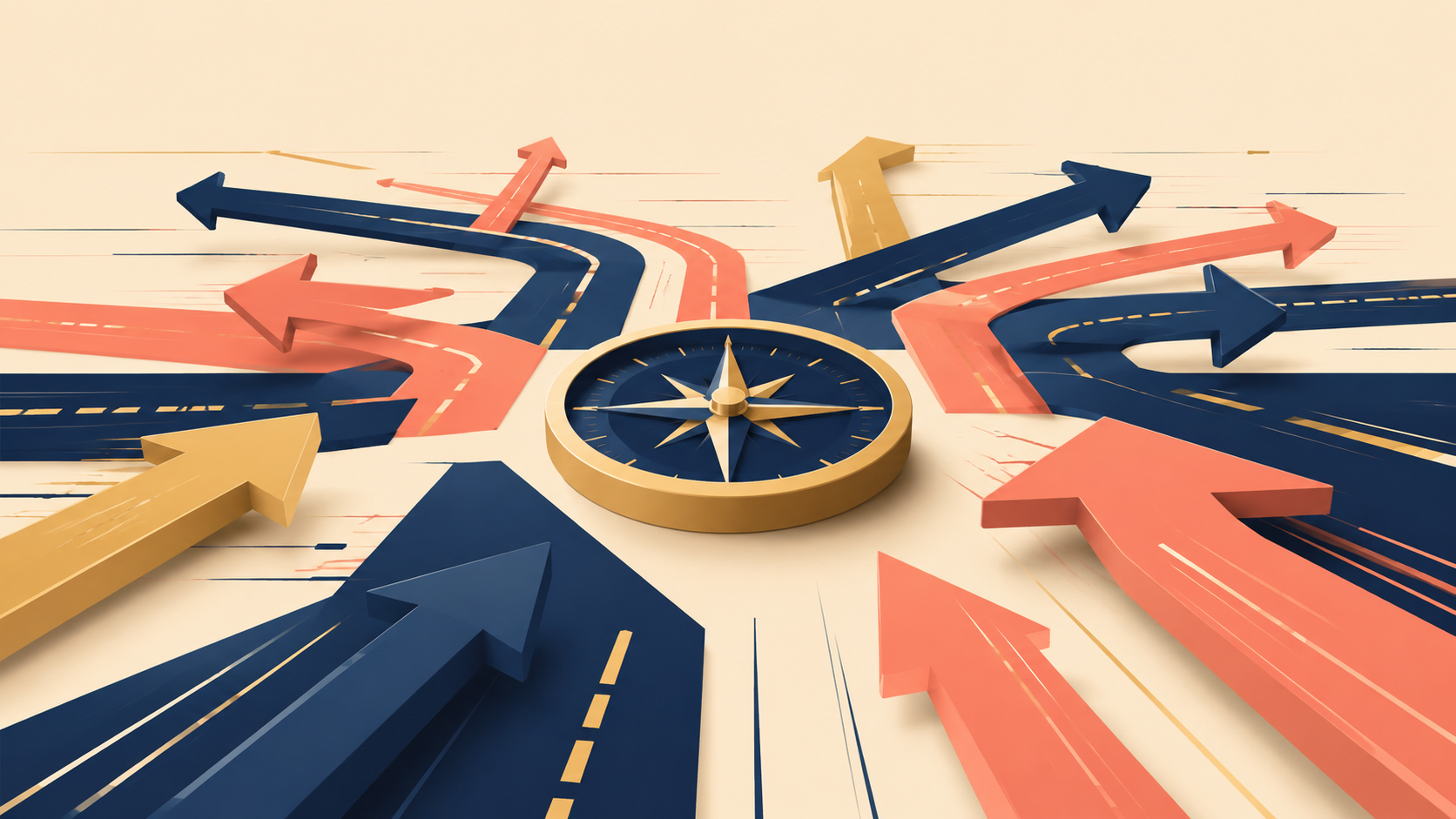
AI arrived with a clear promise: automate the busywork, free us for higher-order thinking, deliver “10x” results. The copilots, the agents, the autocompletes — all framed a future where humans focus on judgment while machines handle the rest. And yet, the lived experience tells a different story. Most people I talk to feel they are working more, not less, since AI showed up in their daily workflows.
That gap between what AI promised and how it is actually reshaping our behavior keeps widening. This piece is not an argument against AI. I use it every day. It is closer to a thought experiment — a deliberate slowdown to ask a more uncomfortable question about AI productivity:
What exactly are we optimizing for?
AI Is Adding to Our Workload, Not Reducing It
Look across the tech industry and working hours do not seem to be shrinking. In many places, they are stretching.
- Workdays are getting longer, not shorter
- Context switching has multiplied
- The bar for “output velocity” has quietly risen
There is also an unmistakable admiration in parts of US tech for extreme work cultures — sometimes openly, sometimes implied. The Chinese “996” pattern (9 a.m. to 9 p.m., six days a week) is being repackaged as a necessary sacrifice for staying competitive in the AI race.
A few questions keep returning:
- Is this driven by existential fear — the idea that humans could be fully replaced?
- Or by national and economic anxiety — losing technological dominance?
- Or, more honestly, some mix of both?
AI is no longer just a tool. It has become an amplifier of fear.
The pattern is not new. When the washing machine arrived, time spent on laundry did not actually fall — standards of cleanliness rose to absorb the gains. AI looks suspiciously similar. The tool delivers speed, and we respond by raising expectations until the surplus disappears.
Speed Without Direction: The Missing Clarity Problem

Long hours are worrying, but the deeper issue is a lack of clarity about why we are investing so much — physically, mentally, emotionally.
Every investment carries risk. That is fine. What is harder to swallow is the growing sense that:
- We are sprinting without a finish line
- Speed is being valued over direction
- “Being productive” and “doing meaningful work” are being treated as the same thing
In many cases, the end goal is hard to articulate. Whether this effort produces something genuinely useful for users, for the business, or for ourselves is even harder to see. Execution without a clear purpose is just chaos that happens to be well-organized.
“Busy,” “productive,” and “meaningful” are three different things, and AI has only blurred the lines between them. AI raises production speed, but production speed is independent of direction. You can drive 200 km/h down a highway and still arrive somewhere wrong faster than ever.
When Means Become Ends: Putting AI at the Wrong Center
AI does work as a powerful lever — when a few conditions are already true. If a company has:
- A well-structured operating model
- Clearly defined problems
- Strong feedback loops
…then AI can meaningfully accelerate growth.
But those are not most companies. Most teams I see are asking questions like:
- “Is this AI product basically a wrapper around ChatGPT or Claude?”
- “If we automate something inefficient, are we now doing inefficient work at scale?”
The real problem is that many organizations do not have the foundation to begin with. The core problems are not well-defined. Processes are broken or unclear. Metrics measure activity instead of value. And into that, AI gets dropped in as a kind of universal cure.
This is a textbook inversion of means and ends. The right question is:
“What problem are we solving, and how can technology help?”
The actual question being asked is:
“We have AI. What can we do with it?”
In business and in personal work, technology is increasingly being used to hide the absence of clarity rather than resolve it.
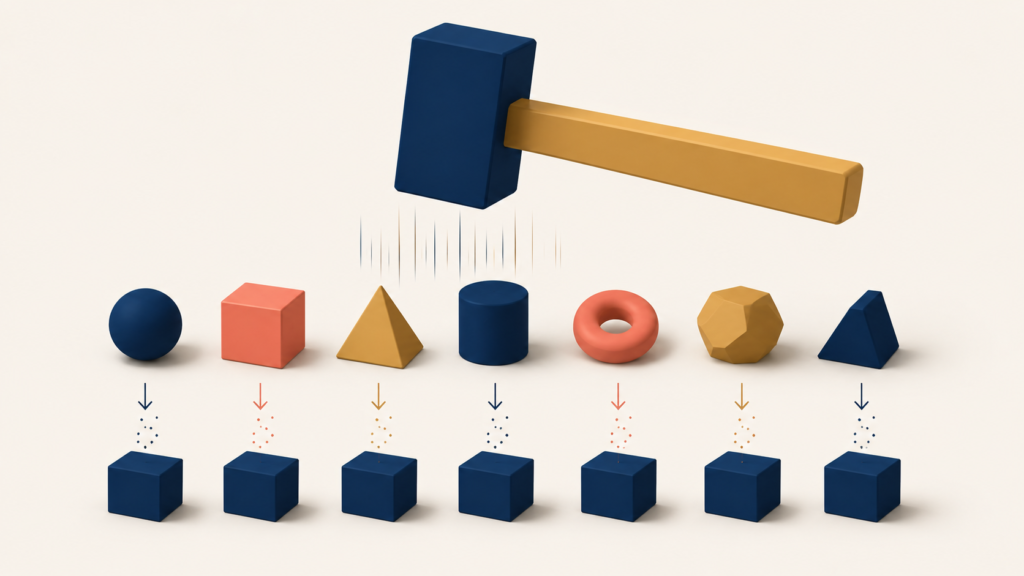
The hammer-and-nail analogy fits perfectly. “If all you have is a hammer, everything looks like a nail.” If all you have is AI, everything starts looking like an AI project. Good tools do not guarantee good outcomes. Problem definition has to come before tool selection — not the other way around.
AI Amplifies Confusion, Not Just Clarity
A few patterns show up over and over:
- People and teams using AI performatively, mostly to avoid looking behind
- Optics — appearing AI-fluent — beating actual outcomes
Identities like “someone who studies AI” or “AI-forward organization” start to obscure the real objective. The distortion does not stop at work. On social platforms:
- Low-quality, strange AI-generated content is flooding feeds
- Misinformation, manipulation, and outright fabrication spread faster than before
- The number of people who believe and amplify these outputs is growing at an uncomfortable pace
The more troubling shift is the moment people start to outsource their own agency.
- Copy-pasting AI-generated responses without review
- Brushing off mistakes with “ChatGPT got it wrong”
At that point, AI stops being a tool. It becomes a convenient excuse. In some cases, people seem to be tying parts of their identity to AI rather than using it deliberately.
Outsourcing agency is dangerous because responsibility goes with it. Most people who use a calculator still have a rough sense of whether the answer is plausible. AI outputs deserve the same instinct. “The AI said so” can quietly become a synonym for “I don’t know” — only with more confidence attached.
The Drift Toward Instinctive, Transactional Behavior
One pattern surprised me. AI seems to be nudging parts of society toward more instinctive, even animalistic behavior.
In the milder version:
- Influencer-driven ecosystems are exploding
- Content is increasingly optimized for attention rather than interaction
The irony is that as “social” platforms get bigger, real human-to-human interaction seems to shrink.
In the more extreme version:
- A meaningful share of self-described “AI startups” have quietly pivoted to adult-oriented chatbots
- Companies already operating in that space are scaling faster than ever
The common thread is hard to ignore. People are increasingly being treated not as humans to communicate with, but as objects to stimulate, extract from, and optimize against. When interactions become transactional and fully mediated by systems, it gets easier to forget there is a person on the other side.
AI behaves like a lens — it magnifies whatever is already there. For people seeking depth, it can become a richer instrument for connection. In environments tuned for stimulation, it becomes a more addictive content machine. The technology is not the variable. The way it is used is.
Intentional Use: Not AI Skepticism, but AI Mindfulness
This is not an argument against AI. I use it every day, heavily. It is an argument for using it more intentionally. If we want to know how to use AI effectively, the answer is less about prompts and more about judgment.
Career perspective: identify the real fundamentals
The ability to:
- Understand business fundamentals
- Quickly spot what actually matters
- Work inside (or choose to join) organizations with strong operating discipline
…matters more than ever. This has always been true. AI just widens the gap between people who do this well and people who do not.
Execution perspective: judgment over speed
Speed is no longer the bottleneck.
- Moving fast is easy
- Failing fast is even easier
Without strong feedback and improvement loops — and judgment behind them — speed only accelerates failure.
“Fail fast” is good advice, but it is only useful when paired with the second half: “learn fast.” Fast failure without learning is just fast resource burn. AI raised execution speed, but if judgment and verification do not move at the same pace, results get worse, not better.
Human perspective: what makes us human in an AI age
The deeper question is existential:
In a world where AI can do more and more of what we used to do, what makes humans more human? And which roles should we deliberately keep for ourselves?
This moment sometimes feels like Everything Everywhere All at Once. We are facing a choice between two responses:
- An optimistic nihilism that accepts uncertainty and still chooses meaning
- A destructive nihilism in which nothing matters and everything becomes disposable
This may end up being the most important question of the AI era. The more powerful the tool gets, the sharper the question “What is it that I actually do?” becomes. When AI writes, codes, and generates images, deciding what only a human can do is no longer optional.
What Actually Matters: Fundamentals Over Exploration
Technology cycles tend to follow a familiar arc:
- Explosive experimentation
- Convergence
- Commoditization
- A new paradigm
We are clearly in a phase of massive divergence. Personally, I do not want to get swept along by it without thinking. What most of today’s experiments need is not more exploration. It is stronger fundamentals.
- Clearer problem framing
- Better system design
- Sharper judgment
There is one more thing worth keeping in mind. We are still, broadly, operating within probabilistic, transformer-based models. A growing number of reports suggest that pure compute scaling is showing diminishing returns. The dominant approach today could flip faster than expected, the same way 2023–2024 GPT models flipped the previous one.
That does not mean current efforts are wasted. It means the next round may matter more than the current round.
- Understand the broader direction
- Avoid over-investing in narrow details
- Focus on what really needs to happen right now
I am not a math prodigy who is going to push the limits of model architecture. So I take the simpler path: calmly identify what matters, and concentrate on solving that.
Conclusion: AI Should Give Us Clarity, Not Fear

If AI is going to give us anything, it should be clarity, not fear. As product builders, as leaders, and as humans, the responsibility is not to run faster. It is to run in the right direction.
The AI productivity paradox is not really about AI. It is about whether the speed we have gained is being pointed somewhere worth going. The tool will keep getting more powerful. The question is whether our judgment keeps pace — and whether we still remember what we were trying to build in the first place.
Leave a Reply