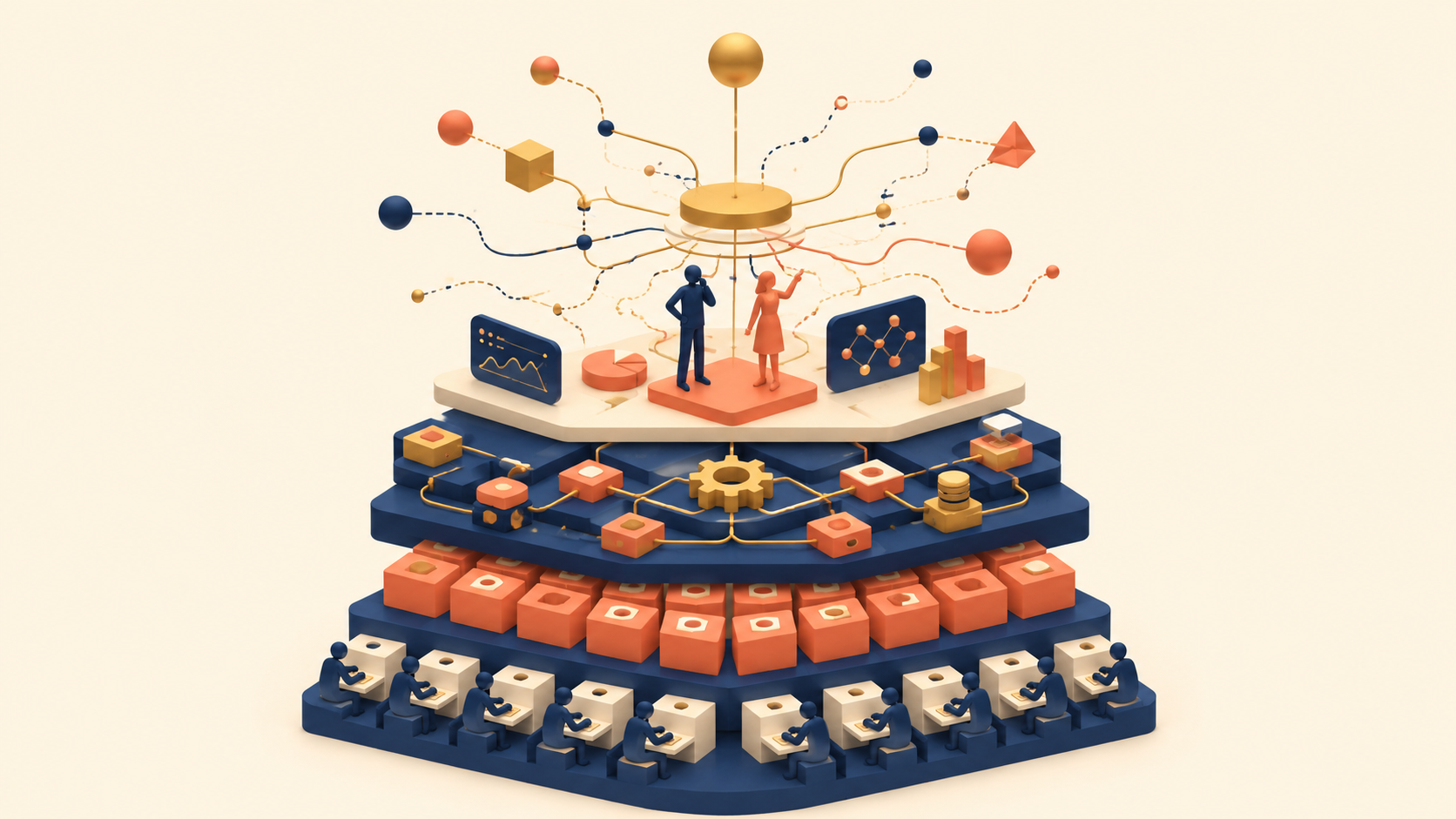
Artificial intelligence is no longer an experimental tool. It is becoming a working layer inside products, workflows, and even physical systems. Over the past few years, AI has moved past generating text and images. It now influences real-world decisions, automates complex workflows, and reaches into the physical world through robotics.
As AI becomes more capable and more accessible, the same question keeps surfacing about AI’s impact on jobs: Is AI taking work away from us, or is it changing what meaningful work means?
A more productive question is this: when the act of “building” is no longer the hardest part, what becomes harder — and more valuable?
The honest answer reshapes how we should think about expertise, role boundaries, and what counts as a successful outcome in the AI era.
Why Domain Expertise Matters More, Not Less, in the AI Era
Product teams have long lived by one principle: outcomes over outputs. What matters is not whether a team shipped something, but whether what they shipped moved users and the business in a meaningful direction.
The same logic applies to how AI is spreading across roles. AI does not erase roles. It raises the bar for depth, judgment, and domain expertise in every role it touches.
When AI can generate interfaces, code, copy, and flows at near-zero cost, speed of execution stops being the differentiator. The real questions become harder:
- Does this solution actually solve the problem?
- Does it match the business intent?
- Can it scale and survive over time?
AI amplifies output, but it also exposes shallow thinking. The teams that lean on AI without domain depth ship work that looks polished and falls apart on contact with real users. The teams that pair AI with strong domain judgment ship work that holds up.
In other words, domain expertise is not becoming less valuable. It is becoming the only thing that separates a credible product from a generated one.
Outcomes vs Outputs: What Does Success Actually Mean?
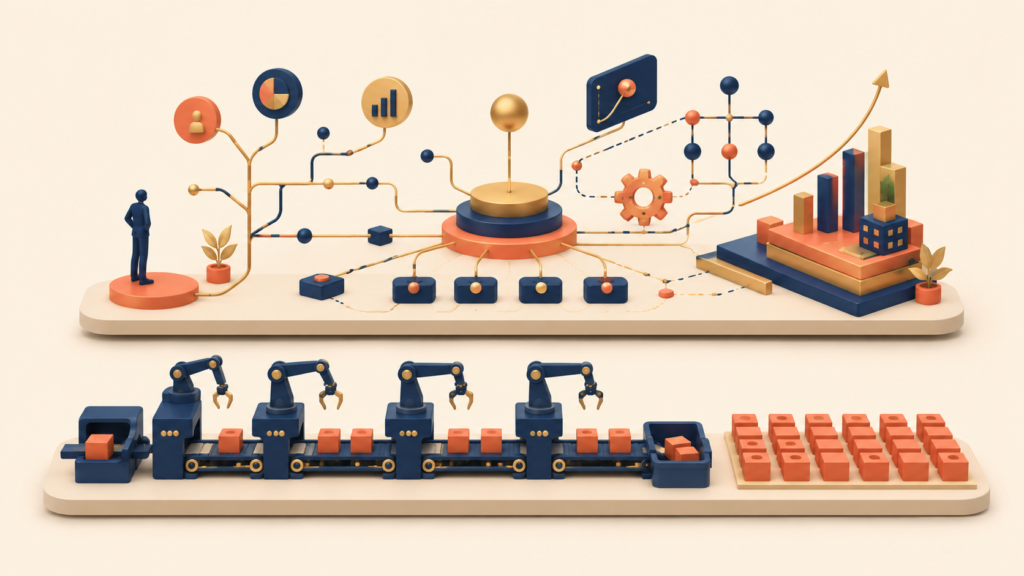
In product-led companies, an outcome is straightforward: a product that is meaningful to both users and the business.
Teams usually break the work of building such a product into two layers.
First-order outcomes ask whether the product was built correctly:
- Does it work as intended?
- Does it meet basic quality and usability standards?
- Can a real user finish a real task without confusion?
Second-order outcomes ask whether the product can survive its own success:
- Is it designed to scale efficiently?
- Can it evolve without collapsing under technical, operational, or organizational debt?
Historically, teams spent most of their energy just clearing the first layer. The act of building was the bottleneck. That single fact shaped roles, team structures, and even job titles.
AI is now removing that bottleneck. And when the bottleneck shifts, everything built around it has to shift too.
This is the core of the outcomes vs outputs debate today. For two decades, the industry has talked about prioritizing outcomes over outputs while quietly being forced to optimize for outputs because outputs were genuinely hard to produce. AI changes the math. Outputs are now cheap. Outcomes — the part that requires judgment, taste, and system thinking — are not.
What was once a slogan (“outcomes over outputs”) is now a survival skill.
How “Just Build It” Became the Job
When building is hard, “just build it” feels like the most rational response. For years, that response made sense. In fast-moving markets with limited time and money, a delayed execution could put the entire business at risk. Shipping anything often beat shipping nothing.
But this trade-off slowly distorted the definition of many jobs.
Roles drifted toward optimizing outputs, not outcomes. Teams treated skills around how to build as more valuable than the judgment of what to build and why. Because the act of building was already overwhelming, conversations about scalability, long-term maintenance, and operational efficiency became nice-to-haves. Many teams quietly accepted long-term thinking as a luxury they could not afford.
Then AI arrived and started absorbing the painful part of building.
For the business, this shift is mostly good news. AI rapidly meets the demand for execution and delivers dramatic productivity gains. The cost of producing things has dropped, and the speed of iteration has gone up.
For individuals, the same shift feels less comfortable. Many professionals spent years optimizing output inside narrowly defined roles. As AI takes over a large share of that execution work, the capabilities a business actually pays for are being rewritten in real time:
- Strategic thinking
- Ownership of outcomes
- System-level understanding
- Judgment under uncertainty
From an individual’s point of view, this can feel unfair. The rules changed. The skills that used to guarantee employment are no longer enough on their own. That feeling is real, and it deserves to be named clearly rather than dismissed.
But it also points to a more useful direction: the work has moved one layer up, and the people who move with it will do fine.
Role Boundaries Were Never Clean to Begin With
In real startup environments, work has never fit neatly inside a job description.
Responsibilities tend to spill across roles. Teams operate as interconnected systems, not as isolated functions. A product manager talks to engineers about architectural tradeoffs. A designer pushes back on copy. An engineer notices a UX problem nobody flagged. This was true before AI, and it is more true now.
For an interconnected team to work well, the team has to embrace depth across the system:
- First-order outcome: Was it built correctly?
- Second-order outcome: Was it built in a way that scales efficiently?
In an AI-centric environment, these questions take a slightly different shape:
- First-order: Is the AI-generated output well-structured?
- Second-order: How do we modify, restructure, or redesign this output to be scalable and durable?
Once AI removes the bottleneck of building, teams gain the time and energy to understand the wider system. The hours that used to go into execution can now go into the parts of the work that actually create business outcomes. The role boundaries that always leaked are now leaking on purpose.
AI Outputs: New Opportunities and Dangerous Traps
New Opportunities
This shift creates real upside.
Creative work is becoming far less painful. When a designer wants to understand engineering, or a product manager wants to explore data engineering, AI can produce a tangible artifact that turns an abstract idea into something the person can poke at, break, and learn from. By making and inspecting something, professionals can pick up context and knowledge at speeds that were not possible before.
The result: the cost of cross-disciplinary learning has dropped. People can now build a working mental model of a neighboring discipline in days, not years.
Dangerous Traps
The same convenience creates a serious trap.
“Good — it’s built.”
“Good — it works.”
Many teams stop right there and push the AI-generated artifact straight to market.
Organizations that focus only on AI-generated output hit a ceiling. They move fast at first, but they never reach the real J-curve. Without deeper evaluation and restructuring, AI-built products stay fragile, shallow, and hard to scale. The team feels productive, the dashboards look good, and then the product cannot absorb its first real wave of users.
The trap is not AI itself. The trap is treating “it’s built” as the same as “it’s right.”
Redefining Success in the AI Era
A more accurate formula for success looks like this:
Outcome = embodying the business’s underlying intent + scalability
In plain terms, a successful product is one that matches the business’s intent and grows without breaking.
AI alone does not build a successful product. Surface-level use of AI accelerates short-term delivery, but it cannot carry long-term growth. What carries long-term growth is the ability to take an AI-generated output and professionally analyze it, refine it, and shape it into something that can keep evolving. This is true for design, engineering, product strategy, and operations.
In today’s environment, differentiation works on two levels at once:
- Understanding how something was built
- Knowing how to make it more meaningful
These two questions define competitive advantage — at the company level and at the individual level. The people who can answer both are the people who turn AI from a productivity tool into a strategic one.
Why Hybrid (T-Shaped) Talent Matters More Than Ever
Ten years ago, the idea of a “hybrid expert” was discussed often and enforced rarely. It was a desirable trait, not a hiring requirement.
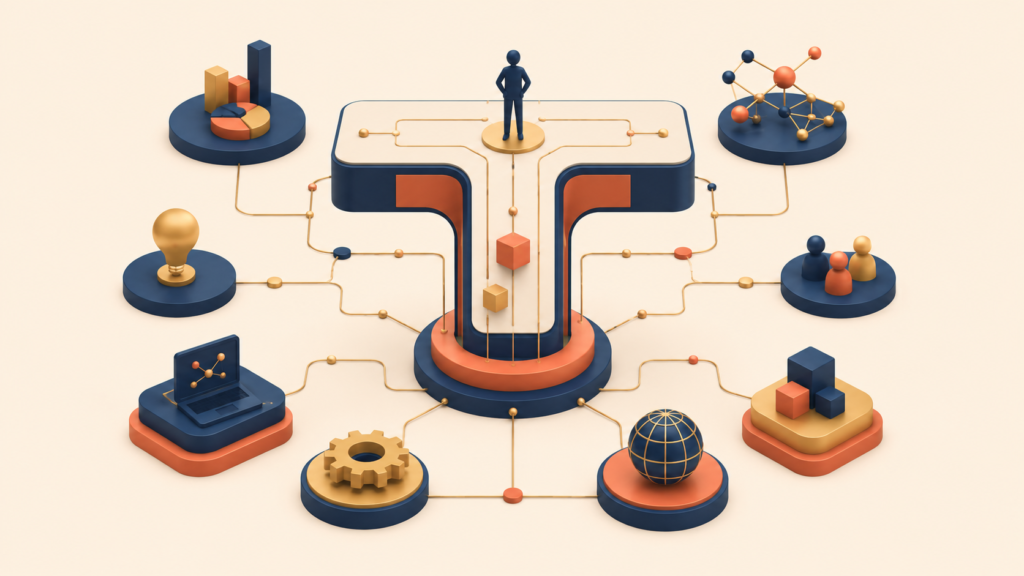
In Silicon Valley, product managers are often described as T-shaped individuals: people with a broad understanding across many areas and at least one area of deep expertise. The horizontal bar of the T lets them collaborate across functions. The vertical bar gives them something real to contribute.
Over the last few years, AI has quietly been pushing everyone toward this model.
This does not mean product management will become the most promising profession. It means the boundaries between roles are dissolving. Companies are increasingly hiring people who understand the entire business system and bring a sharp, differentiated skillset on top of that broad understanding. The horizontal bar is no longer a perk. It is the floor.
People who never considered themselves competitors are now in the same arena. The labels matter less. The combined capability matters more.
How Individuals Should Respond
A more useful question than “this job is dead” is this:
What is this role actually trying to achieve?
AI is excellent at producing things that look right. It can generate design, code, and content quickly, and at first glance the result looks finished. If a role is defined only by producing “good enough” output, that role will eventually be absorbed.
This does not mean the ability to produce output is now useless. The ability to build is still a foundational capability. It is what lets a person critically evaluate AI’s output and make informed decisions about it.
What has changed is the scope, depth, and impact of these roles.
Execution skill can no longer stand alone. It has to evolve into cross-functional, system-level capability that crosses role boundaries. The professional who survives this shift is not the one who builds the fastest. It is the one who can decide what is worth building, judge whether the AI-generated version is actually fit for purpose, and shape it into something the business can keep using.
The work has not disappeared. It has moved up one layer.
Conclusion
For many people, the effort needed to broaden a skillset feels heavy. Learning across disciplines takes time, energy, and a steady tolerance for discomfort. There is no clean path and no syllabus.
How each person responds to that weight will, over time, define their place in the talent market.
- Some will become cynical and disengage.
- Some will sharpen the expertise they already have.
- Some will deliberately stretch into new territory, accept the ambiguity, and take on more responsibility than their job description asks for.
AI has not made careers simpler. It has made them more honest. The work that used to be hidden behind the difficulty of building — the judgment, the prioritization, the system thinking — is now exposed. There is nowhere left to hide behind output.
If you take one thing from this: stop defending the part of your work that AI can do, and start investing in the part of your work that AI makes more valuable. That is where the next decade of careers will be decided.
Leave a Reply