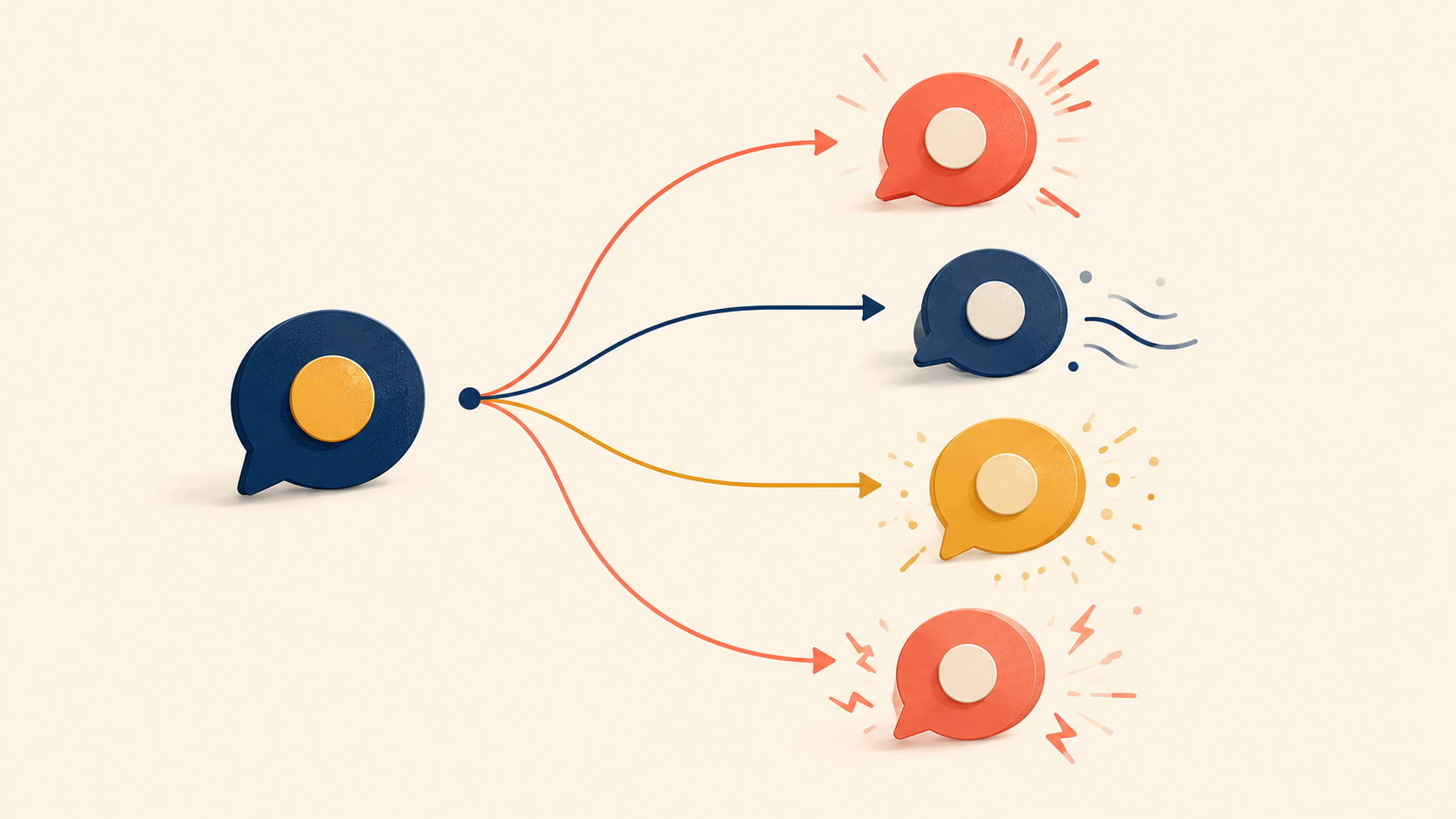
Voice is the consistent personality of your product. Tone is how that voice adapts to the moment. The two work together — but they are not the same thing, and conflating them is one of the most common reasons product copy feels inconsistent or off-key.
Think of a close friend. That friend has one personality (their voice), but the way they talk at a funeral is not the way they talk at a birthday party (their tone). They are still the same person; they are just adjusting their emotional expression to fit the situation. Good UX writing works the same way. The product’s voice stays constant, while the tone of voice shifts to match what the user is doing, feeling, and needing right now.
This guide covers four things: the difference between voice and tone, the four dimensions of tone (drawing on Nielsen Norman Group’s research), a situational tone matrix you can map onto your product, and a structure for documenting voice and tone in a style guide your team can actually use.
Voice vs Tone: What’s the Difference in UX Writing?
They often get used interchangeably, but they answer different questions.
- A product’s voice answers “Who is this product?”
- Tone answers “how should it speak right now?”
Voice: The Consistent Personality of Your Product
In UX writing, voice refers to the consistent personality behind your product’s communication. It is the brand’s character expressed in words. If your brand voice is “confident, friendly, and honest,” that personality should carry through error messages, success screens, onboarding flows, empty states, and confirmation dialogs alike. Users should be able to read any string of microcopy in your product and recognize it as coming from the same source.
Voice does not change between screens. It does not change for different audiences within the product. It does not change because a designer is in a hurry. Voice is the part of UX writing that you commit to once and then defend over time.
Tone: How Voice Adapts to Context (The Funeral vs Birthday Analogy)
Tone is how that voice adjusts to the moment. The same personality can be celebratory at a success state, empathetic at an error state, calm during a sensitive request, and encouraging during onboarding. The personality (voice) stays fixed; the emotional register (tone) flexes.
| Voice (Constant) | Tone (Variable) |
|---|---|
| Friendly | Celebratory (success state) |
| Friendly | Empathetic (error state) |
| Friendly | Calm (sensitive request) |
| Friendly | Encouraging (onboarding) |
A product with a strong voice but no tone strategy ends up sounding tone-deaf — cheerful when the user is frustrated, or stiff when the user is excited. A product with shifting tones but no underlying voice ends up sounding like several different products glued together. You need both.
The Four Dimensions of Tone in UX Writing
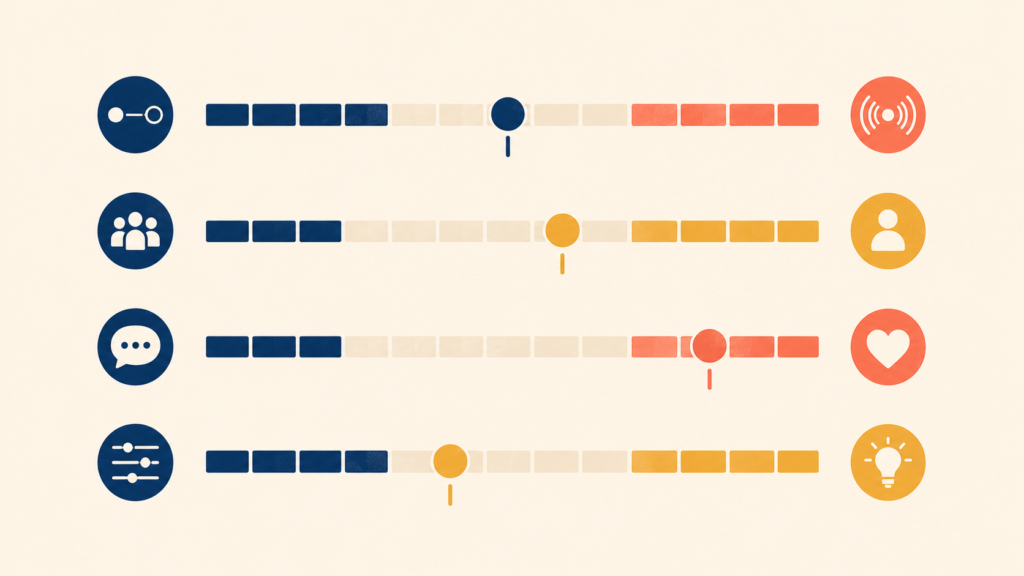
Building on Nielsen Norman Group’s four-dimension framework for tone of voice, most product teams describe their tone along four spectrums. Each dimension is a spectrum, not a binary choice, and the position you pick on each spectrum defines your brand voice. Most products live somewhere between the extremes, but knowing where you sit is what makes copy decisions repeatable.
1. Humor: Funny vs Serious
Spectrum: Humorous ←→ Serious
Humor signals that a product is approachable and human. It can also signal that a product is not taking the user’s situation seriously, which is a problem when the user is losing data or filling out a tax form.
| Closer to humorous | Closer to serious |
|---|---|
| Consumer apps, games | Healthcare, finance |
| Low-stakes interactions | Consequential decisions |
| Success states | Data-loss error states |
Humor is the riskiest dimension to dial up, because it depends on shared context. A joke that lands for one user can alienate another. When in doubt, default to serious and let warmth come from other dimensions.
2. Formality: Formal vs Casual
Spectrum: Formal ←→ Casual
Formality is closer to a dress code than a personality trait. The same person wears a suit in court and jeans on Saturday. A B2B enterprise tool reads naturally in a formal register; a social app for teenagers reads naturally in a casual one.
| Closer to formal | Closer to casual |
|---|---|
| Enterprise software | Consumer apps |
| Legal or compliance contexts | Social features |
| Professional audiences | Younger users |
Casual does not mean sloppy, and formal does not mean cold. The decision is about register, not about quality.
3. Directness: Polite vs Direct
Spectrum: Polite/Indirect ←→ Direct/Blunt
Directness is about how much the copy hedges versus how much it gets straight to the point. Polite copy softens; direct copy moves the user forward. Both have their place.
| Closer to polite | Closer to direct |
|---|---|
| Asking for personal information | Guiding routine actions |
| Delivering bad news | Confirming a simple success |
| Interactions with new users | Power-user features |
Over-politeness reads as evasive. Over-directness reads as cold. The right setting depends on what the user is about to do and how much friction the moment can absorb.
4. Enthusiasm: Enthusiastic vs Matter-of-Fact
Spectrum: Enthusiastic ←→ Matter-of-Fact
Enthusiasm marks the difference between “Welcome aboard! Let’s get your first project running.” and “Sign-in successful.” Both can be appropriate. The choice depends on whether the moment deserves celebration or simply needs acknowledgment.
| Closer to enthusiastic | Closer to matter-of-fact |
|---|---|
| Celebrating achievements | Routine confirmations |
| Feature announcements | Settings and configuration |
| Onboarding | Error recovery |
Enthusiasm dialed up everywhere becomes noise. Enthusiasm reserved for real moments of progress feels earned.
Adjusting Tone by Situation: Tone of Voice Examples
Voice stays constant. Tone changes based on what the user is doing and how they are feeling. The most useful way to make this concrete is to map situations to emotions to tones — and then show what each combination sounds like in actual copy.
Matching Tone to User Emotion: Success, Error, Loading, Sensitive Requests, Onboarding
Five recurring product moments cover most of what UX writers face day to day. For each, the user arrives with a specific emotional state, and the appropriate tone follows from that state.
| Situation | User emotion | Appropriate tone | Example copy |
|---|---|---|---|
| Success / achievement | Joy, satisfaction | Celebratory, warm | “You did it! Your first project is live.” |
| Error / failure | Frustration, worry | Calm, helpful | “That didn’t go through. Here’s how to fix it.” |
| Waiting / loading | Impatience, uncertainty | Reassuring, informative | “Saving your changes… about 10 seconds.” |
| Sensitive request | Caution, vulnerability | Respectful, trust-building | “We’re asking to protect your account. Here’s how this is used.” |
| Learning something new | Curiosity, possible confusion | Encouraging, clear | “Great start. Next, try adding a teammate.” |
Notice that the voice underneath every one of these examples could be the same — friendly, confident, plain-spoken. What changes is the emotional register, not the personality.
Using a Tone Matrix to Map Situations and Emotions
A tone matrix puts product moments on one axis and user emotions on the other, then names the tone that belongs in each cell. It gives writers a shared map instead of asking them to invent the right tone from scratch every time.
| Moment | Happy | Neutral | Frustrated | Anxious |
|---|---|---|---|---|
| Success | Celebratory | Confirming | — | Reassuring |
| In progress | Encouraging | Informative | Patient | Calming |
| Error | — | Helpful | Empathetic, solution-focused | Reassuring, clear |
| Request | Enthusiastic | Direct | Understanding | Trust-building |
Share this matrix with everyone who writes user-facing copy — product designers, PMs, support agents. When the matrix is the source of truth, tone stops being a matter of taste and starts being a matter of policy.
Building a Voice and Tone Style Guide for Your Team
Voice and tone decisions only hold up if they are written down. Documentation keeps the product sounding like one product as the team grows, as people leave, and as new features ship.
Five Sections Every Voice and Tone Guide Needs
A useful voice and tone style guide has five sections. Each section answers a question that writers ask in practice.
| Section | What to include |
|---|---|
| Brand personality | 3–5 adjectives that define the voice |
| Voice principles | What each trait means in practical writing terms |
| Tone guide | How voice adapts across different contexts |
| Examples | Do’s and don’ts for key scenarios |
| Vocabulary | Preferred terms vs. terms to avoid |
The first two sections describe the constant (voice). The next two describe the variable (tone). The last one keeps everyone using the same words for the same things, which is where consistency usually breaks down first.
Defining Brand Personality with 3-5 Adjectives
Pick three to five adjectives that capture how your product communicates. Three is the floor; five is the ceiling. Fewer than three is too thin to give writers guidance; more than five becomes impossible to remember and apply.
For each adjective, write what it means and — just as importantly — what it does not mean. The “does not mean” line prevents writers from drifting toward the nearest cliché.
Confident
- We speak directly, without hesitation.
- We avoid words like “maybe,” “perhaps,” and “it seems that.”
- But confident is not arrogant. We acknowledge limitations honestly.
The format matters less than the discipline. Pair every adjective with concrete behaviors and one boundary that keeps the trait from sliding into a flaw.
Writing Do’s and Don’ts with Concrete Examples
For each voice principle, show what it looks like in real copy. Abstract principles get interpreted differently by every writer; side-by-side examples leave less room for drift.
| Principle | Do this | Don’t do this |
|---|---|---|
| Friendly | “Need a hand? We’re right here.” | “Please contact the support team.” |
| Clear | “Save up to $50 a month” | “Significant savings potential” |
| Confident | “Your data is encrypted.” | “We try to keep your data safe.” |
Do’s and don’ts are the section writers actually consult. Make them specific enough that someone could pattern-match a new piece of copy against the table in seconds.
Documenting Tone for Key Product Moments (Onboarding, Payment Failure, Account Deletion)
Pick the product moments that recur often or carry high emotional weight, and spell out the tone for each. New writers should not have to guess what the right tone is for a payment failure — it should already be written down.
| Scenario | Tone guide | Example |
|---|---|---|
| First-time user | Welcoming, encouraging, not overwhelming | “Welcome. Let’s set up your workspace — about 2 minutes.” |
| Payment failure | Calm, non-blaming, solution-focused | “Your payment didn’t go through. This usually means your card details need an update.” |
| Account deletion | Respectful, clear about consequences, no guilt | “Deleting your account permanently removes all your data. This can’t be undone.” |
Documented tone-by-moment guidance turns a style guide from a nice document into operational infrastructure. That is the difference between a team that agrees on principles in the abstract and a team that ships consistent copy in practice.
Conclusion
Voice is constant; tone is variable. That single distinction is most of what you need to write product copy that feels coherent across hundreds of screens and dozens of writers. The four dimensions — humor, formality, directness, enthusiasm — give you a shared vocabulary for describing where your voice sits. The tone matrix gives you a map for adjusting it to the user’s moment. And the style guide makes both repeatable.
In the next article, we cover the writing workflow itself — how to take a clear voice and a documented tone strategy and turn them into a piece of copy that ships.
UX Writing Series
(1) What Is UX Writing? Definition, Reading Behavior, and Core Principles
(2) Voice and Tone in UX Writing: A Practical Framework with Examples
(3) The UX Writing Process: A Step-by-Step Workflow for Writing UX Copy
(4) Microcopy in UX Writing: Buttons, Errors, Empty States, and More
(5) UX Writing Mistakes to Avoid: 5 Patterns and Before/After Examples