Every strategy must answer one foundational question before anything else: what are we trying to achieve? In Part 1 of the Strategy Playbook, we looked at why most strategies fail and what good strategy actually looks like. This piece sits one step earlier — at the top of the cascade, where goals and vision live.
A strong goal motivates a team to spend years on the same problem. A powerful vision pulls talented people toward a future worth building. Together, they sit at the top of every strategic choice that follows. When teams struggle to focus, the cause is rarely tactical. More often, the goal is vague, the vision is missing, or both are disconnected from the strategy meant to deliver them.
This guide covers three things: how to write a goal that motivates your team, ten principles for a powerful vision (with the kind of vision statement examples that actually move people), and the common mistakes that quietly break the link between vision and execution.
What Makes a Goal That Motivates Your Team
A goal is not a slogan. It is a specific picture of an ambitious future state — the destination that every later strategic choice must serve. Purpose explains why an organization exists; the goal names the future it is trying to build.
The Four Characteristics of a Strong Goal
A goal that merely says “participate” or “survive” cannot guide decisions. It has to show what meaningful, valuable thing the team will have built, and what position the organization will hold once that work is done.
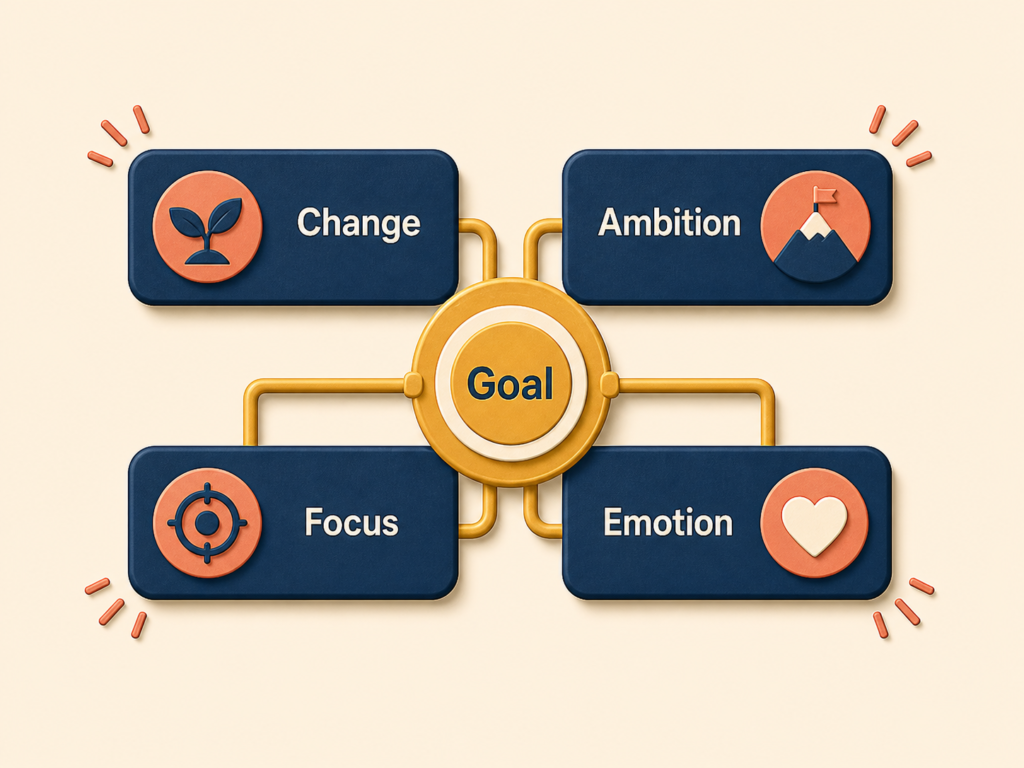
Strong goals share four characteristics:
- They describe a specific change in the world, not a business metric.
- They are ambitious enough to require years of focused effort.
- They make it clear what matters and what does not.
- They move people emotionally — they make people want to spend their energy on the work.
A goal like “become the default tool for engineering teams managing on-call incidents” does all four. A goal like “grow revenue 30% year over year” does none of them. Revenue can be a constraint or a measurement, but it cannot be the thing that gets a designer through the fifteenth iteration of a concept at 11 p.m.
The Motivation Test: Would Talented People Choose This Work?
A useful test for any goal is this question:
Would talented people, given many other opportunities, choose to work on this?
If the honest answer is no, the goal is not strong enough. Talented engineers, designers, and product people have endless options. They will not stay for compensation alone. They stay because the work is worth doing.
The motivation test also helps in the moment. When a developer is debugging at midnight or a designer is rejecting their own work for the third time, the goal is what reminds them what they are building toward. A vague goal cannot do this work. A specific, ambitious one can.
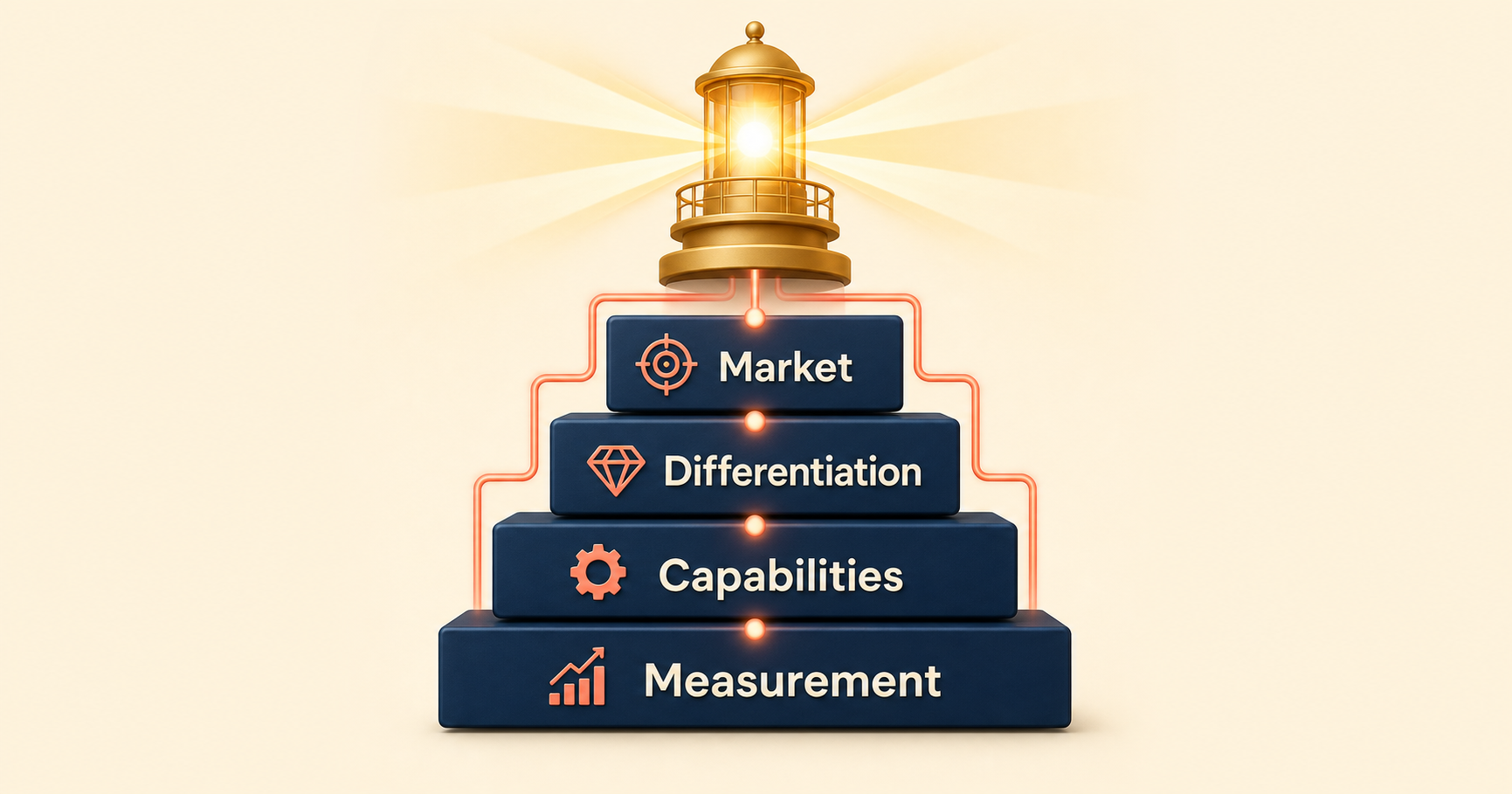
From Goal to Strategy: The Cascade
The goal sits at the very top of strategic planning. Every later choice cascades from it.
Goal Setting
   ↓
Market Selection (market, customer, geography)
   ↓
Differentiation in Market (value proposition, competitive advantage)
   ↓
Required Capabilities (what you must be excellent at)
   ↓
Measurement (how you track and adapt)
Read top to bottom, this is a strategy cascade. Read bottom to top, it is a sanity check: if your capabilities, differentiation, and market selection do not visibly serve a clear goal, the strategy has come uncoupled from its anchor.
Ten Principles of a Powerful Vision
A vision is the specific picture of how a product will contribute to reaching the goal. It is more concrete than purpose and more directional than strategy. The strongest vision statement examples — Amazon’s “Earth’s most customer-centric company,” Tesla’s longtime mission to “accelerate the world’s transition to sustainable energy” — share a set of patterns that hold up across very different industries.
These ten principles describe what those patterns look like in practice.
1. Start With “Why”
Before describing what a product does, be clear on why it should exist. “We make a calendar app” and “We believe people’s time is their most valuable resource, yet most tools treat scheduling as administrative work” are not the same statement. They produce different teams, different trade-offs, and different products.
Starting from purpose helps in three ways. It guides trade-off decisions when features conflict. It attracts people who care about the problem itself. And it keeps motivation alive when progress is slow.
2. Focus on the Customer Problem, Not the Solution
It is easy to fall in love with the product you have built today. But the product is a means, not an end. Problems persist; solutions keep changing. Teams that get attached to their current solution stop seeing better approaches. They polish existing features instead of imagining what becomes possible next.
Teams that stay anchored to the underlying problem stay open to approaches that overturn their own work. When a better solution appears, they are willing to disrupt their own product to reach it.
3. Think Big
A vision should describe years of work, not a quarter. If you can finish it in twelve months, it is probably not ambitious enough to sustain focused effort or build a durable competitive advantage. This is not a call to be unrealistic. It is a call to point your attention at something genuinely important — something worth your best work for a long time.
4. Don’t Fear Self-Disruption
Many organizations get stuck defending past success. A better approach appears, but the company protects its existing product and business model so carefully that competitors get to disrupt it instead. A good vision accepts that the best version of the future may look very different from today. If someone is going to make your current product obsolete, it is better that someone be you.
5. Make the Vision Move People
Talented people have many places they could spend their energy. A vision has to make them want to be on this particular journey. The best product teams are not mercenaries executing tickets — they are missionaries who believe in what they are building. A vision that moves people is what turns hired hands into committed teammates.
6. Ride Meaningful Waves
Technology, society, and markets shift constantly. A good vision recognizes which shifts are relevant to its problem and articulates how those shifts open new ways to solve it. This does not mean chasing every new technology. It means noticing when the ground moves under the problem you care about, and recognizing the opportunities that movement creates.
7. Skate to Where the Puck Is Going
Wayne Gretzky famously said he skated “to where the puck is going to be, not where it has been.” A vision works the same way. Aim at where customers and markets are heading, not where they are today. By the time you have built the product, the world will have moved that far anyway. Build for the world you are aiming at, not the one you started in.
8. Hold the Vision, Flex the Details
Jeff Bezos has described this as being “stubborn on vision, flexible on details.” The destination should rarely change. The path to it — the strategy, the tactics, the specific features — should change as you learn. Weak organizations swap their vision quarterly for whatever looks promising at the time. Strong organizations keep the vision steady and adjust the route.
9. Vision Is a Leap of Faith
This part is uncomfortable: if a vision is genuinely ambitious, you cannot fully validate it before starting. A vision that is already “validated” before you begin is probably not bold enough to create meaningful differentiation. This is not a license to leap blindly. The underlying problem should be real, and the approach should be grounded in evidence. But the vision as a whole requires a leap of faith that the details will resolve as you go.
10. Communicate Relentlessly
A vision only has power when people know it, understand it, and believe in it. That requires leaders to communicate it far more than feels necessary. You will be tired of saying it before the team starts owning it. By the time you think everyone has heard it, a new hire is joining who has never heard it once.
Anxiety about where a product is going travels through an organization quickly. Re-stating the vision regularly is what gives every layer of the team the confidence to make local decisions on their own.
Common Mistakes in Goal Setting
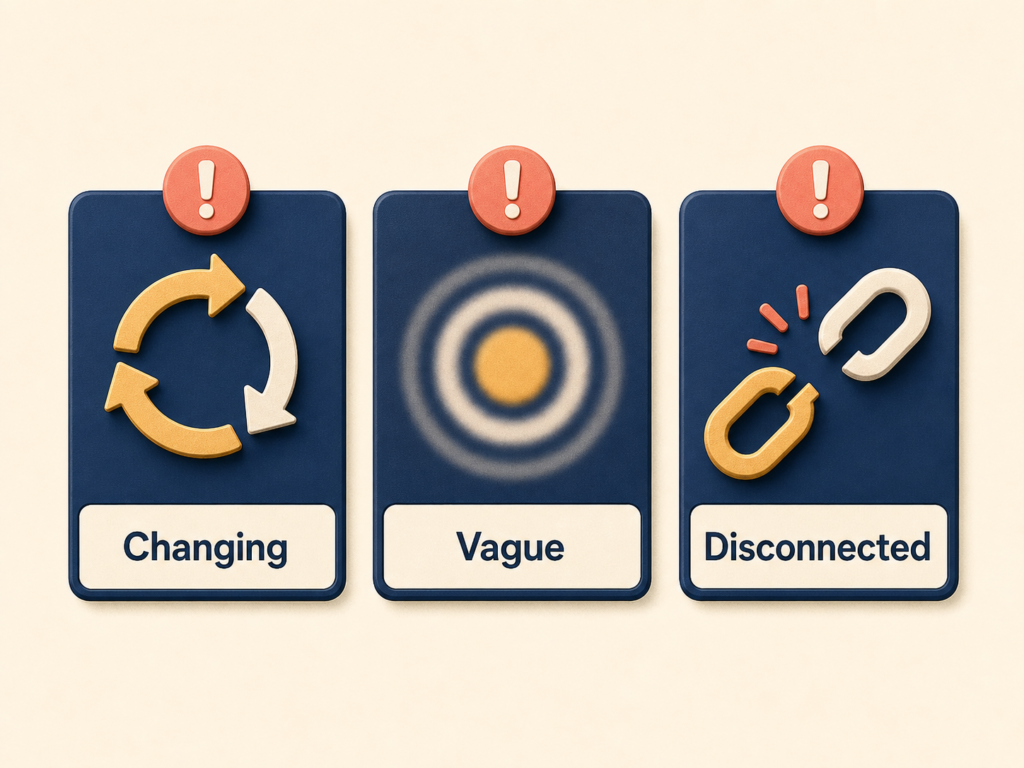
Three failure patterns appear repeatedly when teams try to translate ambition and vision into operating goals. Even with a strong vision in place, this is where most teams stumble.
Changing Goals Too Often
When goals shift every quarter — sometimes every month — teams cannot build momentum. They constantly swap context, abandon unfinished work, and lose faith that any direction will be carried through.
Adjusting based on what you learn is healthy. Thoughtful adjustment and reactive churn are not the same thing. If goals are changing dramatically more than once or twice a year, the problem is either in how the goals were set or in the organization’s willingness to see them through.
Signs you are changing goals too often: the team responds to new initiatives with quiet skepticism (“this one will pass too”), work stops before it is finished, and people stop investing energy in new directions because they expect another change soon.
Goals Too Vague to Guide Decisions
“Improve customer satisfaction” is not a goal. It does not say how much, by when, for which customers, or by what means. Vague goals feel safe because they are hard to fail against. But they cannot guide daily decisions, which leaves team members to interpret them on their own — or to freeze under the ambiguity.
A goal that cannot resolve a real product trade-off is not doing its job. The test is simple: if two reasonable people on the team could read the goal and reach opposite conclusions about which feature to build next, the goal needs more specificity.
Goals Disconnected From Strategy
Sometimes an organization sets goals entirely bottom-up. Each team proposes what it wants to achieve, the proposals are stitched together, and the result is called the company “strategy.” This usually produces a loose collection of goals that do not reinforce each other and do not converge on any single competitive position.
Goals should cascade down from strategy. Set the strategic choices first — which market, which customer, what differentiation — and then ask: “if we are executing this strategy well, what goals would show that?” Bottom-up goals reveal team preferences. Top-down goals — anchored in strategy — make those preferences serve a coherent direction.
Conclusion
A strong goal motivates a team to do years of focused work. A powerful vision pulls talented people toward a future worth building. And both only work when they connect cleanly to strategy — when the cascade from goal to market to differentiation to capabilities to measurement holds together end to end.
The vision vs strategy distinction matters here. The vision is the destination; the strategy is the route. The most common failure is treating them as the same thing or letting one drift from the other. When teams understand which is which, they can hold the vision steady, adjust the strategy as they learn, and avoid the trap of constantly reinventing both.
The next piece in this series moves down one level of the cascade to market and customer definition — how to choose where to compete, how to size the opportunity, and how to define the customer in a way that actually shapes product decisions.